

The FarmED Podcast: Holistic Planned Grazing with Rob Havard
Jan 20, 2026
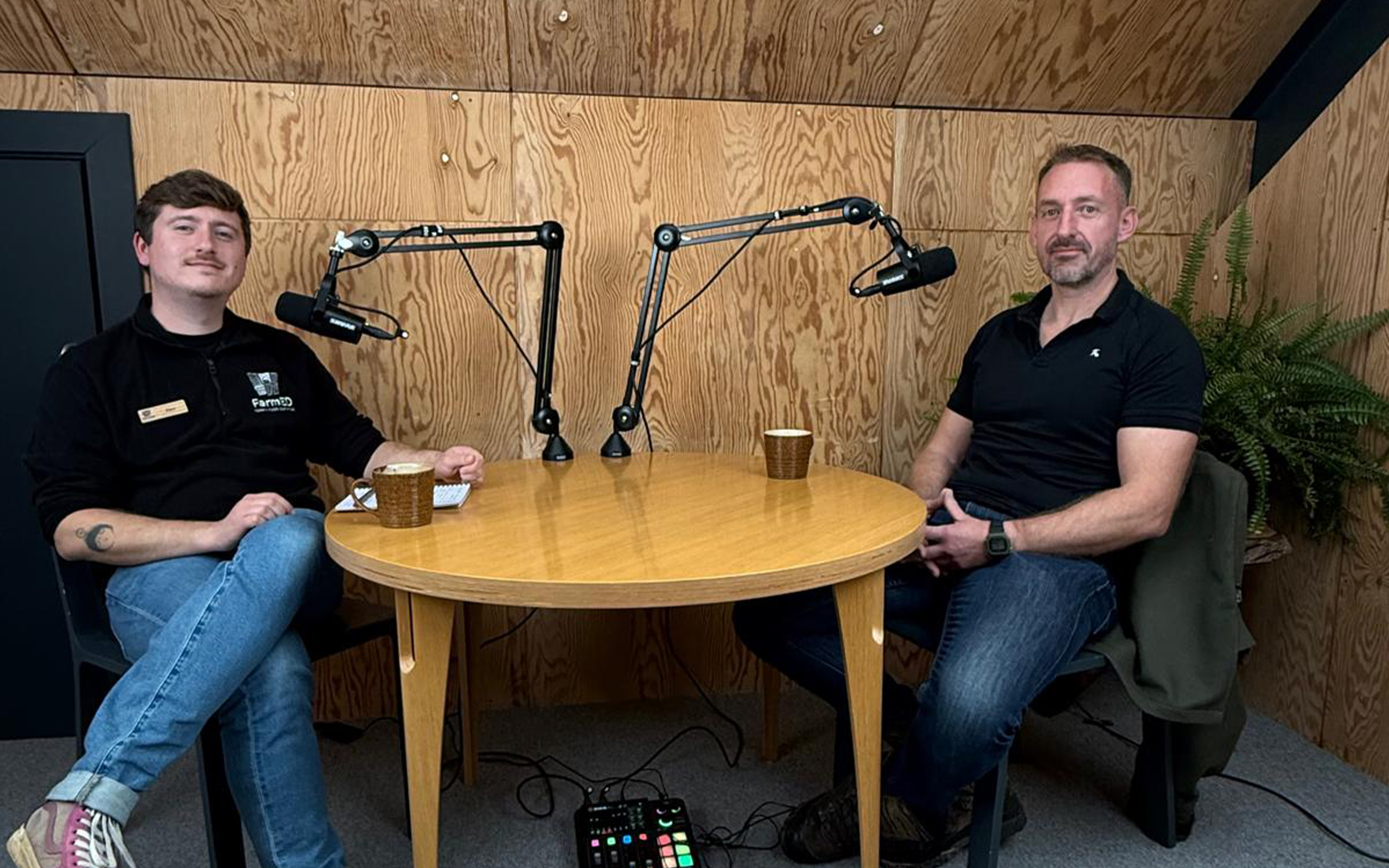
Our guest this month is cattle farmer, ecologist, Nuffield scholar and trainer Rob Havard, who will be running a course on Holistic Planned Grazing at FarmED on 11th March.
After working for various wildlife trusts and conservation organisations, Rob returned to his family’s farm and now he and his wife, Lizzie, run Phepson Angus, a 100% grass-fed suckler herd of Pedigree Aberdeen Angus across 1,200 acres of diverse pasture in Worcestershire and Shropshire.
Rob talks to Alex Dye about his passion for combining productivity with ecological gain. ’I do think we can get to industry standard suckler cow stocking rates with probably at least a third if not quarter of the costs and at that point an ecological cattle system becomes more profitable than a conventional system,’ he says.
Rob describes his eureka moment and how holistic management provides a ‘framework’ for farming. He explains why he was so inspired by the bison on the Great Plains in America and how he convinced his farmer father to embrace farming more regeneratively. Rob also talks about travelling to Argentina and Uruguay as part of the research for his Nuffield Scholarship and closer to home, discussed the delights of involving his whole family in spotting the orchids on his farm, which have increased as a result of their farming systems.
Listen wherever you usually get your podcasts or watch on the FarmED YouTube channel.
Please subscribe, like and leave us a review. They really help to get the word out.
FULL TRANSCRIPT
0:00:07
Alex: Welcome to FarmED on this not so shiny and nice day for another episode of The FarmED Podcast. Our guest today is farmer, ecologist and Nuffield scholar Rob Havard.
Rob: Hi, how are you doing, Alex?
0:00:20
Alex: I’m alright, thank you. How are you today?
0:00:22
Rob: Yeah, good, thank you.
0:00:23
Alex: Yeah, you travelled down a little way to be with us, did you, today?
0:00:25
Rob: Just over an hour, so not too bad at all, yeah.
0:00:28
Alex: Let’s hope we're worth your time.
0:00:30
Alex: So just for anyone who is either aware of you and just wants to know a bit more, or people who aren't, do you think you could tell us a bit about your farming background, how you got to be where you are today?
Rob: Yeah, sure. I farm in partnership with my wife Lizzie and my dad as well. Lizzie's mum's involved too, across our different farms. Our main business is Phepson Angus, which is, we basically sell grass-fed genetics in cattle to fit regenerative systems and totally grass-fed. Everything’s out-wintered, the bulls never get grain. In fact, we kind of, second winter, we'll push them really hard. We want to see which cattle really perform in grass-based systems. And yeah, my career before that kind of led up to taking that direction.
0:01:25
Alex: So has that been tough this year? Wanting to be as little, have as little grain input as possible with the weather conditions we've had?
0:01:33
Rob: Yeah, I mean, I think the grazing system lends itself to drought, you know, so when people say, we definitely had less grass than we have done, but we were always okay. And I think just planning for that. I'm always a bit wary of saying the word drought in the UK, when we've got friends in sort of America, Australia, who are just like, when they go 18 months without rain, I think we sort of, it's an easy word to throw around. Yeah no I mean on one of the farms in particular it was pretty tight but yeah we got there so no problem.
0:02:06
Alex: You mentioned these two farms these are family farms?
0:02:10
Rob: Yeah we well I suppose probably if I go back to the start is sort of I left uni and I went into working as an ecologist, but during my time at uni, my dad wasn’t. He had like a major back surgery and was kind of had to be bedridden for a while. And he'd always farmed really conventionally and on 180 acre farm, had 40 suckler cows and 550 ewes. And so it was pretty intensive, followed all the advice from all the government advisors and the Ministry of Agriculture advisors, and it didn't work out. Just seeing that and then that led Dad with the surgery and then the bank saying well you can't work now. So the bank pulled the rug and then we ended up or Dad ended up selling about 230 acres leaving us with 50 acres at home. So that kind of made me really skeptical about a lot of the conventional wisdom in the industry.
0:03:15
Alex: And when you say it didn't work out or it wasn't working out. Do you mean financially or yield or?
0:03:17
Rob: Yeah financially yeah so and I guess it's that kind of production at all costs but then that it kind of is production with all the costs and so the costs are more than you're getting out the other end and then and then that's a familiar story I think for family farms and particularly smaller family farms um and yeah so I was at uni I came out of uni and wanted to do it go in a different direction so I became an ecologist and I worked as a professional ecologist for many years for wildlife trusts, charities but also consultancy, private consultancy and then I ended up managing a charity in Worcestershire, the Malvern Hills Conservators, which owned about 3,000 acres of common land. And most of that was SSSI. I then went on to be managing director of a charity called the Rare Breed Survival Trust. And sort of that corporate or that sort of, you know, organizational leadership role was potentially that could have been a path, but I just realized, you know, working and managing the land, and that was something that was missing from my life, something I'd grown up with. I'd always had my hand in on the farm, but then came back to just the 50 acres in about 2013, and, you know, to come back full-time, working a bit off-farm, and then built the business up to where it is now.
0:04:40
Alex: And when you came back to this farm, did you take one look at that and think, something's got to change here? Or did you, had you been working on it gradually, or was it a sudden, no, this has got to be, totally different now?
0:04:50
Rob: Yeah, well, I sort of came with... Dad was not able to do as much as he was, so I was always sort of helping out, doing a lot of the work, just on the 50 acres we had. Taking on ground, losing ground on the side, as a kind of side hustle to the main job. And that was spinning a lot of plates, very busy, trying to make things work with the full-time job and the farm, and it was always... That was a bit of a challenge. And I'd always, I was grazing nature reserves, I was getting paid to graze them, but the cattle enterprise in itself wasn't really wiping its feet and so it was a good job we got paid to do it.
0:05:30
Rob: And I always had this concern of what if the environmental subsidies go? Are these agroecological systems or those conservation grazing systems are they going to be, are they going to stand on their own two feet if those subsidies disappear but as I said, the business was okay because I was getting paid to graze but then we weren't making money out of the animals. And it wasn't until doing a holistic management course in 2013, and I read the book in 2012, that that sort of really opened my eyes. And I was like, oh, I don't need these subsidies. I could go and take on ground.
0:06:08
Rob: I then rented a farm off the National Trust, took on another farm. And then I realized I could cash flow just from the animals. And that gave me the confidence to grow. Because if you're not making money out of the animals, initially then it's like you don't have the confidence to take on ground to grow it because you can't see where that's gonna take you but as soon as we realized that. Dad was a bit skeptical I'd say at first with the environmental approach. But then once he'd seen a couple of years of what we managed to do with the cattle. Buying and selling and managing the grazing holistically. He was like he was on board. He doesn't offer a lot of praise in that way, sort of traditional farming sort of approach, but I remember he saw the kill sheet, we sold I think 60 fat cattle off the one farm in one year and the kill sheet came through and he saw the check and he just put his hand on my shoulder, and said, ‘you better do that again' but that's sort of the highest praise he'd say. But it was kind of almost permission. I'd had to go and rent a farm really to prove I could do it and then that was permission just to go for it. Then using holistic management we built the amount of ground we cover up over 1,000 acres, lots of different types of land from heavy clay to sand to all sorts, scrubby stuff where three quarters of it is scrub and brush. So stocking rate is quite hard to sort of work out on that sort of stuff.
0:07:35
Rob: But yeah, and then that's taken us up. And one of the things, I was lucky to be early in regenerative agriculture and holistic management. And so, seeing other places coming on to do that conversion into these kinds of systems, and I did some consultancy in Scotland and elsewhere, and I saw these great big cattle, continental breeds, Simmental, Charolais types, being put into all grass out-wintered systems because people wanted to go regen. And it was kind of a car crash and we were, you know, I was pushing the fact you need the native breeds, but more than that, you need cattle adapted. And I realized that this was going to be a massive potential Achilles heel of people converting. Loads of people were looking at these big estates transitioning to regen and thinking that everyone was watching and I don't want to say they were willing it to fail, but seeing the cattle go downhill and the cows not thriving in the system, I was like, this is a real risk to the reputation of these kinds of systems, which I was really passionate about.
0:08:44
Rob: But I also saw that as an opportunity because if we could actually work out what genetics really did work and were really profitable, then we could provide those, you know, as a tenant farmer, give us a margin to make a little bit more, but also provide value to people who wanted to farm in these systems.
Alex: You’ve mentioned holistic management a few times there. Could I ask you to define what that is?
0:09:10
Rob: Sure, yeah. I mean, it's quite a detailed thing, holistic management.
0:09:13
Alex: It’s a big question, I appreciate that.
0:09:14
Rob: You know, it's a big question. But essentially, it's a decision-making framework. And so it's quite easy to be pulled around in your business if you're not careful and I think that in farming in particular we see that at the moment with policy changes so in the past if you look at how production agriculture, the focus on production at all costs came because of policy, because of the way subsidies were structured. It's the same with environmental subsidies now. There's, you know, ideas around biodiversity net gain and carbon capture and local government policy and planning policy, inheritance tax policy.
0:09:59
Rob: All of these things can sort of pull us around. And if we're not careful, we just end up following all of these pressures on our decision making without actually thinking about, you know, really, what do we want? And we end up just kind of following a path that may lead to losing the farm, might lead to success, might lead to burnout, might lead to not enough time with family. All of these things are possible, but having clarity about what context you want to have now and in the future, what your goals are, is really important. And holistic management provides a framework. So you can set that out. So you can say, this is actually what we want.
0:10:40
Rob: And yes, there's this grant for this. Yes, there's this policy pressure here. How can we circumvent it? How can we actually continue on our path rather than get pushed around by other people or other people's ideas of what they want? And I think there's a great phrase, I think, something along the lines of, if you don't have a plan then someone's probably got a plan for you and I think if you look at the policies at the moment you can see there's a lot of people, whether they think the whole landscape should be rewilded or whether they you know whether the tax policy is going to be lots of people seem to have a plan for us so we better have a plan for ourselves otherwise we're going to be blown around by those winds of change and I think a key part of it as well, really important, is that it's a kind of an old idea which is a triple bottom line, but it has to stack up economically.
0:11:36
Rob: If the business doesn't stand financially, you're not going to have a lot of choice. Secondly, we want to have an environmental outcome. That's about handing on something as good as we got or better to try and improve it for the future generations. I've got memories of going down to our local brook where there's a ford, and we always went and paddled. My kids have been down there, we paddle in that stream. So we want to make sure that the next generation can do that too.
0:12:06
Rob: And it's not full of pesticides or full of, whether it's sewage sludge residue or whatever's going on. We want to think about what we're doing on our land so it doesn't affect other people or our ability to enjoy our environment in the future. And that links in quite closely then with our social responsibility too. In terms of the people involvement, we really want to make sure that all the stakeholders in the business have a say, have an understanding of what the direction is, what we're trying to do, and then you put all that together and then think about what your goals and context is for all of that, and then keep coming back to it, and then your decisions over time help you to move forward to that, and I've found it, you know, you could take credit for what you know, we've achieved over time, but I think holistic management actually takes all the credit. Without that process, without that decision-making framework, we didn't have, or I didn't have, a way forward that got us to where we are now. So, you know, that, it's worked so well for us and that's why, you know, I train in it now and train people because it can make such a huge difference to your farming business if you just take it on board.
0:13:15
Alex: You mentioned that, um, particularly with your practice with the cows, your father perhaps was slightly apprehensive about it to begin with at least. Is there something different generations view these sorts of things slightly differently?
0:13:27
Rob: I think a new idea should be tested. I don’t think in agriculture a little bit of conservatism is a bad thing. If something works, or if you think that there's a certain way of doing things, it's not a bad thing if there's a bit of friction to change, because then that change kind of has to prove itself to work. So I think, yeah, Dad was skeptical of the environmental side of stuff. I think locally, at the time when I was doing that I might have been seen by the local farming community as more as like the weird flower boy who was interested in wildflowers but then that was before it was kind of cool to be in regen or ecological farming and then the industry kind of came to me and I think he's seen that now and we actually had a big production sale where we sold 50 cows uh 50 females at Worcester market we had our own sale and people came from around and dad was there I had my whole I was in with the auctioneer in on the rostrum to see everything sold and I could see all my family in the audience as well it was a really nice moment and dad came and said it was his best day in farming and so to see that sort of full circle of having proper true scepticism of what I was trying to do initially, but then seeing it work and then seeing the sale a couple of weeks ago being almost a fruition of, okay, this works financially. We're actually doing, benefiting not just our farm, but others through the training and sharing we do. And ecologically we're seeing like the environment improve year on year.
0:15:12
Rob: So it's, yeah, and it's really positive to be involved in that because then like the stories I grew up hearing about where your fertilizer prices are too high, price of lambs, price of cattle was too low. Costs are going up, it's all this negative story. But then when the kids come and see all the cattle sold and then they're sort of adding up the totals and seeing what it comes to and then we go out and do an orchid count and see the number of orchids increasing.
0:15:40
Rob: We do that as a family so we always line up in a line and we walk through a field and then like shout one two three and then whoever's got the next one until we get a total and we see that going up over time and then you can feel and see the improvements to the environment and so you know all of those things lining up again holistic management is why we've been able to do that.
Alex: And that's the sort of thing I think we need across the board for regenerative agriculture or holistic management however you want to term it in order for things to become more backed by the government and other bodies as well, to have that data to prove that actually this is working, these things are happening, more money is being made, more orchids are appearing, we're seeing more in the environment, the soil's improving, etc. So I think that's a fantastic thing. And surely on your land, you mentioned you had lots of different soil types. There must have been lots of different approaches you had to take at different points to get these different, or the same results, I suppose, improving things.
0:16:34
Rob: Yeah, I think in a way, at the time you sort of think, when you're trying to out-winter on, you know, 12 foot deep Evesham Series II heavy clay that's like yellow and blue in colour and you think you'll never be able to do it. And then but you're right that you have to manage different soils differently and be aware but that's actually been a really good learning curve and it's really expanded my knowledge and our team's knowledge in in how to do things. I think even people who've worked for us as well have benefited they'll talk about that how they can see the different approaches over time and and in terms of training as well or people coming to these ideas it's quite helpful because quite often you'll hear, oh they'll never work here. Oh, it's all right for you because you're on sand, or it's all right for you because you're on clay. But actually having had experience of all of those different soil types, it's possible on all of them. And so that's given us the ability to share that.
0:17:34
Rob: So rather than say, oh, well, I don't have that experience, but I'm pretty sure it would, we're like, well, this is how it worked here is more compelling, I think.
0:17:42
Alex: I think having, it must have helped out with various training events, like you say, training other people on these principles as well, to say, well actually I have got some similar soil, I've done this and that has worked, or maybe that's an idea to take away, something like that.
0:17:55
Rob: Yeah, absolutely, and I think that's it. The other thing is, like you say, is sharing what's worked. So we're sharing our experience. We're not trying to lecture people and say you should do this, but if you're interested and you want to see what's worked for us, we're very happy to share it.
0:18:13
Alex: And if anyone is interested on how they can get involved with holistic management and learn from the best. There is a course coming up at FarmED in 2026, so do check out the website. We'll see you there. But when it comes to holistic management and all these practices you've mentioned, I know you said you came from ecology and that sort of background and you grew up on the farm. What was it that really sparked your interest, that really got you in? Was there anyone in particular, or people who inspired you to think this way? Or was it just a case of all these different ideas you had floating around in there, once you came back to the farm, you thought, how can I get all of this in there? Or was there one or two people that you thought, oh, they're doing that, I'd like to do what they do?
0:18:49
Rob: That’s a really good question. I think...I genuinely had that care of, I really cared about the environment, and not from like an altruistic point of view really, I just, selfishly, I just really liked wildflowers and all that, and identifying them. Randomly it turned out, I went to uni and then, I didn't know this, but my mate's dad was the botanical recorder the British Isles for Herefordshire and then he sort of took me under his wing and sort of we went off trying to find these rarest plants in the UK, there are places where there's only one grid square in the whole of Herefordshire where this plant pops up and ghost orchid pops up only every like once a seven years so we go hunting plants and I had this passion for that and again, like I was saying, before it was cool, I was kind of like this weird flower boy, geeky guy. But then, so I'd always wanted to make farming pay, but also deliver the ecological outcomes.
0:19:53
Rob: And so in terms of the big Eureka moment, I got given a copy, from someone in Pasture for Life, of André Voisin's book, Grass Productivity. Which is a brilliant book. And in terms of managing grass in this country, I think Alan Savory says it can't be bettered and Alan Savory is the founder of Holistic Management. And Alan Savory wrote the forward in that book. And I'd not heard of Holistic Management before. So I read his forward and thought, OK, what's he written?
0:20:24
Rob: Got the book. And I was like, Oh, okay, I can see that now. And I put a load of stuff together. I'd also followed a guy called Franz Vera, who was, he's quite big in rewilding. But he really talked about the impact of large herbivores in ecological or conservation grazing. And some of these big expanses in Holland, I think I probably get this wrong, but I think there's a place called the Oostvaarder Plassen in Holland, which is about 14,000 acres. And they've put in, you know, they've got red deer and wild cattle and they just put them in and they let them die and, you know, populations crash and then start again. But it's the importance of herbivores in grazing systems. And then what I saw in Alan Savory’s work was, okay, so he's now using domestic herbivores to mimic naturalistic grazing systems. And when I saw that, and then you read more and you think like in North America the productivity of the Great Plains in America and the amount of bison that it used to hold and it's actually even with all the maize and the corn they feed and everything they grow is still having to feed vegetative material to these cattle they still haven't got the same stocking rate as nature did with migratory buffalo bison. And so like the potential for productivity is still, I don't think we're there yet. We're really early.
0:21:53
And so there's something quite exciting there about like what could we do, because we've got like 60 years of research into plant genetics, plant breeding, fertiliser use, but it's all on the basis of kind of chemicals for the last 50, 60 years. Imagine if we had all that resources, like with the way regenerative agriculture and organic agriculture has taken off, is like what is going to happen over the next 60 years how are we going to fine-tune and improve and what's our productivity potential. I mean if we can do that, feed the world and have the environmental benefits I mean that's exciting and I think trying to drive that forwards, that’s something that gets you up every day.
Alex: And did you think when you when you first started this and you thought Angus, that's the one I'm going to go for, that's what I'm going to hitch my wagon to. Is there any other breeds that you think might have been good as well, or were you particularly keen on this one? And have you seen this continuous increase in productivity from that?
0:22:51
Rob: Yeah, I think it is, there's a few things there in terms of mindset on the cattle, I’ll come to. But first of all, the choice of the breed was really that, through conservation grazing and other things, we'd kept so continentals. My dad and granddad were pedigree Hereford breeders back in the day and won ribbons at Royal Show and Royal Welsh and stuff like that. We'd had Galloway, Shorthorns, you name it, we'd had Whitebred Shorthorns, we'd had all sorts and we'd kind of tested them all. And then looking at what worked and what didn't, a lot of the native breeds can kind of work in the systems.
0:23:33
Rob: But what I saw was that throughout North America, South America, Australia and in Europe, Angus had such a diversity of genetics and the number of people who were breeding performance off grass alone and out wintering using those genetics were probably 20-30 years ahead of any other breed. And so that was why choosing that and then on top of that, in the UK there is a premium just for it being an Angus so when you're selling store cattle, fat cattle you'll get 10-20 pence per kilo extra just because it's an Aberdeen Angus so if we're selling breeding stock, we're saying selling a bull to someone in a organic grass-fed system, they'll have the ability to get a premium just because it's an Angus. So it's providing value to the customer, but also for the things that don't make it as a breeding animal, we've then got a higher value product, a premium for that going off farm as well. So all of those things put together was the Angus choice. And then it's been really cool through the Nuffield travel into South America, seeing Angus over there, 10,000 cattle, They don't hold any prisoners, they just cull anything that doesn't work, but also seeing those really big businesses, bigger than any cattle businesses over here, and they focus on small cows because they produce more calves. And so that's the thing I was going to come to is that really works for us is small cows pay as long as we can get a calf out of it that meets market requirements.
0:25:10
Alex: And those farms you went to visit in the US that had the big, lots and lots of these cows, were they quite conventional systems?
0:25:16
Rob: They were kind of set stock to a lot in South America, that was.
0:25:20
Rob: Yeah, and in Argentina and Uruguay. They were focused on smaller cow genetics. Everything's out-wintered. The grass pretty much grows 12 months of the year outside of droughts. So they're really blessed. And to be honest, it was terrifying the thought that if they actually managed their grass and used holistic management, they could probably double their stocking rates, considering how much beef they produce anyway. It’s, yeah, it's pretty amazing. But yeah, again, much smaller cows, 350, 400 kilo cows. And that's what made them the money because they could produce more calves essentially off thin air, so yeah.
0:25:59
Alex: And for my own interest, this is more than anything, from the ecological side of things, as you've been doing this over the years and improved the soil on the farm and improved the, I want to say, wilded areas, however you might refer to them, is there anything exciting or interesting that you've seen pop up over the farm over the past few years that you thought that's a real rarity, that's a real delight to see that?
0:26:20
Rob: I think certainly seeing the orchids come in, and there's kind of a bit of a dogma within ecological conservation, botany, working at wildlife trusts, where if you have coarse grasses or deep-rooted grasses that they'll dominate and reduce your diversity but that sort of forgets about the fact that we've got the ability to put animal impact onto a pasture, and to make space and maybe to create a bit of bare ground, where you can then manage diversity so if you're losing it you can come back but I think that's the really cool thing is seeing how you can change a sward over time and actually in one of the places we've been doing this the longest which is a National Trust property called Croom Court and we see like tall fescue just arrived. And it kind of, and it was like one or two plants the first time I noticed it. And then over the last five or six years, it's now spread across the whole of that farm. And where we've got really good populations of tall fescue and cocksfoot as the kind of base foundation sward, even on the heaviest of heavy clays in wintering cattle, it's almost like we can't poach the ground.
And so this is like to me that's like if you get the sward, if you get the plant genetics right and then you get the animal genetics right, it's hard to screw it up and that sounds um a little bit crazy but I haven't even got close to where we can go on stocking rate, that the limit to me on that farm are the areas where I don't have that foundation. And so now we've kind of worked out the kind of sward type we really want and the structure. We've actually just on the farm in Shropshire, we've just overseeded about 200 acres of pasture with those deep rooted grasses and some herbs in the right composition, just because we know that's going to pay off long term.
0:28:22
Rob: And our out-wintering then, you know, I do think we can get to industry standard suckler cow stocking rates of the top third but with probably at least a third if not quarter of the costs so at that point an ecological cattle system becomes more profitable and for us it already is than a conventional system so then you don't need policy change.
0:28:50
Alex: Just changing direction a small bit. At the Oxford Farming Conference earlier this year, it's still 2025 here - not going to date this, but happy birthday mum - you were asked to join the debate at the Oxford Union. Was that right? What was that like?
Rob: Yeah, it was fascinating. It was really interesting. Just, we were up against Henry Dimbleby. And yeah, I think that I had to propose, on the side to propose, that this house believes that we need more cattle, not less, to solve the climate crisis. And yeah, and we won the debate, so that was good. I think it was pretty close.
0:29:35
Rob: Henry was a good debater. But yeah, it was really good. I think we got the biggest cheer I got was for pointing out that since Oxford had banned beef from the canteens and the university that they slipped to the second university in the UK with the benefits of beef has for cognitive ability and all that sort of stuff. But it was yeah, it was it was good to see I just think it's a lot of that debate around do we need cows is to me just seems like a crazy idea. It's a diversion when you actually look at how much of the stuff in the atmosphere comes from cattle and then you look at how much is actually just part of a carbon cycle it's a great diversion for people who are digging up sort of fossil fuels and pumping them into the atmosphere, everyone look at cows I think, and um so I think it was good publicity for that and hopefully we got the message across that you know we need more not less.
Alex: And did you think it was quite an exciting prospect as a regenerative farmer rather than a more conventional farmer to be invited to take part in something like that.
Rob: Yeah, I guess so. I mean, I probably didn't think it through that much. I was just kind of crapping myself that I didn't screw up. So, yeah, it's quite an intimidating thing to go into that debating chamber and stand up in front of a few hundred people and there's the floor and then there's the balcony around above as well. And it, yeah, so it's just, but yeah, it was a really good thing to do.
0:31:04
Rob: And I think it's good, actually, that if the Oxford Farming Conference is seen as more conventional and then at the same time there's the Oxford Real Farming Conference and there's been a bit of friction between them in the past.
Alex: It's always a funny trying to explain the difference between the two to people who don't do farming and don't do these conferences. What's the real farming conference and what's the farming conference? Sorry, carry on.
Rob: No, no, absolutely. And I think it is a bit odd that they're both there. And obviously the Oxford Real Farming Conference is more about organic farming. It's kind of more community-based stuff. So they do kind of complement each other.
0:31:39
Rob: But what's nice, I think like anything actually, all the interesting things happen when these movements slightly overlap. So if I think of some of the best conventional farmers I know, they're incorporating a lot of the kind of best ideas from regenerative organic farming. And so where there's that overlaps, interesting stuff happens. And I think hopefully that was maybe an example of Oxford Farming Conference embracing that side of things. I think they are actually. And it just shows actually that these agroecological approaches are becoming more mainstream, I think.
0:32:15
Alex: And I think it's important as well that we sort of risk becoming a bit of an echo chamber, don't we, otherwise, if we don't take these ideas to people who will come up against them and have different thoughts on it and maybe won't agree with them, otherwise we end up just, I don't know, going round in circles and no one ever really, nothing ever really changes.
Rob: I think that's right. It's really important to be challenged and I think, and the conventional sector will do that with spades on. And that's really good. There can be in regenerative agriculture, I mean I kind of, I don't even really like the term to be honest, you know before that sort of came about, it was just organic farming. And nothing, not a lot has changed.
0:32:56
Rob: Most of the techniques and the stuff we talk about is kind of still organic farming and was happening sort of 30, 40, 50 years ago within organic farming. And I think sometimes with the whole regen thing, there can be a little bit of BS in there and it's kind of when we do consultancy and we've got people who want to get the ducks, the chickens, the pigs, the turkeys, the sheep, you name it, they're going to do everything and they're going to do it all yesterday. And we kind of, when we're advising, we have a phrase we say, you never go full regen. But people kind of do that. And it's, is it real? And there's quite often a lot of money that backs those sort of full regen systems.
0:33:40
Rob: And either that being like a big estate you know putting a lot of money in but for people who are actually starting a new entrants, you’ve got to be really careful we talk about what works and I think I hope that that's something that we can give because we had we built the business on cash flow we didn't have a big land base or inherit a big farm or a load of cattle we had to build it all out of cash flow so we had to make that business work so there's proof in the pudding there and I think conventional people will respect that whereas they'll always question if they can see something doesn't quite pay. So I think that's important within holistic management that you do have the financial aspect working otherwise the whole thing falls over.
Alex: Do you think with regen it’s, or the term regen agriculture, do you think it's a bit of a woolly, amorphous sort of thing, it's not quite as bound by rules and restrictions? Like organic is, you have to meet certain requirements in order to be organic, whereas regen is a bit more, yeah, open to interpretation to an extent.
Rob: I think that's right. I think there are risks there, because essentially if you, because it's regenerative agriculture, I think that the term was defined by Robert Rodale of the Rodale Institute, which interestingly is an institute that promotes organic farming. So it came from organic farming. And it's just this idea that you're improving the resources year on year. But that means that if you're starting from a point of throwing on loads of chemicals, being the most intensive farm possible, potentially causing pollution, whatever. If you just move slightly to improve things, you could be considered regenerative the next day. And I think the danger is, is if we put a label on it or a certification or a promise on that, that then I think there's a reputational risk there that if people see something and they think, well, hang on, that's not, that doesn't look particularly ethical or and so we have to be careful. But I understand where it came from, because you had organic farming, you had the holistic management started in the 90s, and then Alan Savory bringing that in through the 2000s, 2010 sort of time, that coming in, plus the no-till movement as well, and that wasn't about the no-till movement really wasn't an organic farming movement and all of those things sort of came together at the same time and I guess to have a catch-all phrase was was quite useful uh but the no-till using glyphosate to look after their soil and so but now we're seeing sort of no -till maybe take some of the organic principles and maybe work out how to do that without chemicals as well so I think overall it's useful to have a catch-all but I think you know, we should just think about how can we improve our soil, because it's our resource that we farm within. And if we just focus on that, whatever system we're in then we'll probably be good.
Alex: Great and as we start to sort of wind down we've talked about lots and lots of different concepts and ideas then could I throw quite a blue sky question to you and say what do you think the future of farming in any context might look like? We were talking a little bit about this before we hit the record button.
0:36:53
Alex: You said some nice things which I would have been nice to have captured, but I'll see if I can't feed it back in again. Yeah, thanks.
Rob: Well, I think we're just at a time of immense change at the moment. You know, and fairly, I think artificial intelligence is very in the news, it's quite trendy at the moment.
Alex: It’s quite a controversial thing right now as well, isn't it, yeah? Quite controversial.
Rob: I’m not sure it's all it's cracked up to be. It's obviously incredibly powerful and useful, but I think it has a lot of flaws too. There's automation. I think there's certainly a technocratic move by powerful corporations and the people who own them to capture more of the economy.
0:37:35
Rob: And so I think we're in an interesting phase, whether we move to a more autocratic, technocratic world, or whether we actually connect back to the land a bit more. You know, if I think about some of my friends working in, earning good money, working in cubicles in London, who perhaps are not happy, and there's a lot of people talk about work, people being happy with their work is at an all -time low, I saw the other day. And so actually something agriculture has is the ability to provide meaningful work. So to have a connection with land, with mental health crisis out there to have a connection with the environment and nature, which has shown to have massive positive benefits. And actually to bring people back to that connection, I think that's a choice we have got now, but we need to find pathways to include people so we're as inclusive as possible and give people those opportunities.
0:38:34
Rob: So I think that's a huge challenge right now and something we probably all need to work on working out.
0:38:41
Alex: And if people who have listened to this and thought, wow, he's a very incisive, intelligent man, where can they hear more of your thoughts, aside from the holistic management course next year at FarmED, where can they hear more of your thoughts and ideas on these concepts?
Rob: Well, they might hear it and think the opposite, but I think if... We actually just started a podcast where we're sort of trying to get people on who are talking about those kinds of ideas and how we could change things and how, you know, we might be able to move forward in a positive way and that's called Call to the Land. People could probably find that wherever they want, just follow on the social, search for that, you'll find it. Phepson Angus as well, so Phepson Angus is our business, and that's what we do most of the social media on at the moment. So through Instagram, Twitter, just search Phepson Angus and you'll find it. And yeah, and just keep having conversations, love talking to people. We’ll be here doing the training at FarmED on holistic management, so that's another opportunity too.
Alex: Fantastic. And after you finish looking up Phepson Angus and your podcast, do give The FarmED Podcast a rating and some reviews if you like it, or if you don't like it, let us know what we can do and what you'd like to see from us. Thank you so much for your time today, Rob. It's been nice having a chat with you. Is there anything you'd like to end off with, or are you quite happy with that?
Rob: No, just thank you very much for having me. It's great to chat. And yeah, let's do this again.
Alex: Perfect. Wonderful. Well, thank you very much. See you again soon.
Recent news items