

From Resilience to Rainforests at the Inspiring Oxford Farming Conferences
Jan 29, 2026

We’ve been gathering our thoughts from a hectic and inspiring three days spent at the Oxford Real Farming Conference (ORFC) and Oxford Farming Conference (OFC) earlier this month. Alex, Fiona and Verity attended ORFC while Matt was over the road at OFC as part of the Inspire Programme.
Matt Elliott, Agricultural Lead (maternity cover) at FarmED was selected as one of the 15 strong cohort for the OFC Inspire programme for 2026. Sponsored by BASF and TIAH, the programme includes a varied group of people with backgrounds ranging from farm education, rural policy, diversified enterprises, agritech and estate management.
At the Oxford Farming Conference the Inspire cohort met up on day one (Wednesday) ahead of the main start to be welcomed by Jude McCann (OFC chair 2026) and a number of the OFC directors. The OFC programme is put together by a board of directors who shape the agenda for the conference, serving for a period of three years before being replaced by new directors.
The morning session on Thursday was dominated by politics and policy with Emma Reynolds MP (Secretary of State for Environment, Food and Rural Affairs) and speeches from the various farming ministers from the devolved assemblies.
‘The theme of this year’s conference was ‘Growing Resilience,’ Matt explains. ‘We heard from various speakers, notably Jack Bobo, director of UCLA Rothman Family Institute for Food Studies and later on (quite randomly!) my old school friend Rizvan Khalid who runs a Halal abattoir in South Shropshire and has been affected by Brexit and the knock on effect on trade to the EU. Princess Anne also joined us in the afternoon to address the conference.
‘In the evening I attended the OFC Oxford Union Debate at the Oxford Union which centred around the use of technology in farming and how it will affect farmers and land managers - the motion that “this house believes that in the next 90 years farming will become a one day a week job” was proposed but successfully defeated with the consensus reached that humanity needs to keep its hands in the soil for mental and physical wellbeing if nothing else! After the debate dinner was held at Christ Church College in the Great Hall, another fascinating experience.
‘Friday was interesting and challenging - it started with a session led by Molly and Kumar Vasanthakumar. Kumar, originally from Sri Lanka now lives in Somerset where he runs a market garden and vegan street food stall. Kumar told us about his life’s journey and the trials he had faced (and the resilience required) and specifically went on to explain how he had gone from being an immigrant to the UK to becoming a small scale livestock farmer to more recently a vegan market gardener. Kumar's daughter Molly is a qualified vet and the current Programs Manager at ‘Stock Free Farming’ an organisation that helps livestock farmers transition to alternatives to livestock farming. Molly spoke about the moral dilemmas that both herself and her Dad had faced as livestock farmers and as an animal vet and what had led them to make such a dramatic change to how they made a living from the land. This session was quite radical, and I thought a brave discussion to bring in front of what is perceived to be a fairly conservative conference.
‘In a later talk titled ‘Inspiring Farmers’ we heard from founder Douwe Korting about a kind of CSA community driven model of agriculture currently growing in Holland known as ‘Herenboeren’ whereby communities get together to create small farming co-operatives to supply families who have invested in the project. The families buy shares in the farm (essentially investing in the capital and land ownership of the project) then also pay a subscription, much as happens in the CSA model, to employ farmers to produce fresh food for these families.
‘Before the close of the conference Dominic Watters a food poverty campaigner, a single Dad from a council estate in Kent, who spoke at last year's conference, was invited back to update on how his campaigning had transformed his life - he is now studying for a PHD in food poverty, is being asked to speak at select committees and becoming involved in shaping government strategy. It will be interesting to see the direction that the conference takes over the next few years!’
Meanwhile, Public Engagement Coordinator, Alex Dye and copywriter Fiona Mountain, both kicked off ORFC with the session on glyphosate. This round up of Round Up was a fantastic discussion with lots of different perspectives and data coming together. Researcher Michael Antoniou from King’s College London discussed findings on the health risks of glyphosate usage - including the fascinating fact that it may not be the glyphosate chemical itself that can be harmful, carcinogenic or otherwise, but it may be the adjuvants included in roundup sprays that cause the issues, left out of most studies. Nick Mole from Pesticide Action Network made the decree that ‘whilst there are times in which we absolutely need some of these chemicals, we should agree that there are times we don’t NEED them, such as dessicating crops, and more superficial uses such as in our gardens,’ and this is where we ought to ban the usage of pesticides in general.
Personal stories are always very popular at ORFC and this year one of these featured ‘My journey into nature-friendly tenant farming’ by Nature Friendly Farming Network Champion Amelia Greenway of Springwater Farm, who talked us through her journey into farming as a tenant for the National Trust. ‘Her experiences of conservation grazing on the farm and as a farmers wife - a term she finds empowering, believing that her role as a farmer’s wife is important and shouldn’t be belittled - gave plenty to think about,’ says Alex.
Of course a real highlight for us at ORFC was the session on Assessing Soil Health via Energy Flows at FarmED. The room was packed out, with a ‘Session Full’ sign pinned to the door long before it even started.
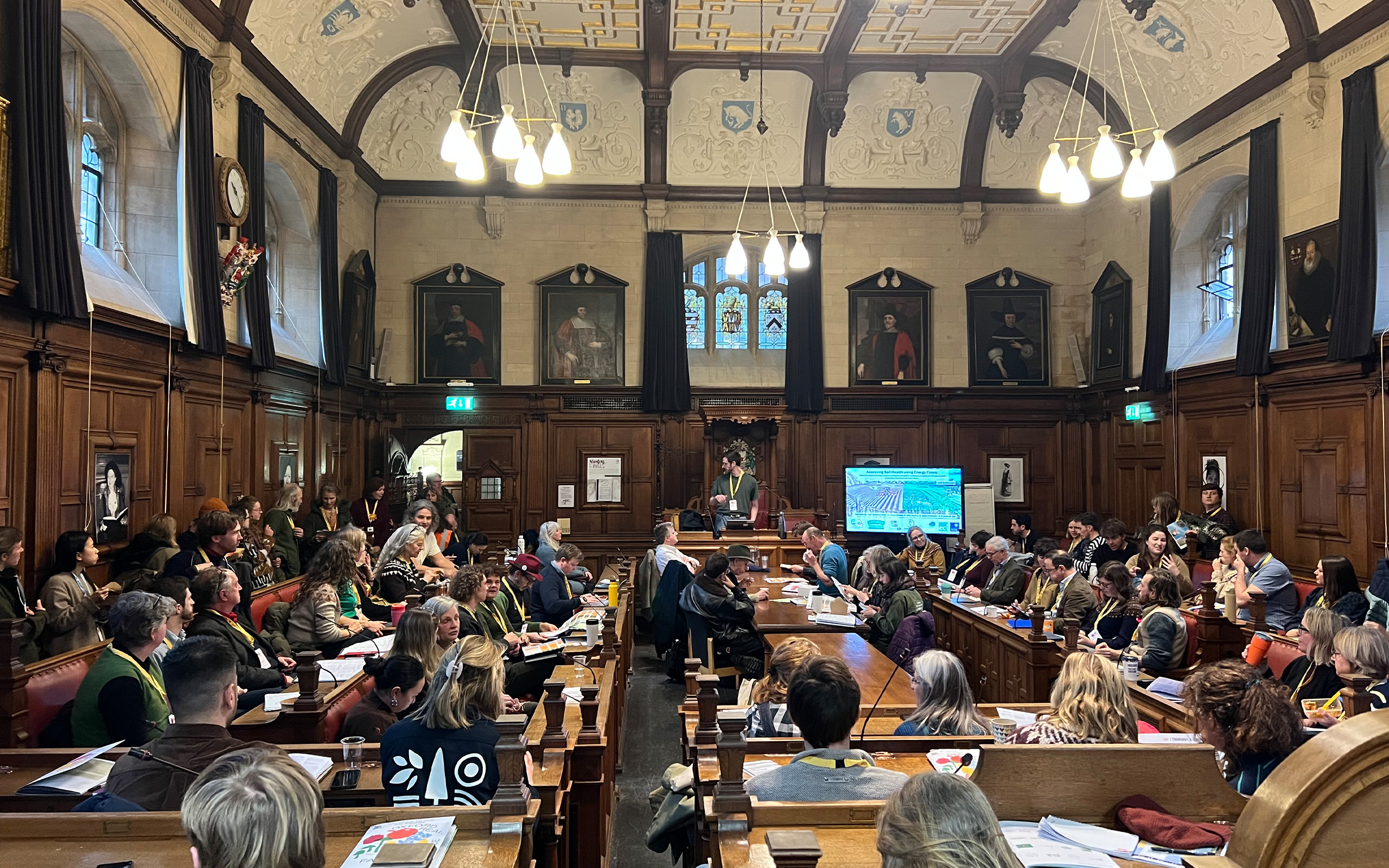
‘After several years of hard working sampling and studying the soil and microbiota of FarmED, it was great to hear our own Jed Soleiman give us an update on what’s actually happening under the soils here,’ says Alex. ‘He has found macro and micro fauna which could be used as representatives for observing energy flows in the soil - meaning these would be the organisms to look for in order to replicate this research on other soils and other sites. He also gave us an in depth look at how the energy flows differ between our more diverse fields and our more conventional fields. Keep an eye out for this work when it’s officially published soon!’
The Wool Workshop in the main hall at the Town Hall was also interesting to drop in on.
‘It was great to see everyone engaging and getting hands-on with the spindle and spinning wheels and it was also great to catch up with Vera Hoenen - who is coming to FarmED on the 28th of April for a lunchtime talk on her wool working,’ says Alex.
Fiona Mountain, FarmED’s copywriter and storyteller, had the pleasure of sharing an ‘In Conversation’ session at ORFC with Cornish conservationist and veteran Merlin Hanbury-Tenison, talking about his acclaimed book, Our Oaken Bones. Merlin is no stranger to FarmED, having featured on The FarmED Podcast and last year, interviewed by Alex, and also attending the Wainwright Awards, which we hosted in 2025, as a shortlisted author. ‘It was wonderful to connect with Merlin again and to hear more of his story about the healing powers of the natural world, in particular the temperate rainforest at his farm, Cabilla on Bodmin Moor,’ says Fiona. ‘Temperate rainforests are hugely important for biodiversity, climate and people and as the Founder of The Thousand Year Trust Merlin is dedicated to safeguarding their future.’
Fascinatingly, although 20% of the British Isles offer climate and environmental conditions in which temperate rainforests could thrive, less than 1% currently remains. Merlin explained how multi-disciplinary research is crucial in order for them to thrive.We heard how Merlin and his team are currently building a research station to facilitate ground-breaking collaboration in Cornwall and across other temperate biomes.
While the theme of OFC was resilience, Verity Portas, Partnerships Lead at FarmED, says it’s a word that came up in every talk she attended at ORFC too.
‘Monika Zurek from Oxford University’s Food System Transformation Group questioned whether it should mean to bounce back, or rather whether the shocks and stressors should bounce us forward. She also asked whether a system can be resilient if different actors in the system are not. Jennifer Clapp from the University of Waterloo suggested resilience could also involve diversity through more participants in the market, as well as a diversity of products in the market.’
Below are some noted insights from the speakers from the sessions Verity attended.
Co-creating resilience: nature, farmers and science
Monika Zurek, Researcher, University of Oxford
Jen Lucey, Researcher, University of Oxford
George Bennett, Farmer, Sandy Lane Farm
Tom McVeigh, Farmer, Kenton Hall
Panel discussing challenges and opportunities for meaningful collaboration between farmers and scientists.
- There is a need for co-created participatory research, especially as information often gets lost before it gets to the stakeholder.
- How do projects maintain longevity and the community they build? Often participatory projects are funded for a period of time and when they cease, the communication channels between researchers and practitioners also cease. Researchers struggle to find the channels to communicate with farmers.
- There is a correlation between countries with strong food cultures and the strength of their research output (more questions asked, more value placed on food, more funding…).
- Investing in your team: allows farmers to go beyond day to day and engage with research.
Digital dilemmas: who controls agtech?
Jennifer Clapp, Professor, University of Waterloo
Barbara Van Dyck, Researcher, Free University at Brussels
Edu H. Nualart, Farmer and European Coordinator, La Via Campesina
Chantal Wei-Ying Clément, IPES-Food
A panel assessing whether increasing digitalisation and “innovation” aligns with agroecology.
- Who are innovations serving? Innovations are coming from start ups that then get bought up by big companies. Companies often merge to acquire digital assets, vying for “digital dominance,” then using these technologies to shape the digital space.
- There is a narrative that growing digital transformation is a “necessity” - the panel argued this is not the case.
- “Innovation” as a term is driving the dominance paradigm. Innovation has been defined as “high technology” but that dismisses innovations that farmers make daily in their work.
- The digital world provides lock-ins: it’s top down solutionism. It grows a lack of agency or autonomy for practitioners. There is also a high cost to accessing technologies, which excludes smaller scale farmers.
- Questions of liability: if an ag tech company's app tells a farmer to do something and it goes wrong - who is liable?
- “Dual serviceable” technologies: technologies that can be used by both civilians and also the military - these are prioritised and funded by European universities at the moment (e.g. drone technology).
- 90% of R&D is from private companies, meaning the system perpetuates.
Banking on nature - only for the rich?
Simon Crichton, Triodos Bank
Martin Lines, NFFN
Molly Easton, Young Wilders
Mike Barry, ex-M&S
Panel discussion on the finances of nature restoration and food production.
- In the context of the land use framework coming out later this year and the watering down of BNG, only the big and connected people will get the early opportunities: need to democratise it.
- BNG is a 30 year agreement so focusing on youth now, means there will be that consistency of delivery.
- There needs to be a restructuring: how do you view nature as an income stream as a farmer?
- Integrating nature and food production may be problematic for farmers in the supply chain: retailers want to be with the smallest number of large producers (according to Mike Barry).
- Focus on localism: people are concerned with nature in their local community e.g. River Wye pollution rather than a long term global crisis.
- Narratives: it is an easy narrative for e.g. the car industry, “diesel needs to turn electric” - not so for food. Complex explanation means there is not buy in.
- Nature literacy for the c-suite?
- Martin Lines: the argument that building nature is risking food security is a fallacy; most farmers in this country don’t produce food for humans, they produce food for either animals or energy (off back of “no farmers no food” protesting).
- There needs to be long term legislation that don’t change with the election cycle.
- Need to unlock citizen science.
Food, Trade and Turmoil: Navigating Global Disorder
Jennifer Clapp, University of Waterloo
Sophia Murphy, Institute for Agriculture and Trade Policy
Ruchi Tripathi, Global Alliance for the Future of Food
Panel on the new geopolitics of food and how we need to respond to the stressors in the system.
- What is the new geopolitics of food? Conflicts, tariffs, weakened global institutions, etc. resulting in volatile food prices (dollar has declined and food is traded in USD), corporate profiteering, debt burden, ecological costs.
- The global south is overwhelmingly reliant on imports and so is the most affected.
- The Via Campesina is campaigning for food to be removed from the WTO.
- “Patent laws were not made for living things”.
Book talk: Titans of Industrial Agriculture
Jennifer Clapp, University of Waterloo
Jennifer Clapp discussion on new book looking at corporate dominance in the agricultural inputs industry.
- 200 years ago seed, machinery, fertilizer and pesticides were not market commodities - now they are controlled by a handful of corporations.
- John Deere owns 60% of the market share of the North American tractor market.
- “The history of the industrial age is the history of corporate concentration”.
- Patenting: advantage granted by patenting policy: a 20 year monopoly, then they can create lock-ins by providing producers credit as they have the capital.
- These technologies were critiqued at the time of development. There is a belief that Silent Spring in the 1950’s initiated first waves of criticism of industrial agriculture, but actually there was Balfour, Howard, etc. who began publishing on industrial agriculture and monopolies contemporaneously.
- Source of power to get and stay big: tech, policy and market.
- Monopolies enable control over the market, keeping competitors out and raising prices. Also leads to consolidation of land holdings as the tech facilitates larger land areas (which are also growing in monocultures).
- Also a point Clapp makes is that the lock ins are locking into one another: seed, inputs, machinery and land consolidation.
- There needs to be money shifted into r&d for an alternative model.
- Need anti trust regulation, but Clapp not hopeful of imminence given current politics.
- In 30 years there has been no new research on herbicides.
Recent news items