

The FarmED Podcast with Wildfarmed’s Andy Cato
Feb 26, 2026
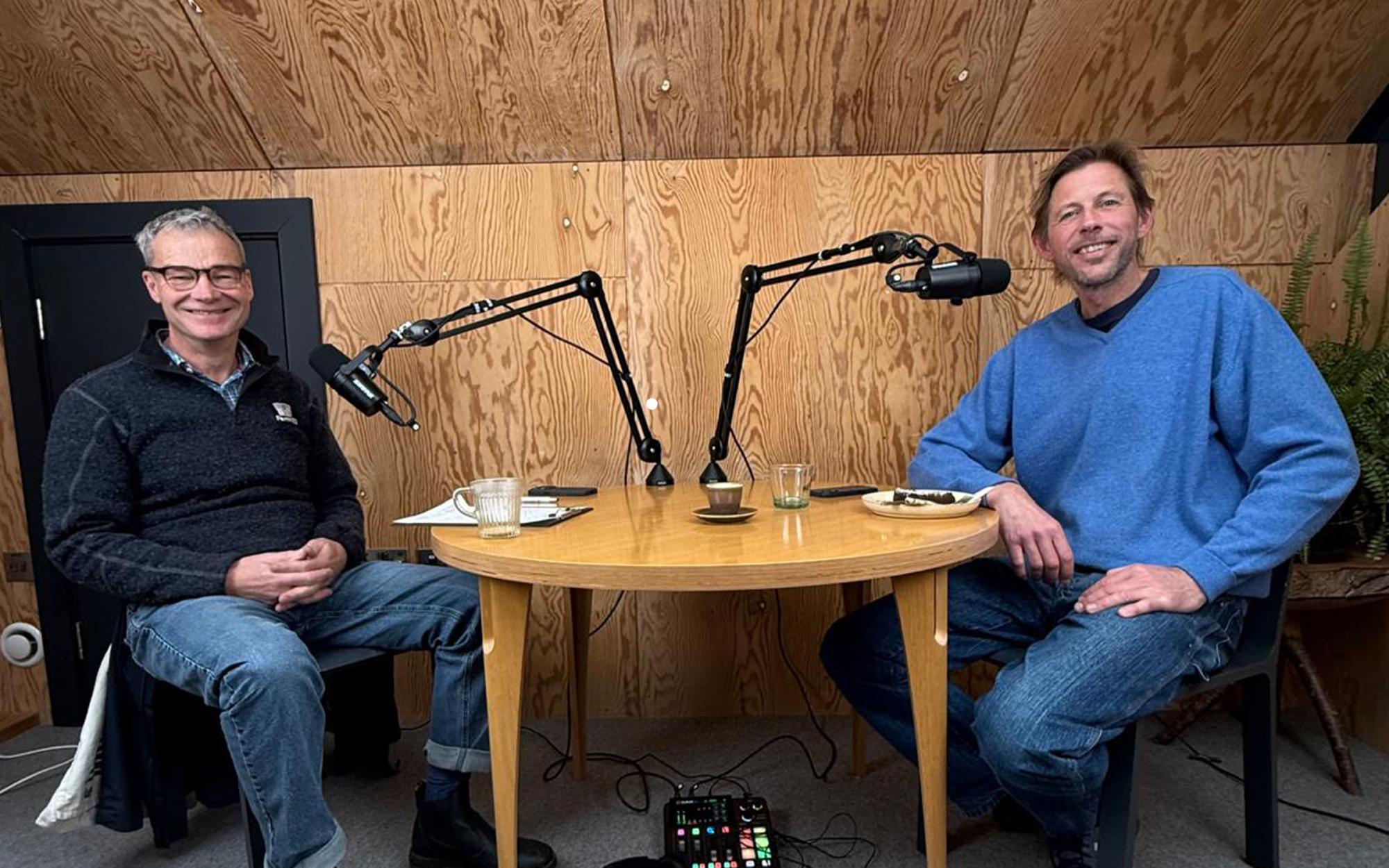
In this month’s episode of The FarmED Podcast, co-founder of Wildfarmed, Andy Cato, talks to co-founder of FarmED, Ian Wilkinson.
Andy famously found fame as part of Groove Armada and then sold his music publishing rights to buy a farm in France, before going on to establish Wildfarmed and starring on Clarkson’s Farm.
Andy talks to Ian about his inspiration, the tough lessons he learned in France, and why he is so passionate about growing regenerative wheat to make flour and bread for the supermarkets.
Hear about everything from how he measured nature uplift, ‘such a key indicator of ecosystem recovery,’ by bribing neighbours with pain au chocolats, his views on the use of glyphosate and how he set up Wildfarmed because actions bring about change, and ‘how can you act in a world of anonymous food?’
His message is ultimately hopeful. ‘I think that based on incoming messages, the idea of agency and purpose and hope, particularly amongst young people, really, really does resonate. And there's this sort of sensation that people are on a kind of slow motion train crash that they can't do anything about, and that there is a way to act through their food choices, is definitely a thing that I think has huge potential. It's not easy to communicate it, but where we have landed it, the response to that has been amazing.’
Listen wherever you get your podcasts or watch on FarmED’s YouTube channel. Please subscribe, like and leave us a review. They really do help.
Links
Transcript
Ian: Welcome to The FarmED Podcast. Our guest today is DJ, farmer, regen advocate, co-founder of Wildfarmed, Andy Cato. Goodbye nightclub, hello country.
0:00:26
Andy: Very good. I've been waiting for someone to do that for a long time.
0:00:29
Ian: Ah, I thought that. I just assumed that would happen every time. Really.
0:00:33
Ian: For those that don't know, the significance of that?
0:00:36
Andy: Yeah, that was a Groove Armada album that had... I should know this. I'm pretty sure it's the album that had SuperStyling on it anyway. And it was called Goodbye Country, Hello Nightclub. So in a very eloquent reversal, here we are.
0:00:48
Ian: Sorry, pretty simple. Alex, my good friend and co-presenter on this podcast, I should say main presenter, gifted me that. Andy, welcome. We've known each other for a long time, and I suppose through the seed trade, actually. I mean, I remember sending you, sending this strange amount of seed to southwest France probably 20 years ago, and it turned out to be you. And then I got the backstory, which some listeners might know, but you sold your music rights. You really did put your money where your mouth was, and you went farming.
0:01:27
Andy: I did, yeah. A moment of madness. Yeah, I mean, it's a story that I've told a few times, but that I’ll give you the headlines. It's that I was a musician. I had a very passing sort of acquaintance with food in that I was an occasional buyer of organic food, given that I read a few things about pesticides and stuff. But that was as far as it went. And I was coming back from a gig one day, picked up an article about the environmental consequences of food production. It was brilliantly written. It was very sobering and it had a line in it which said if you don't like the system don't depend on it. And I think that kind of resonated with my musical origins. Well, after all the kind of brass bands and jazz of my youth, the house music origins, which was the free party era. There's something in that phrase, if you don't like the system, don't depend on it, which pulled on those heartstrings a little bit, I think. For whatever reason, that article upended my life. I started growing vegetables in a quest for self-sufficiency, thanks to John Seymour's 1970s guide.
0:02:26
Ian: Oh, really? Gosh, that book is so well-read.
Andy: That was in my record box for a long time, as I sort of stood in pasture in Ibiza, thinking about top soil, which is probably a world first.
0:02:37
Ian: But you had that book already?
Andy: No, I bought it after this article. I decided to use a bit of the garden to try and become self-sufficient. I just went down a spectacularly sized rabbit hole and ended up selling my publishing rights, as you mentioned, which is a musician's pension, basically, to finance a farm in France. Only possible because land in France is a fifth or a sixth of the price that is here.
0:03:00
Ian: Is that why you went there?
Andy: And so it happened to be possible. Had we been in the UK, it never would have been possible. And then had a very humbling lesson in how hard it is to be a farmer.
0:03:12
Ian: Yeah, how did you learn?
Andy: Well, I mean, everything that could go wrong did go wrong. You know, I was farming on... I bought a farm without doing a soil test. I mean, total madness. I was farming on very degraded soils.
0:03:26
Andy: I was... went in there naively thinking I was going to sort of just pick up where the previous guy left off and start producing organic cereals. I had no mechanical knowledge whatsoever. Obviously all the machinery I had to get from scratch, so there's an awful lot of zeros on those checks when you start doing that. And I was fundamentally dealing with soils that were in such a state that they were much better suited to growing weeds than crops. And two or three years in, for the first time in my life, I thought, I'm going to have to accept defeat here.
0:04:02
Ian: Really? So what turned it around?
Andy: What turned it around was finding a book by Albert Howard. And it was called The Agricultural Testament. I found it whilst looking for an Enid Blyton book for my daughter. And he led me into this whole amazing world of, you know, Faulkner and Newman-Turner. The pioneers. You know, Balfour. All of that amazing sort of, you know, pre-war cohort of people who were talking about all the things that we're talking about now.
Ian: Real counterculture, weren't they?
Andy: They must have felt very isolated in many respects. Of course, they had the voice. I mean, they were able to, well, write books, I suppose, and get it across at a time when everything was sort of almost going the other way, industrialising and becoming quite intense. Even then back.
0:04:47
Andy: Yeah, I mean it's just not a new problem. I mean that you know the the Romans lost so much soil through erosion that their seaports ended up miles inland, you know. Then they had to start getting all of their grain from around the Empire and the same fertility loss happened there. So Chocolate cake? Is that for me? I think that's for Ian, isn't it? Thank you.
0:05:17
Ian: We've been talking about soil, and I know you always say, you know, when someone says to you, what's good soil look like, you say chocolate cake. So there you go, there's your chocolate cake.
0:05:31
Andy: Perfect.
0:05:32
Andy: We can also reference the fact that the price of cocoa is what happens when wild weather hits degraded ecosystems, and maybe that's for later on.
Ian: Yeah, probably. Let's get to that. So...so you were farming in France, inspired. How did you farm? What were you growing and how'd you do it?
Andy: Well, it changed radically, you know the first few years I was essentially waging mechanical warfare against perennial annual weeds and I was losing and so, you know, and there were all of the kind of awful bits of being an early adopter. So for example, I tried a camera guided interrow hoe and, you know, now they're a brilliant nterrow hoe, back then in the middle of a sort of very isolated field in southwest France when no one else is doing anything like that. You know, it just makes me feel slightly nauseous even reflecting on it. But if everything worked perfectly, all the hydraulics and the electrics and the sun wasn't pointing in the wrong direction and, and, and, you know, you might get kind of 100 meters where it was happening. But a lot of the time was just ripping out what you're trying to leave behind and, you know, trying to get GPS going and the tractor was going round and round in circles and I couldn't stop it. Or, you know, I mean, it's just there was so much time and effort and energy just trying to solve these problems in a very solitary way.
0:07:00
Andy: And, you know, they make for good stories. And I was lucky in that I could go and earn some money at the weekends in Ibiza or whatever and not go bankrupt. But it was totally exhausting.
0:07:10
Andy: Yeah. And really, you know, psychologically left a deep scar. And it's what made me want to just build this next chapter around community. farming communities, because it was just grim, to be frank.
0:07:28
And it's a position that so many farmers are in without the luxury of being able to go away the weekend and keep the show on the road.
0:07:37
Ian: Yeah. I guess, you know, reading about something or hearing about something in another part of the world, you think, great, I'll copy that. I’ll buy that bit of kit do the job you know like you said with you know with hoes and you know guiding the GPS it all sounds brilliant doesn't it but actually in reality isn't always the case is it especially when the soil or the weather or something that you don't expect happens happens you know rain or sticky soils or clay and that sort of thing that you just assumed it would deal with of course doesn't always work does it?
0:08:06
Andy: It doesn't work and you know I was definitely guilty then I've been guilty since if you get obsessed with the mechanical solution rather than the thing that actually needs solving.
Ian: Yeah, cause you've been actually very, I would say very experimental compared to most farmers. I mean, you’ve tried all sorts of, you know, by cropping and all sorts of things, haven't you?
Andy: Yeah, lots of things. I mean, I guess essentially, you know, coming in as an organic cereal farmer, I was trying to work out, you know, how you limit disturbance, and the inter row mower was all about, you know, how do you avoid this thing of soil restoration for three or four years with pasture and then turn it all upside down to go into the cropping cycle, you know, it's the eternal conundrum, so I was wrestling with very long standing problems, but things like the crimper roller, you know, it's hard to get it going and just even getting hold of one was this whole escapade which involved the thing being delivered by a kind of pair of Tarantino lovers pulling it behind a sports car from Germany and there's all kinds of madness.
0:09:13
Ian: Did you have doubts when that turned up?
Andy: But you know, that was a very interesting idea. It's a great shame that the timings of spring sowing cereals in the UK mean it's just not an option really certainly not a reliable option without frost you know so but that was very promising and actually some of the things that I was experimenting with back then around cropping or polycropping things like that, having understood much more about why that was a good idea and why it was important.
Ian: Yeah, you need to have the failures, don't you, to understand, you know, the possible future successes, I think, sometimes. So, I suppose, I think you said, I can't remember when, but a while ago to me, farming with nature is very challenging, you know, and it really is, isn't it? It is not, you know, it's not a binary thing. These are really interrelated, complex things. You talk about controlling weeds with mechanical methods. I mean, I'm sure our conversation will get on to, well, what's the option if you don't do it that way? Yeah. And I think recently on this podcast, I think Guy Singh Watson was interviewed and he spoke about regenerative farming and he spoke about the use of glyphosate and he's got strong views on that.
0:10:31
Ian: And I suppose if you don't use mechanical cultivations of some description and you wanna grow a crop, you're gonna use something else. Yeah, but I think he was right to call out the fact.I was saying this for a long time that, you would just hear again and again, it's all about no -till, it's all about no -till, it's all about no-till, without anyone saying, how does no-till work then? And you've just got to be honest about that, you know. And so, personally speaking, I came in, as I've said, from an organic perspective, and I've been very, very vocal about my views on glyphosate and pointed out the sprayed off fields to the kids from the car and all this stuff, you know. And then I think one of the things that has been the overwhelming takeaways of the last sort of 16, 17 years of trying to in different ways work out how we can bring nature and food together is just we just have to avoid dogma and move forward on the basis of evidence or the best evidence that we can find.
0:11:36
Andy: And as you say, and it's difficult because it's nuanced, and we live in a world where everyone's shouting in black and white slogans, and actually standing up for a bit of nuance is really hard.
Andy: So in the case of glyphosate, it's used to spray off crops before harvest. It should, in my opinion, it should be banned, and in lots of countries it is. It's got associations with the GM crops which were developed to work with it, and on which, you know, 10 or 12 applications will be made every year. And it accumulates to the extent that it's even coming down in the rain in parts of South America, where that's been the case for a long time.
0:12:14
Andy: And then you've got the example that we're talking about, where we have poor soils, generally speaking, we need to take them forwards. One of the ways to take them forwards is using cover crops or pasture. And then you get to the point where you've got to go back into a crop again and you've got two choices, you either cultivate it or you spray it, so which is the least bad and as you know we uh got to the point uh where we just like we can't ignore this question it might be easier to ignore this question but we can't we've got to look it in the eye we've got to do some research. I don't want to talk about it but you've just got to look it in the eye. We did the research I know you did with the same Andy Neal who did some research for us he did some research on your pastures here and it's you know it's not always the results are not always what you want to see you know and so our um conclusion from that was that for sure you know if you've got a cover crop and the weather's kind and you can graze it down tight and you might be able to cultivate an inch deep and sow your spring wheat well have fantastic you know it’ll do that every time but it might also be that the weather is unkind and unseasonable increasingly it is and the only way to get back into a crop is to do some very dramatic cultivations in poor conditions that are going to undo all the good that you've just done with whatever's preceding you. And in that situation, the evidence suggests that spraying it off and leaving all that alone and being a bit more gentle on the soil structure is the least bad option. So, again, it's a nuanced position because people associate glyphosate with all these other things. And I'm talking about a very, very specific thing.
0:13:48
Andy: But we just have to be able to live in a world of nuance if we're going to solve these things.
Ian: Yeah, you articulate that, I'm sure, for the vast majority of people. How do you feel about the risks, the unknown risks? So, you know, the precautionary principle often applies in the world if something is, you know, at global scale for the whole population. Because I think for me, I mean, what I remember about was that it was something I was experiencing when I was a kid. I mean, we were applying it in farming in the 1970s. I came to farming late 1970s. And it was a product that was used then. And so we got this 50-year thing. And as you mentioned, in North America, on the soy crops there, they were spraying on dozens of times with this product. And I think Guy in his podcast, saying it's in everyone's urine and it's sort of in the environment. And I guess it is. Whether that's having an effect, we just don't know. So my question really is to you, how do you feel about that? And generally speaking, should this be something that we need to be concerned about? It's an unfair question to you, Andy, but I feel like this thing that's used worldwide could be a ticking time bomb. Nobody really knows. And it is the nuance of it. And I agree with you that if you're using it 12 times, perhaps it isn't 12, but six times a year, or you're using it on desiccating crops that we're then going to eat literally two weeks later, that seems a bit stupid.
But it's this middle ground, isn't it, that we can't really be sure on. So Richard Gantlet in Wiltshire, for example, he's a biodynamic farmer, so he doesn't use glyphosate. And he has a system of surface tillage, really. And so he's using diesel and he's using machines and disturbing the topsoil. But he seems to be getting quite good results. Big question, I think, for all regenerative farming, and people that are not doing it in a conventional sense, is this question around yield. So maybe we don't have an answer. I mean, you might want to just add something on the glyphosate question.
0:15:43
Ian: But one question that we do need to address now is this question around yield, the quantity we're getting. Because the two things are sort of linked, aren't they, really?
Andy: I do, but I think on what you just said there, I think there are a couple of points. I think these are big questions, and to my mind anyway, we need to break them down. So like, none of us wants glyphosate in our urine. And so I will, if I can't find an organic apple, I won't eat an apple, you know.
0:16:12
Andy: And so for Wildfarmed customers, that pesticide-free guarantee is critical. So we know that we can test for residues of all pesticides including glyphosate and however you prepare your seed bed that isn't showing up in the grain. So let's deal with the glyphosate and urine question by saying we can test that, it's black and white, is it there or isn't it there and that's that so we can solve that problem. So then the separate problem is in terms of the soil impact. Now we know from research around the world, from Andy Neil's research that you've done and that we've done. So we can say that in terms of soil connectivity and structure and porosity, in terms of the sort of physical characteristics of the soil, the choice between, now obviously when the conditions allow sort of an intersurface cultivation, great, but like they often don't.
0:17:13
Andy: So between plowing and deeper cultivations and spraying it off, the physical characteristics, they are better if you don't do that. So then the second thing is what's happening to the microbial communities and the evidence that I'm aware of anyway suggests that it doesn't affect the overall abundance, microbial abundance. There is an interesting question around microbial function and that's something that I really want to look into more deeply with Andy Neal when we can. But in terms of the response of the subsequent plants, which is probably as good an indication as anything of the state of the soil, then cover crops, pastures that have been sprayed and in which the soil structure is moving forward, that is happening in biologically, measurably biologically healthy systems.
0:18:12
So I think we've got to try and zone in on get the ticking time bomb problem into its component parts. There's the human bit, there's the soil bit, there's the microbial bit, there's the structural bit. Let's just look at it and find out the answers as best we can.
Ian: Yeah, I hope when we do discover the answers that we're not, you know, wishing we had that precautionary principle in place. I don't know. I think it's a debate we should be having and I think that's the point, you know, that's why we've had this conversation this morning, isn't it? To get this into some sort of, make some sort of sense of it rather than just saying we either do it or we don't.
0:18:48
Andy: Absolutely. And I think the main thing here is going back to what we're trying to do here. We've got an urgent need to move food production from being reliant on chemistry to being as reliant as it can be on natural biology. So we have to push our soils forwards and we're starting from a pretty low bar. And so what are the ways that we can maintain production whilst continually moving forwards as best we can.
Ian: Yeah, thank you. Very clear on that Andy, thank you. Do you think, to the second part of the question about yield, with regenerative, we could come on to maybe regenerative standards or certification or whatever you want to call it, if you like, but do you think that the general concept of having a regeneration of soils where we're inevitably going to be using crop rotations to enhance organic metacarbon stocks in the soil to make it more fertile and rebuild it. Do you think that there is an inevitability that we're going to have less volume of food from a regenerative system, certainly during the transition stage where we're rebuilding soils? Because if we're backing off a little bit on the synthetic inputs, inorganic nitrogen fertilizer and that sort of thing, do you feel that we just need to accept that we're going to have less tonnage of say wheat in this case that we're talking about.
Andy: I’ll just start with the sort of tantalising prospect, and this is something that John Kemp talks about a lot, that I think we're so used to degraded ecosystems that we've lost sight of the potential of fully functioning, natural ecosystems and so you know John talks about the photosynthetic potential and how our crops are operating at a very small percentage of their photosynthetic potential and when you look at undisturbed ecosystems the sort of extraordinary abundance of them.
0:20:43
Andy: Yeah, and so I think there's all kinds of as as we hopefully moved more towards holistic system science rather reductionist science and start to understand and embrace these natural systems a little bit more I think there is all kinds of on untapped potential. So I'm quite optimistic, that feels quite exciting to me.
Ian: Yeah, this is about your early work in France I mean you were trying to really enhance solvability with diversity of plants etc in the source so that you get more.Yeah, it takes time clearly but I think you're right. There is a lot of low baselines. The middle of England where we are here, you know, we've got your farm and ours here is relatively, relatively poor soil could be enhanced by having more perennial cropping, for example. So there is potential there, sure.
Andy: There is potential. I mean, in the here and now, the yield question is something that I push back on a bit. I'm sure some of this will be familiar to listeners of this podcast. But the first thing is we've got to look at yields over time. And so it might be on a given piece of ground.
0:21:44
Andy: You can get nine tons of wheat or whatever if the weather stars align and you throw the kitchen sink at it. And maybe that will work for another five years, maybe 10, maybe even 20. But what's the amount that we can produce in a way which is moving things forward and building resilience and allowing us to infiltrate more water and store more water as we're going to have to do as the weather gets more and more wild. What is the amount that we can produce infinitely and so looking at the time period rather than just next year's result I think is really important.
0:22:20
Andy: The second part of it is um you know roughly speaking two-thirds of all grain goes to animals so we don't need to reduce that very much to have quite significant wiggle room in how much we need to produce.
Ian: Yeah, people don't, I don't think people realize that. I think, I mean, farmers in the primary production sector. Of course, we do it, we know it, we understand, but when people drive past a field of wheat, uh I think they just generally assume that that's for human consumption yeah and this the other side of you know biofuels and uh animal feed and so on it's not something that people consider very much I'm sure but you say it's two third whatever it is two thirds of the quantity. I mean it's a great I think on the grain side we produce in an average year 18 million tonnes of grain in the wheat in the UK I should say. And of that 5 million tonnes of it we make into bread, your breads and biscuits and so on. But that's it. So 5 million out of 18 million tonnes seems to me there's a lot of room in that system for change. If you think about the efficiency of using the grain itself, that calorie.
0:23:28
Ian: So in your mind's eye, if there were, and I'm putting words in your mouth here, if there were a temporary yield reduction until soils are rebuilt, how will we as a population have to adapt to that if we're thinking of food security? At population level?
Andy: Well I think I will flip that round in that the assumption in that is that business as usual won’t involve a reduction of yield, but we have seen how wild weather hits degraded ecosystems and the price of chocolate in this delicious chocolate cake has gone up 250 per cent. Because of declining producing. UK wheat harvest down 20%. Just carrying on will maintain the current output. And I think we need to just say that's just not true, is it? Because if we've got soils that can't infiltrate, percolate and store water, that's not going to happen.
0:24:28
Andy: And also, I think what gets lost a lot in the kind of feed the world, feed the world mantra is that we don't have a calories problem we've got enough calories for 15 billion people you know so we've got a use and distribution problem yeah this is before we even get into kind of throwing a third of it away and so it's actually the things that are driving those last bits of yield. Just farmers just trying to hang in there and make a living yeah you know yeah.
Ian: No I think it's a very well put point I agree with it um the yield the yield thing, the price of the grain, the price of bread will come to no doubt. But I think the farmers this year, for those that don't know, have really suffered across the middle of England in particular with a low price for the food they produce, ie. the price of wheat's low and the cost of production is pretty high. So the margin, in fact, is not a positive figure. There's no surplus. It’s a deficit for most English farmers.
0:25:21
Andy: I read the other day was that 5 % of, I don't know if it's English or UK farms, I can't remember, but 5 % are going to make profit this year.
Ian: Isn't that astonishing? I mean, that's really worrying. And I hope that's a piece of outlying data, but it's the general trend, isn't it? It's the general direction of travel. Do you know the thing I noticed this year more than anything was farming here in the middle of England on grade three soils, which is sort of average soil, not great, not bad. The yields that we got from these crops around here were very below average. I drove over to Lincolnshire to Spalding in the summer harvest time and the farmers there were getting literally double the yield. Grade one soils, same input, very similar inputs, good farmers, good farmers here too. But the doubling of the yield on that very good quality soil really struck me because we, it's not, when you think about it, I'm not saying we shouldn't be producing grains everywhere, I'm not saying that, just simply that there's a big difference between doubling of the yield with the same inputs, the same environmental cost, compared to struggling on with something that isn't working.
0:26:28
Ian: And the farmers in the middle of England, many of them are gonna be really scratching their heads trying to figure out what next, especially as their funding through effectively subsidy, or now the SFI, is in doubt. So it's a really horrible place for farmers to be, especially on what I call average ground, because you'd be a really good farmer, but still on average ground, it's tough.
Andy: Yeah, it's incredibly tough. And I think in farming, as in social care, hospitals, where, as we mentioned before we started, I've been spending more time than I'd like to recently with my mum, and teaching, all these crucial areas of society, the show goes on because there are big and brave-hearted people. But we can't build a future relying on that.
Ian: It has to be sustainable. And the economic has to be sustainable, doesn't it, clearly. You’ve worked really hard to make soil farming, probably the wrong terminology, but to make it really cool. I think a lot of people look to you for that. Is that, do you think, a part of our future of people in agriculture to communicate to the outside world to bring new people into the space. Someone told me recently that they googled through AI, what's it like to be a farmer? Basically, it was like, it's dirty, dusty, smelly, rubbish money, don't do it. And that's what the rest of the world sees and what I think is actually a brilliant place to be. Yeah, I mean, economically it's difficult for the primary producers, but most of the farmers have got second jobs, you know, three quarters of them. But how do you get new people in? I mean, you're a new farmer. I'm a new farmer. I only started farming 12 years ago. So...
Andy: Yeah, I think, you know, by cool, I suppose what I meant was valued and aspirational. How do we turn it into something that people want to do, you know? Two thirds or more, is it 70 % of the UK's farmland. This is how we interact with our environment.
0:28:34
Andy: And so this is the, this is not a niche concern. You know, this is this is the key question of our time, environmentally speaking. And so, therefore, the people who are the stewards responsible for that, that should be one of the most valued and aspirational professions. And it is, despite all the difficulties we've just been saying, I think when you're farming in a way based on observation and trying to harness natural systems, it's endlessly fascinating. I have yet to meet a farmer who will stop if they have any way of carrying on and that tells its own story too.
Ian: So let's change our focus a little bit. You're probably currently best known for, you're known for a lot of things, Wildfarmed is the brand that's making real headway and is a real, really fascinating example for everybody involved in the space. Tell us a little bit about that. I mean, I think most people know the backstory, but you've created something that's going to market in a very different way. But I'd love to know what you've learned from it expanding into uh, you know quite a serious product and also what it's like to be in the supermarket space in the big food space having stuff because you know, you started pretty small and here you go. You're you're up and running and you must I guess must be learning a lot of things seeing a lot of change within your organization. And having to adapt to this big system.
Andy: Yeah, I mean the the idea came from… Well, it goes back to that, what I was saying in the article, you know, if you don't like the system, don't depend on it. That was my starting point. So, so then self-sufficiency. And then even when I was farming in France, you know, I went through the kind of the dark years and the hallelujah moment with Albert Howler.
0:30:30
Andy: It wasn't quite like that because it's always, you know, one step forward and 10 steps back. But eventually what came out of that was a farm, a mill and bakery. So even then it was very much, I was wedded to the idea of essentially building a new system, a local food system. And I think the more of those that we have, the more that proliferates, the better for everyone. But I also was left with a sense after, you know, a decade or so, that we just don't have much ecological road left.
0:31:05
And it isn't people's opinions that change things, it's their actions. But then how can you act in a world of anonymous food? You can't. And so the starting point with Wildfarmed with Ed and George and Adriana in the French farmyard, was here are these customers coming to buy their bread. They're buying it either because it's more digestible or because they like the butterflies in the fields or whatever. But they have, and this is a poor part of France, this is not, you know, people coming to buy eight pound sourdoughs. These are normal people using their food choices to support something that they're into. And how can we make this a choice for people on the high street? And we have to try and make this a choice for people on the high street. Had we had any notion how hard that was going to be...I don't think it would have begun, to be frank. We definitely had the superpower of naivety at that point.
Ian: Yeah. Yeah, because I'm sure, well, when you're starting out, nothing's in, you know, nothing, there's no barriers. You just want to get on and get on with these things, but the reality soon kicks in, doesn't it? You found a route to market. You're in a number of supermarkets with a well-known and well, heavily promoted brand.
0:32:17
Ian: So what was that like? Because I imagine that you've had to shift from thinking small to thinking big, I imagine through the supply chain the events that happen in terms of, do you have enough grain to mill? Do you have enough people growing the grain, et cetera? And then also the reality of getting into you know, having a significant amount of grain going into your brand and holding the standards where you need them to be as time progresses and the brand gets bigger.
Andy: Yeah, I mean, there's lots of different ways to that. I mean, you know, we have, because the whole point from the beginning was this agency point. In other words, having the option of, you go into a supermarket, you've got all this choice. Choice that you haven't got is knowing who grew anything, never mind how they grew it. So how do we make that a high street choice? So that meant that we're only getting grain from Wildfarmed growers, and that does mean that you're always in this chicken and egg of, you know, you need supply so you can go and sell it, but you need demand so you can ask farmers to grow it for you. And that's not easy balancing act. What we found in time is that is that everything just takes a long time. So if you start having a conversation with someone about making their crumpets or whatever, that's not gonna happen next week. These things take a long time. And one of the many amazing attributes of my partners in this business is their infinite patience.
0:33:50
Andy: Because when you're losing money every month, to take a kind of, enter into a two, three year negotiation with someone, it takes balls, you know, and I absolutely take my hat off to them because that's not something that I'm good at, you know. So, in terms of managing supply and demand, actually, the bigger we've got, the easier it gets because you're dealing with longer conversations and you have more flexibility in the system and we're also going between, you know, we sell flour to some people, but we also make our own products and so things can move around within that system in terms of priorities if we have to.
Ian. How do you hold that the brand itself because I mean the brand’s accountable whereas as you say it otherwise it's just a grain in a white sliced loaf on the shelf and no one knows where that's come from but you stuck your neck out that this is our brand, these are our standards and you have put standards in place driven by you know the need for ecological change and environmental responsibility so have you had to compromise as you've gone on and got bigger, which I imagine must be, you know, must be a balance that you have to strike to get the volumes through.
Andy: Yeah, I don't know. There hasn't been, I think there's two very separate things here. I think one is, you know, trying to build awareness, trying to tell this story, trying to democratise this message. This isn't just kind of, you know, niche expensive foods. This is a choice that everyone can have, trying to give people agency by, you know, making a connection to a known set of farmers. You can go on our website and see all the Wildfarmed farmers every year, and that's where the grain comes from. And so trying to, not everyone's going to choose to do that, but, you know, giving people a choice of doing that on the high street. So there's that side of it. And then distinct from that, I think, is the farming and how we go about the farming. But the idea of compromising that or rather changing how you do that, being necessarily compromising that. It's just not the case. It's just you learn about what are the outcomes that we're trying to generate here. And we're dealing with an incredible community of farmers. There's research coming in from all over the world all the time. We're getting better at being able to measure the outcomes of systems rather than defining the practices that we're doing. And from all of that, you can make progress.
0:36:20
Andy: But it's amazing how up in arms some people get about change. So when we said, OK, we started with people who we knew um and we sold flour to a couple of bakeries and a Michelin-starred chef and you know you don't just turn up in Tesco. That's the culmination of endless concentric circles of sort of outward influence, because everyone on that circle out looks at the people in. So artisanal pizzerias will be looking at the top bakers and the top restaurants, and then AskPizza will be looking at the artisanal pizzas, and so on and so on and so on. And so it's been a very considered and deliberate spreading of this message and the word and getting people out onto farms and walking into fields and saying this is what we mean and this is what you're helping us do and so on and so forth.
Ian: And what is the outcome in your mind that you would love the brand to achieve in the environment, in the field?
Andy: Yeah, so where I was going with that was that when we moved out through those circles to people who we didn't know all of them, and they all come from our open days, we didn't know all of them, and we're saying, can you pay a bit more for this flower, please? And they quite reasonably say, well, why? And as has been discussed, as you discussed with Guy, regenerative is a word like healthy or natural. Anyone can use it. Lots of people do. And so we wanted to say, well, this is what we mean.
0:37:48
Andy: Not that that means that everyone has to do, but this is what we mean.
Ian: No, no, you can control your bit.
Andy: We can control our bit. And so coming from organic origins, in fact, Wildfarmed was an organic business when it started, I followed that model, which is defining practices. You can do this and you can't do that. And that's what the Wildfarmed regenerative standards were. And then we had a process whereby every year which I thought was an eminently sensible and natural thing to do, you would get feedback from the experiences of your farmers, what worked, what didn't, what we should change, and then look at research and you say, okay, for the next year, we'll adapt it. I was really surprised by how cross people got the idea that you'd adapt your practices based on the experience. But what we really wanted to do with those practices, it was essentially the best guess to be able to say to our customers, if you buy this flour, well, it's pesticide free, it's better for nature, it's better for water, it's better for carbon emissions, it's a better deal for farmers. That's what we're actually trying to do. And so from that point, it was, well, wouldn't it be great if we could just measure those things rather than constantly getting caught up in you know, updating practice by practice to achieve them.
Ian: Yeah, I think this question about is it the practices that you specify or is it the outcomes you get from different systems is fascinating. I don't have an opinion on this by the way, but I wonder... I think any brand has to be very clear on what it does and doesn't do so people can buy into it or not as they choose and see fit. So I suppose there's two things really. One is, do you think the consumer that eats the bread eventually does care more now because they know what you're trying to achieve and the outcomes you're trying to get? And secondly, do the farmers, are the farmers that you know and deal with now regularly, I don't know how you measure it, but the outcome for them will be a financial outcome, I guess. So is it a financially viable proposition and better than an alternative, which I guess is that anonymous commodity market without really knowing where our grain's going when I've grown it. And I would really like the idea of that, but I wonder whether this question around standards and regulation and certification, whatever you want to call it, whether that's going to come for regenerative brands of food, without sort of picking any names. There is chatter about regenerative culture in some of the big brands.
0:40:26
Ian: What does that actually mean? How's it measured? Do we trust it? And it's that sort of question around greenwash. And you, I imagine, have been the driving force behind the authenticity of your product. I'm just really curious, I have a brand of my own in the seed business, and I'm really curious to understand how you maintain the authenticity and get it to scale where it's commercial in the world we're in.
0:40:57
Ian: Because you say the ideal solution would be to have a localised food system, a resilient food system that's robust and not many faces, but the reality is that we've got six or seven big supermarkets where 95 % of the food's bought. That's where the trade is. Yeah, and you've been you've been through this journey really quickly I mean I've been in my business even 50 years in the making you're well my guess is 10. So in on the timeline you’re a relatively young one, but moving much more rapidly than I ever did. How do you keep your authenticity?
Andy: Yeah, well, I suppose, again, there's a lot of things. I'm trying to break it down a little bit. But I think, well, first of all, in terms of the outcomes. And so I think, you know, in all of this, you know, like Guy was talking about the decisions around, you know, do you get fruit from abroad out of season. You have to choose your compromises, where are your red lines? And so our absolute USP is, it comes from these farmers, so you know who's are and you know the result of what they did. And in terms of the importance of knowing the results of what they did, for me, is so fundamental to dealing with all of the, we call it greenwashing, whatever you want to call it. I don't want to sort of start casting aspersions, but it's like, you know, people want to, people can use the word however they want but just say what you've done say what the result is let's get beyond kind of labels to what happened just as as an aside it was interesting that I was listening to Henry Dimbleby the other day and he was saying that whether you cook food from scratch or whether it's UPF, if it's got the right combination of salts, fats and sugars, it'll lead to overconsumption.
0:43:02
Andy: And it was just another reminder that labels, tribalism, let's just look at the actual result of the thing. But the problem was, how do we do this affordably and at scale? Because certainly not that long ago when I was drawing up these Wildfarmed standards with the help of the farmers in the community, if we take nature, that was the preserve of, you know, big estates with teams of ecologists, the money and the time to do baselines and come back in five years and all these things. And certainly for a tenant farmer like me, completely out of the question. And yet nature uplift is such a key indicator of ecosystem recovery. I mean, without that, you know, what are we doing all this for, you know, so, then they take that specific one.And there was various iterations of trying to solve this thing.
0:44:01
Andy: The first thing is what I've started calling, and I'm just going to go with it, is the plankton principle, in that if insects are going in the right direction, everything follows. Okay, so first thing is, because we tried measuring birds, we tried measuring bats, they've got huge ranges, I'm not saying there's no point in doing that, but from a farm perspective, they've got huge ranges, there's a lot of noise in the data. Insects are hyperlocal, and if they're there, then everything's going to follow. Okay, so then from that starting point, I was then thinking back to the farm visits in France, and it would basically be anyone who goes to the neighbouring field over the hedge, finds anything that moves, worm or whatever, can get free run on the pain au chocolat. And my pain au chocolate was pretty safe.
0:44:44
Andy: And that was actually an organic farm, but there was high tillage, you know, soybeans, wheat. Awful, pale, degraded soil, same as mine was, you know, when I started. And then they come back over the hedge, and there'll be lots of your herbal leys, and they'll be full of life. And I was thinking, hang on, this is 10 meters apart. And so the response of insects to the ecosystem is hyperlocalized. And so that led us down this path of relative measures.
0:45:15
Andy: So we'll put an insect bowl in a wildfire field. We'll put it in the nearest conventional equivalent of whatever the crop is. And then we'll measure the difference. And this is what we started doing with Bristol University. And the differences were very, very stark. Because if you introduce a flowering companion plant and there's no insecticides and you've got some infield habitat, whatever it is, the response to that is year one and dramatic. So the results for 2024, which they're just putting forward for peer review, was 3.7 times as many bees and a doubling of insect biomass. So that's huge. And so the way of doing it as a relative measure just means that now you can roll that out affordably and scalably and say, right, in the Wildfarmed fields, this is what happened to insects and this is what happened to bees. And I won't sort of drone on about how, you know, the same thing for water and the same thing for carbon emissions. And obviously we test everything to be pesticide free, so it's just a binary test.
0:46:19
Andy: But we've got this framework now where you can say, this was the result. And we just joined the SAI network, which is this big network of food businesses, I think we're the smallest business by a factor of about a thousand. But the reason why we've done this is because we keep getting told by water companies, scientists, no one has collected as much data on the outcomes of regen systems as we have, because to me and to us, this is the single most important nut to crack if this change in the food system is going to be real and meaningful.
Ian: Okay, so outcome measurements. Yeah, I can see where you're going with that. And I think that's eventually what we absolutely need. And perhaps we'll leave the conversation for regulation things in other areas for practices and for another time. It's budget day today. And I don't think we've heard the announcement yet of what's going to happen. 47.00 But the price of bread is an interesting one. I remember one of the chancellors, or was it a prime minister? I can't remember, a long time ago, didn't know what the price of milk was. And I thought the price of bread would be a fun thing to look up. So I looked it up last night. When I was a kid, it was 19 pence a loaf. And now we go from, I think, 75p to four pounds for a loaf. And the average is one pound 40. So my question about the price of bread is, if you can measure the outcomes and you can communicate that to the consumer, so the people that eat food participate in agriculture, of course. I believe, personally, that change will come from the whole system, not just one bit of it. So for people to participate in this change... you go forward over the next years, can we sell the outcomes of a regenerative system? Because we need to in order to deliver it for the farmers to be able to deliver, they need to be paid properly. So you have firsthand experience now of going to the market with this story that you've told. And many of us think you've done it brilliantly. It probably couldn't have been done better. So has it worked? Do people care?
Andy: Well, has it worked? I mean that's, well I think has it worked and whether people care or not, possibly slightly different versions of the same question. Just on the, because implicit in this is some economics as well, and I think another reason. So the outcomes, in my mind, are going to be two things. They say, you call it what you want, but just tell us what happened. I think that's just a really important way of finding a way through the risk of the kind of greenwashing tsunami wave that threatens to kind of break. The second bit of that is, of course, what you can measure, you can value. And the fundamental problem here is that we live in a world where a dead tree is worth more than a living tree and it needs to be the other way around. And unless we can measure these outcomes, we can't value them.
0:49:23
Andy: So, for example, with water companies, we've now, I think it's seven of the water companies are paying Wildfarmed growers directly for avoided water pollution because the water companies are getting a 6 to 1 return on investment for not clearing it up afterwards. We're working really hard now to get our relative nature measure turned into BNG equivalent to try and get farmers paid for nature. So all the services that they're doing, but whilst producing food, not instead of it, because we've got this whole thing of, if you want nature, we stop producing food. No, we need the two things in the same place at the same time.
0:49:57
Andy: So you can see a way through to farmers getting multiple income streams in food producing fields, which one, de-risks them a bit, because it's not all dependent on the final yield. And two, it helps not push the price of quality grains from nature-rich systems so high, because the partners are getting paid for the other stuff that they're doing at the same time. So I think that you can, it's not easy. And the work here is, is tedious long, but we'll get in there and we'll work, you know, interesting conversations with banks and insurers and the SAX are doing similar stuff. You can see a way to square that off. So I'm optimistic about the supply bit of it.
0:50:39
Andy: And then when you get to the other end of it, you know, we've learned an awful lot about what resonates and what doesn't resonate. And we're still learning a lot about that. I think that based on incoming messages, the idea of agency and purpose and hope, particularly amongst young people, really, really does resonate. And there's this sort of sensation that people are on a kind of slow motion train crash that they can't do anything about, and that there is a way to act through their food choices, is definitely a thing that I think has huge potential. It's not easy to communicate it, but where we have landed it, the response to that has been amazing.
0:51:28
Andy: And then in terms of in the supermarket, it's really, really hard. I mean, let's be frank, you know, these sort of the algorithmic systems, the complexity of packaging, getting it produced. There's only a handful of people who can make things on this scale, so getting it produced how you want it produced, and selling enough to make that production cheap enough to sell enough and it's really really difficult. But what we've found where we've slowly just worked through all these problems one after the other. Ultimately everything's just about building relationships and so we got to the point where I know it's Waitrose and it's not Tesco's but we got to the point of Waitrose where we've worked through all the problems. We got to the point where it was visible from the moment. It was visible. The response has been incredible.
0:52:24
Andy: And that doesn't mean that there aren't challenges around price, there are. And part of that will be solved by just getting better and making more of it. And part of it is just having honest conversations about the fact that if you're in London, it's £7 for a pint and £1.40 for a loaf of bread.
0:52:39
Andy: And a lot of people are operating in incredibly difficult economic situations. But there are a lot of people who are buying £7 pints who do have choices. And I think we've got to just look that in the eye as well.
Ian: Yeah, and I think the poverty question is not food poverty. I know a lot of people talk about that. Guy did as well, and we were referring to Guy Singh-Watson earlier on, I think he was saying it's not food poverty that's the problem, it's poverty, you know, because the price of food is cheap, you know, compared to where it is historically in terms of proportion of the percentage of our income that we spend on it is low at 10 % whatever is on average, and yes within that there is a big sector slice that Dimbleby pointed out in his report that is in real poverty and do not have those choices, but many people do have them as you say rightly so, and can make those choices.
0:53:26
Ian: I wonder, I'm just going to turn our attention a little bit before we end. Our good neighbour up the road, Jeremy Clarkson, of course, has caught everyone's attention, which is fantastic. And for a number of reasons, one of which was because he brought you and other people onto the farm as part of the story, which I thought was very clever. I wonder how it's boosted business, because it's probably globally one of the most watched programs. And locally, we joke that StowAg now has four depots. Has it helped Wildfarmed? I'm sure he'll probably have a view on this himself, but he's not here to answer, so I'm going to ask you.
Andy: I mean, the reach of that show is absolutely extraordinary. You know, after after however many years it is, you know, 30 odd years, kind of medium level music as a six foot eight person. I've up until going on that show had a handful of selfie requests and always just in and around, you know, Glastonbury or festivals or whatever.
0:54:38
Andy: And and now it's just a different order of magnitude. I was driving down to Cornwall the other week, and in terms of demographic spread, I stopped to get some petrol, and there were these young lads, sort of late teens, builders, who were going off raving for the weekend. So I was listening to their chat, and then one of them turned around and said, hang on, that's the nature bloke from Clarkson's and then you know a few hundred miles down the road I was in a pub garden with two middle -aged guys looking a bit disconsolate with their pints and they were looking over and then eventually one of them came over and said aren't you that bloke who grew two things together at Clarkson's and then at the end of the day I was in this quite well-to-do restaurant and a well-to-do couple with half-rimmed spectacles sort of lent over and talked about how they were rewilding a few acres on Dartmoor and they'd seen me on Clarksons.
0:55:29
Andy: The reach and the spread of it is absolutely incredible and as has been said many times before, but I think it's absolutely true, just for all of the sort of jeopardy and the drama and the things that make good TV, just explaining how damn hard it is to be a farmer has been something that's of vital importance that I salute him for.
Ian: Yeah, yeah. I think it probably surprised everybody how successful and popular the show's been. And certainly here, when people come, there's a lot of people come here, as you know, to FarmED, and there's always the question, you know, what do you think of Clarksons? Every single time, and the reach, and we get a lot of people here from around the globe, all the continents come here, and it's always the same questions. You know, even in a room full of Chinese visitors and people from Hong Kong and places, you know, how many people have seen Clarkson's Farm and their hands go up? It's amazing and all credit to getting the farming discussion going. And I wonder, you know, I wonder how far that can go in terms of providing the hope and the future visions. Because I think one of the things that we're lacking in agriculture, there aren't many people like you who lead, you know, put your money where your mouth is and take the risks. And I don't think you do it for any other reason than you just think it's the right thing to do, from what I've known of you. You know, it would be great to see that sort of impact continuing through Clarksons.
0:56:57
Andy: I totally agree. And I, you know, I dedicate huge amounts of energy to trying to make that happen within the very limited means that I have. You know, so this harvest 25, you know, it's driest spring, 132 years or something like that. I mean, yeah. And so he was growing some Wildfarmed oats. On a couple of fields, one of them was so stony, it could be kind of crazy paving showroom. But on the rest of the farm, they were doing, I'm not quite sure what it is. It’s kind of autonomous drones, that kind of stuff. Sort of soil mapping for the focusing of inputs where it's likely to be most productive. That sort of idea, as I understand it anyway, sort of very high tech. And in our fields, technology took on a different form in the sense of SAP testing, proactively managing the plants, improved soil structure through cover crops, companion crops, and all that sort of thing. And he wrote in the Times a few weeks ago that I think the farm lost £5,000.
0:58:12
Andy: I think that's what he wrote. And on the oat-producing fields, there was a really good gross margin, despite the drought. And part of that was because they were eligible for a low-input SFI payment, and part of it was because they were also eligible for a well-farmed water payment from Thames Water. The main reason was that he described that the yield was like two thirds of what they wanted on a lot of the farm. And it was nearly 80% of that on these two fields. And so there was just a decent amount of it.
0:58:43
Andy: And so you put all those things together and it's on quite stony ground on not very drought resilient part of the country in a really dry year, it's gone pretty well.
0:58:55
Andy: But that wasn't part of the narrative of the show for that season. And I said to Jeremy, like, two lines about that probably do more for this cause than anything I'll ever say, and certainly anything the government will ever do. Yeah. So keep on trying.
0:59:12
Ian: Well, keep going. I think it's clearly working. Guy was talking about you really need whole farm systems as opposed to just a small piece of a farm to deliver ecological good and environmental benefit?
Andy: Yeah, I mean, we've taken a different approach to that. I think, you know, when you think about whole farm systems, certainly what I think about anyway, is, you know, going to put a little bit down to pasture, move the livestock over here, have the pasture poultry following around, you know.
0:59:48
The reality of a lot of arable farming isn't that. It's, you know, wheat, rape, barley, sometimes rotations that are even tighter than that. And so you absolutely can, I think, take a section of that cereal production and say, let's approach this in a radically different way and test it and see how you feel about it. Because if you're using 300 kilos of nitrogen, 12 pesticide applications or whatever, and you come to grow with us and we say, well, it's nitrogen in 40 kilo doses, companion plants, infield nature habitat, cover crops, no insecticides, no fungicides. It's a big switch. And if you said to a farmer, well, you can only do that if you do the lot, they're obviously going to say no.
1:00:39
Andy: And so that opportunity to go really deep into a different way of doing things on the farm, I think, is just a really useful way of getting into a mindset shift. And that doesn't mean, you know, if you're doing a whole farm transition and you're saying, well, I'm going to reduce my inputs, you know, 30% over the next five years or something.
1:01:05
Andy: That’s also great. All of this is positive, but our mission is a mindset shift on the smaller areas.
Ian: It’s to get that change started, is what you're saying, isn't it? Yeah. It's to open the door to change. Yeah.
1:01:18
Andy: And the impact of that, of course, is the mindset shift. Also, obviously, 90 % of our farmers stay with us year on year, and we see the practices that they've been using on our bit rippling out across the farm. And then the other important piece of this, which actually does link back to the farmers in a way which has proved to be far more important than I thought it would be in the beginning, is that from a consumer perspective, if you're saying, well, I want to give you agency in your food choices, so you know how it's grown, you know where it's from, then the kind of ecotricity principle doesn't apply. If you sign up for wind turbines or whatever, when you put your phones on to charge, you don't care actually where that electricity is coming from. You've done your bit by signing up to the wind turbines. If you're putting it in your mouth, well, you do care. And so actually being able to give our, for example, pesticide free guarantee, being able to say, here's the nature impact of what happened in this field where this crop was grown. It's crucial for us and I think for customer agency to be able to link those two things rather than just saying it's part of a general program.
1:02:36
Ian: Yeah, thanks. Thanks for the clarity on that. That's really helpful. And one quick question on the pesticide free bit, that is pesticide free in the bread. I presume, the product? Yes, so we measure at Control Union, who does our audit measures, and we also do monthly measures in every grain store and at the mill to make sure that the grain and the flour are free of pesticide residues.
Ian: Thanks for the clarity. Brilliant. Thanks, Andy. So I suppose the final question is, what next? Before you eat your chocolate cake, where are you going? Apart from worrying about the next podcast. Do you still worry about podcasts and TV stuff that you do? You must have been in big audiences, so probably don't worry about stuff like that anymore.
Andy: I get incredibly nervous about it and it's it's you know I sometimes overhear people saying oh it'll be fine don't worry about him yeah yeah get him to do the talk it'll be you know and it's about sort of three years ago now that I stopped sleeping very well I get very you know, I dwell on things a lot. I've got a very thin skin. And so when you're kind of standing up for nuanced positions and shit comes at you from all sides, I don't metabolize that very well. And I try and make sure that I kind of prepare. And when I'm talking, the collective effort from so many people within the Wildfarmed team but also all of the people who help us. The collective effort to try and find the sweet spot where affordable food meets quality nature rich landscapes and farmer viability that middle bit of the Venn diagram is so damn hard to find so when I'm talking I feel that I am sort of representing all the people the amazing people who help us try and find it and I want to try and do them justice.
Ian: So yeah, your brain never stops. I think many of us feel the same but it's interesting isn't even with age you don't sort of get totally comfortable with speaking about something that affects so many of us and ultimately everybody that eats food. It’s a real, what’s the word, you know, nasty problem. There's this sort of, you know, great big hairy problem that we're facing. And it's so mentally challenging. And then also, you know, we're publicly, you know, navigating this course that we're trying to find solutions in. And it's such an important thing.
1:05:10
Andy: It is. I mean, I suppose my overwhelming, in terms of your next question, my overwhelming sense from the last several years is that we know that we can have fields full of resilient crops despite the wild changes in weather. We know that we could have NHS waiting lists coming down because food could be at least moving towards being medicine or at least not doing harm. We know that we could have annual reports of nature recovery because we're seeing that in the Wildfarmed fields already. And we know that if all that's happening, then farming can be the aspirational and valued profession that it needs to be. And we don't need any inventions. We don't need any technologies. It's a choice. And all of our food system was a choice that was made a while ago. We can make a different one. I just really hope that we get on and do it.
Ian: Yeah, well, let's work on that basis collectively, like you say. Andy Cato, thank you very much. Really enjoyed speaking to you, as always, and wish you every success in the future.
Andy: Thank you very much.
Recent news items