

The FarmED Podcast with FarmED Co-Founder, Ian Wilkinson
Mar 30, 2026
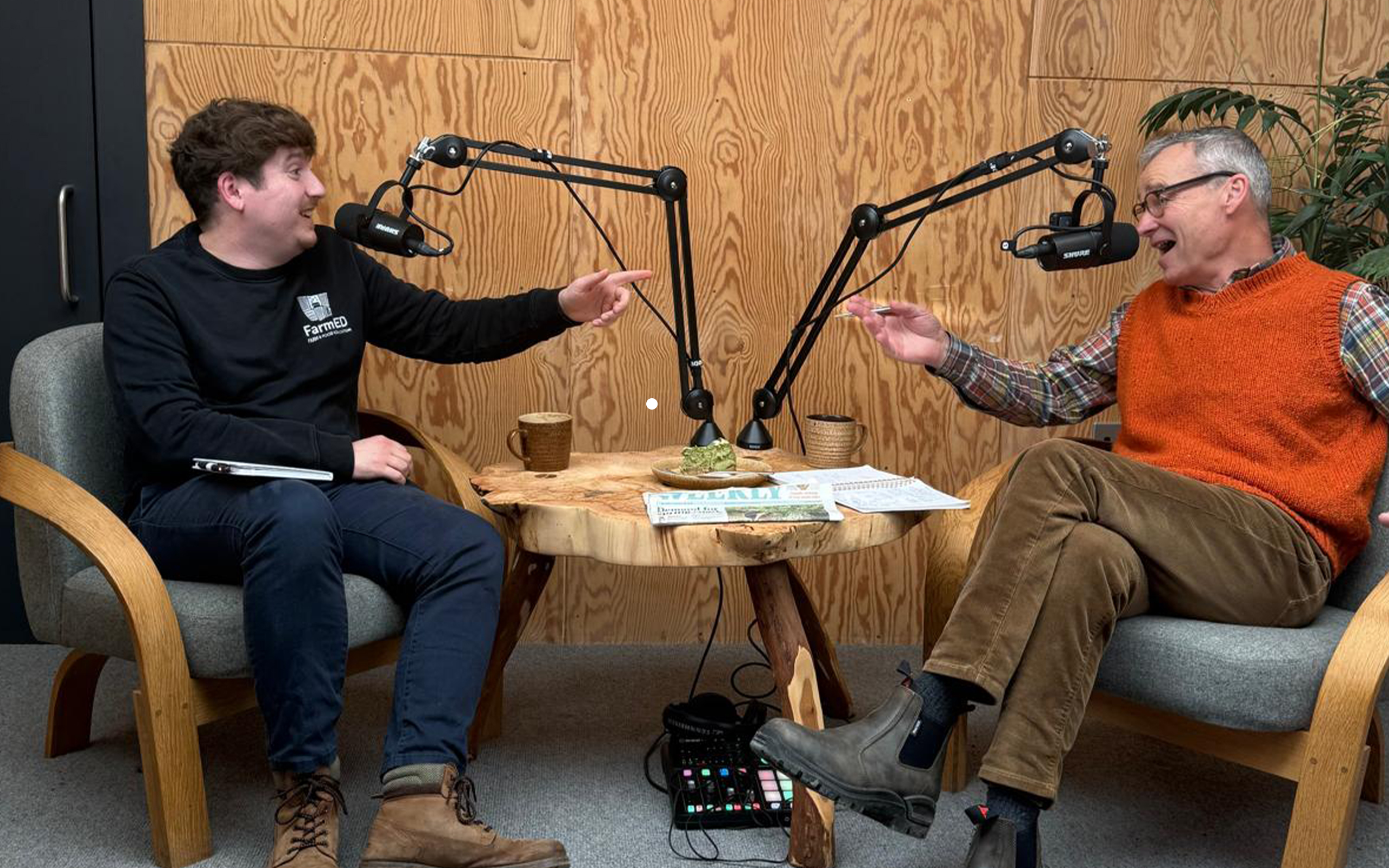
Co-founder of FarmED, Ian Wilkinson has been on sabbatical to Australia and New Zealand. In this episode of The FarmED Podcast he talks to Alex about his original journey from agricultural college to seed merchant, as owner of Cotswold Seeds, and then the decision to buy Honeydale Farm with his wife, Celene, and fulfill a dream of being a farmer. Ian and Celene founded FarmED as a regenerative demonstration and place for debate, discussion and inspiration and Ian talks to Alex about his inspiring experiences in Australia and New Zealand - covering everything from kiwis to kangaroos, cattle to cover crops, agroforestry and logging, and the observations he made about the differences and similarities in farming in New Zealand compared to the UK.
‘New Zealand and Australia are made up of people that have often been there for two or three generations from Europe, a huge number of European families in New Zealand, and a lot of those are farming families,’ comments Ian. ‘The importance of agriculture is valued in society more than I would suggest it is currently in the UK.’
Listen to The FarmED Podcast wherever you prefer to listen... Apple Podcasts and Spotify.
Please give us a rating, like or follow.
Full Transcript
Alex: The winter is over, the sun is shining, we’re back at FarmED for another edition of The FarmED Podcast with me, Alex Dye, and my guest today, who has come back from his globe-trotting adventures, he is the co-founder of FarmED, the owner of Cotswold Seeds, and I've heard him referred to a couple of times as Mr Herbal Lay. It is Ian Wilkinson. What are you reading there, Ian?
Ian: Morning, Alex. Well, actually, I'm just reading the New Zealand Farmers Weekly. The trials and tribulations obviously happen over there as well as they do in the UK, and it's... So many similarities, I can't tell you. Anyway, sorry, yes.
Alex: That’s interesting, New Zealand. I wonder if that'll come up in our conversations as we go on. So let's go broad. Let's start off with the big question. How did you get to be where you are? How did you get to be Mr. Herbal Lay, Ian Wilkinson? Where did it all begin?
Ian: Gosh. Well, so I wasn't from a farming family, but I went to the local agricultural college, having been an apprentice actually on a farm for three years. A 300 acre mixed farm in Berkshire where we farmed a bit of everything. Cows, milking cows that is, beef animals, sheep coming into the farm, crops, woodland, grassland, you know, it's all there and it employed about 12 of us. Really vibrant place in the 1970s. Then I went to agriculture college for three years, met my lovely wife, Celene, there and once we left college, I = went to work in Nottingham for a big pesticide company, Fissons and Boots. We had three years or so there before coming to the Cotswolds to join Cotswolds Seeds, which actually had been going for ten years when I joined it.
Alex: So it's interesting, you've already mentioned you worked on this farm, and you worked for a chemical company. So we're going to talk more about regenerative farming as this conversation goes on. But I'm assuming at these sorts of times, that wasn't something you were thinking about very much, the chemicals, the impact on the environment in terms of farming?
Ian: The growth was good. I mean, everything about the industrialisation of farming I participated in in the early days of my work and we thought that was amazing. We were literally doubling yields in a generation and if you think about that, it's astonishing how much food, extra food, was produced as a result of all the things that are in this Farmers Weekly. Using fertilisers to promote growth. In fact, there was one piece I was actually reading in there, a man who's retiring on the back of his fertiliser business that's what he did he had a whole career in fertiliser he literally doubled the world's food and if you know what he says in this article that if you didn't put this nitrogen fertiliser on you'd only have half the food so he says that isn't a viable proposition for the world going forward in terms of the food from farming you know and this is the view that we have had throughout my farming time I'm my early sixtes now so you know nearly all of the time has been about promoting more yield. We didn't think terribly much about the nutritional value of food, for example. It was much more about the volume of it. And it still is. That's how we are. But we're beginning to see or beginning to raise questions around the quality, shall we say. Can we add value? Because farmers are struggling worldwide with margins, with commodity production. Unless you're the most efficient, you know, if you're on an average farm, it’s very difficult to compete on a global stage where price is everything.
Alex: And what do you mean by adding value?
Ian: Well, how can we add value to a commodity food? Well, it's actually quite difficult unless you just reframe it and say, well, actually, this is about growing nutritious food for people in parallel with a healthy landscape. So we are adding value for people that are prepared to pay for it. Now I appreciate a lot of, most of the world wants cheap food. I completely get that. That's been the policy we've all had all through my time. There is a change going on, albeit relatively small numbers, but there's a change that's rippling through the food industry. Think about the very big global companies that dominate around the world. I think Nestlé, for example, I believe has a policy for its major ingredients to be regeneratively farmed, 50 % of them to be regeneratively farmed, by I think it's 2030. I stand to be corrected on that. But these big organisations now recognise the need to have truly sustainable food systems and they are encouraging farmers through different methods of payment around the world, from what I've seen here and elsewhere, to do that. Now it may not be enough. That's the pathway we're on.
Alex: Do you think these big corporations and companies, like you say, do you think they see much of a difference between sustainable farming and regenerative farming?
Ian: I think some do. You know, it's open to interpretation, isn't it? I mean, I think in agriculture, I think those who are farming are very much interested in the outcomes and not just a box ticking exercise. You know, we want to produce food in a healthy way, in the best way that we possibly can. It's always been what the farmers want to do. But there is this risk of greenwash and people just say one thing, but the proof has to be there. And in the future, I'm sure there will be a lot more regulations and certifications and also the use of remote sensing. If you think about satellites roaming over the earth, how easy that is to do now. You can see what's going on in the land. So there is evidence of good and bad practices that can be monitored and paid for in the future.
Alex: I apologise, I've taken you off on a tangent almost immediately there. So in terms of your story, you've just finished Fissons and Boots. What was your next step?
Ian: So then I left the big company, not because I didn't agree with pesticides. I left it because it was huge, you know, a lot of people, and we were, I think at the time I was there three years, we went from UK ownership to West German ownership. It was before the wall came down, by the way, you'll realise and also then it was sold to a Japanese company. So this was a company I worked for, a global company, and I could sort of see my career path in it. But having come from a 300 acre mixed farm, you know, with a dozen people, I was a little bit fish out of water. So I was really, you know, curious to see whether there might be a future for me in agriculture that was smaller.
And so I joined Cotswold Seeds. in the 1980s of course now, and Robin and Susan Hill took me on as a junior, and I guess I had all the energy and enthusiasm but no real knowledge or wisdom, which they had, and they've very kindly shared with me over decades. And so, through good fortune, you might say, and lots of hard work on their part, and I hope on my part too, but there was this you know, opportunity that I took. And at the time, grass seeds of course is what this seed business does and it supplies UK's farmers. It was the poor man of the seed trade and it was interesting because in the 1980s and 90s and 2000s you know everything was becoming much more industrialised, monocultures you know just wheat everywhere it seemed to me or seed rape and things and the role of grassland was diminishing in the arable rotation it's still of course a big part of the UK's agriculture, two-thirds of the agriculture in the UK is grass, the importance of it was was not considered to be that great and I think all the research money and all the big jobs as it were were in the agriculture sector and so for me just quietly beavering away on the grass seed side while nobody else was interested in it was a good opportunity for me. So the business grew gradually I mean it grew really slowly over over decades and the farmers that supported us appreciated the detail that we did so there is good and still is very good technical advice and service and it's as simple as that so that's the differentiating thing when other people weren't that interested in it and that's a bit unfair on my good friends and colleagues in the seed trade but most people were much more interested in where the money was which was in wheat and those combinable crops so but of course you know it's turned out in over time that grass seeds and the things that they produce in grassland and habitats and carbon sequestration and soil improvement and cover crops and all these things that are now very much part of a regenerative style of agriculture have come back into fashion. So suddenly everyone and their dogs are quite keen to know what's going on in the small seed trade, which has been really exciting. Our businesses benefitted as a result of that, as others have too. So things come and go, we know that, don't we? But yeah, we were fortunate. But then we'd been at it for 50 years. I mean the business is 50 years old now. And the team, if you're wondering, I mean I... put an appearance in, but the team at Moreton in Marsh is astonishing and they're incredibly effective, much more than I ever was when I was there, I think, full time. So I'm really grateful to them, but also, you know, one thing that has become glaringly obvious to me is that as time goes on, I'm, you know, as a sort of first owner of, if you like, my generation of the business, it's, I'm not gonna be here forever. So it's really important to come up with me to make sure that there is succession and that, you know, that things go on in the way that they should. So yeah, that's my role really, is to make sure that happens.
Alex: And you've ended that off on a very nice point there about the succession, the future of all these things, the future of these businesses. So do you mind if I ask really quickly, How does FarmED as an entity, come into all this? Where does FarmED begin?
Ian: So 15 years ago, roughly, we'd always had trials grounds, and we'd always been experimenting and been involved with research. And with others, we were collaborators with other researchers, so we were really good academic researchers. And we've had these trials granted, we can see the value of them, but it wasn't quite, they weren't quite field scale enough, they weren't really farming trials, they were sort of small, the size of a room, and you might have dozens of them, but we just felt that the biggest change we could think of, the biggest beneficial change in agriculture would be to engage other people in farming who were not necessarily aware of what it could contribute in the future, but were stakeholders. So this might be people in the food business, it might be students, it might be policy makers, and we just felt that if we could have a place where people could come and talk to each other and hopefully create solutions to what, frankly, are massive challenges the world faces, and a lot of those are related to the land, then there might be a role for something like FarmED.
So we looked around for land, and as everyone knows, it's not for the faint -hearted. It's so expensive if you want to go farming, and it's the same everywhere pretty much in the world now, that land prices are really high and they're a real obstruction to new entrants. But I was a new entrant, I always wanted to farm, always had that idea, that dream of farming. And this little farm, it is a little farm, it's 107 acres, came on the market, went to auction, and the seed business honestly really struggled the first few decades. I mean, we were sort of a slight surplus, slight deficit on our accounts for years. But about 15 years ago, things started to change for us, really in light of more demand for the seeds that we were supplying. And we had a few hundred thousand pounds in the bank account. And that's what got us going on the farm. We used it as a deposit to take a mortgage from the agricultural mortgage company. And then we had a farm.
Alex: Quick tangent. What do you think it was that changed the fortunes of Cotswold Seeds around that sort of time?
Ian: I think it was just slow progress. I mean, we didn't do anything clever. We were just really keen to build a solid business that had a reputation that was second to none in the field of what we were doing. And so there was no sort of miracle ingredient. It was just every single time we picked the phone up or we went to a farm or we mixed some seed or whatever, we would just do the very best that we could for that task. And if you keep doing things as best as you can, you would hope that you would become really good at it. And that's always been the mantra that I was taught by Robin and Susan and I followed through and I know the rest of the team do exactly the same thing. I was there last week and I was hearing exactly what I was were thinking 50 years ago. So nothing has to change if you keep doing it and if you're patient.
The thing about agricultural businesses, they are so different to any other business. Pretty much every other business I come across outside of food and farming tends to be build it quickly and sell it. Venture Capital gets involved in all these things and it's fantastically interesting, except that in agriculture you can't do that. It doesn't work like that. You're dealing with family farms, very often generations of the same family on a farm. To work in that environment requires slow, methodical thinking and not quick bucks. So that's really, I think, the key to our success. And it just takes time. I mean, it was an overnight, you know, it was, it was a, what's the term I'm thinking of, sort of like an overnight success over 50 years. We're not blasé. I mean, you know, I've never, I've always felt we're as good as our last order, you know. And yes, things have got, you know, we've progressed more, you know, and we've put our roots down more. We employ more people and we sell more seed. But we're still a small company. We employ 25 people. We deal with 20,000 farmers and we're not, you know, we don't feel the need to dominate the world at all. We just want to do a really good job that is sustainable and that people value. So things have gone well, you had a team, you were happy, you were comfortable with that. You started thinking about where can we make a place for people to come and talk about all those things?
This farm, where we are now, came on the open market, and for a farm of this size, which is relatively small, it would be really difficult for most people, farmers to make this a viable proposition. But we were more interested in making it a really interesting place where people could discuss difficult challenges. Because we know, I mean our business, the seed business, is dependent on a healthy agriculture. So we know how important it is and we just felt that if people were to gather and convene as they are today and as they do every day here, that the conversations would be really rich and interesting and hopefully would lead to solutions.
And when we first came, we didn't have, it was a dirt track off the main road. No facilities, no toilets, no car park, no coffee. It was pretty basic. But what we found was people were still coming down the farm drive. We put up some basic trials, so we divided the fields up into small blocks of crop rotations and we kept some control so that we have something comparative. So this is what it was like before and this is what it's like if you change the farming system.
And we were looking at using nitrogen-fixing legumes to build soil fertility, deep-rooting plants to be drought-resistant, how we might protect watercourses, how we might plant other crops that were long-term. So, for example, with an orchard, we've got quite a lot of orchards, we've got a lot of agroforestry strips here. We've reintroduced livestock into the farm, which is very important from a diversity perspective. We've got horticulture on the farm, and we've got a lot of people on the farm. I mean, now, it's astonishing, actually, because when we first came, there was literally no one and now we've got I think 35 people one way or another you know you and I are on the farm and there's a bunch of people around us all doing different things and some of them it's their own business and others are employed at FarmED and so on and it's astonishing what 100 acres can do when you think about it but because all that's going on people come so we work on the same site as our local farming cluster, for example. There's 150 farmers in our local cluster. We're just going into an ELMS scheme, so Landscape Recovery Scheme, the Evenlope Landscape Recovery Scheme. And this is all very collaborative work with local farmers. And we're all different. We're all completely different and doing different jobs. But it's really interesting to see how we're all thinking about the future. And it's, you know, a hot topic around every farm is, what next? You know, wherever you go, it's, what are we going to do next? Because we're facing these huge challenges and everybody wants a piece of agriculture, whether it's for food or for environmental delivery or, you know, cleaning up the rivers, whatever it might be. Farms and farmers are, you know, in the driving seat.
And all these years later, here we are, courses, talks, events, talking about food and farming and the environment.
Alex: Speaking of food and farming and the environment globally, not just here in the UK, a few months ago you were given, well, you had the opportunity to take something of a sabbatical and that's something that I think most farmers would probably agree is not something that often happens for a lot of farmers. So how did that opportunity present itself and why did you decide that now is the time?
Ian: Well, yeah, I mean, I wouldn't be sure what the word means exactly, but we had a family wedding halfway towards New Zealand, and we thought we've always wanted to go. It's like a pilgrimage, isn't it, for farmers? The amount of farmers I've known that have been to New Zealand, everyone says to me, have you ever been? I say, I don't know, one day. Why is that?
Why specifically New Zealand? When I was at college we had Kiwis coming over. In fact we had a lot of people from around the world but Kiwis in particular would come over and do a year in the UK. So I just thought well maybe one day. Anyway we had the chance and it was the winter. And from perspective, you know, we, we've got great teams at FarmED and at Cotswold Seas.
And so we thought, well, you know, we're already 60, if we don't do it now, we might never do it. So we went and, um, we spent a few weeks in New Zealand, uh, and actually in Australia as well on the way there. So we saw, I mean, we were trying to, you know, it's like farmers always say, you know, get off the farm once a week and get out of the county once a month. And in this case, we got out of the country once a year, if you like. And I've never taken a long holiday, you don't in farming particularly. So this was an opportunity to do that, and we were really grateful for it. I hadn't fully appreciated how interesting it would be. Going in the winter was quite a time for work for me, so that was really helpful. But we couldn't help but look over the fence. What's going on? We'd look out the window if we were driving around. We pretty much used every method of transport. So we went on railway journeys, we went on buses and cars. We saw so much, we literally went across the length of Australia. And so we went from the farming areas. By the way, a lot of Australia is farmed. People think it's a big wilderness and outback. And it is. And when you go across it…it just goes on and on for days. It took us four days to get across it on a train, the outback. We went from Sydney to the west coast, which is Perth. And it's a long way. And you go through the farming areas, as we did in that journey. So we sort of saw Victoria and New South Wales and South Australia. And I mean, I've never seen so many cows. I knew there was wheat belts, which we saw, quite big areas of wheat. The Australians grow quite a lot of wheat. It's a rival to the UK, really, in very round terms. They don't have quite the same yields as us. There's quite a lot of regenerative farming going on over there. Good farming, big, broad acre farming. But the number of cows absolutely astonished me, and I had to look it up to see how many they had. And I think it was 27 million. I mean, to put that into context, the UK has got a lot less. I mean, I think we have actually got the numbers here. So we've got 2 million dairy cows and 9 million beef animals. So the Australians have got 2 million dairy cows, mostly for their own consumption. They export a bit as well. They've got 27 million beef animals. And we've got 9 million. It's a huge, huge difference. I couldn't believe it. You couldn't move for Aberdeen Angus and Hereford. Some cows I hadn't even got a clue what they were.
Alex: So why is that? Is that just because the land suits it or is it a cultural thing?
Ian: It’s big stations. I mean, they've got big ranches and stations out there and their stocking rates in these big areas are almost wilderness. They seem to me to be thousands and thousands of animals across tens of thousands of acres. It's a very different style of farming on a lot of it. I mean, some of it's quite intensive. But a lot of it is set stock in big areas. And I mean, how they count the numbers of animals, I do not know, because there's just such a big area. But yeah, a lot of it's farmed. And the soils are really old. I mean, geologically speaking, the Australian soils are really old. And so many of them are not as fertile as ours. So for them to regenerate those soils, rebuild those soils is really important, and for their farming system to carry on.
But they've got a low population. I mean, I think they're less than 30 million people in total uh you know with 70 million in the uk and Australia is a massively bigger as you know you've been I know you told me that you've been once as a child which you must go back to doing things exciting as you did, it was brilliant. You’re probably gonna ask me about kangaroos, I mean inevitably we have to don't well so I you know I don't mind driving a bit we drove we drove quite a lot of stretches it's a long way to get anywhere so some of the coastal routes because mainly because it was a beautiful country and we were keen to sort of get out and see stuff. So when we were on a train or a bus, we were in the car. And most of our driving was in the day because that's when you see things.
And there was just one particular day where we'd be looking at things and we were late and we had to get quite a long way, maybe another hundred miles or so, along the coast and it got dark. And people said to us, you know, they don't like driving in the dark because it's dangerous. I just thought, well, it's like the UK, of course, driving is dangerous. But what I hadn't appreciated was why it was dangerous. So we were driving along, it was getting dark, and we were thinking there was nobody else on this road. And this is like the main outer circuit of Australia we're driving around. There's one route round it, and there's the M1, if you like. There's nobody on the roads. And then we see these little things hopping across the road. Now again, little kangaroos, and then there's bigger kangaroos. And it's like there's this whole invasion of kangaroos on the road it is so dangerous because they jump out at the last minute it's like a deer you know I mean everyone's had the experience of a deer jumping out there's something terrifying kangaroos, they are big some of them huge things and yeah there's a reason they put beware kangaroo signs up everywhere because they do not mix with traffic, anyway so that was a you know that was a real eye-opener uh so from then on in we drove in daytime.
Alex: So you mentioned cows, were there any striking differences from British agriculture that you noticed immediately that you just thought that is so different to how we do it in the UK?
Ian: Yeah, I mean, there's so much variation it's really difficult to be to judge. I suppose the biggest thing I noticed in New Zealand was the similarities, actually. I mean, it was the winter here and it was the summer there, so we were in the summer in grassland country. And New Zealand, roughly about half of it's farmed, roughly speaking, a lot of dairy, a lot of beef, and some sheep. And yeah, I think it was a bit of a mix. If you think about New Zealand geography, if you haven't been there, and the first time I've been, I was really quite struck by it, there's mountains, which runs right down the middle of both the North and the South Island. They're similar-sized islands. And the population's five million people. And the people there earn their money from tourism, farming, and forestry.
That's the three big enterprises that prop up New Zealand. It's not dissimilar in Australia, actually, although they have a lot of mining going on, which is one of their massive income streams. But I think because the rural community is really important in both countries, but particularly in New Zealand, it was striking to see how everything evolves around the farms. It felt like that to me anyway. Grass and the crops, you know, the crops were very limited. I mean, I hardly saw any cropland. It didn't feel that way. We drove around most of New Zealand, or went on a train and saw most of it, both islands. Yeah, it was very dominated by commercial forestry, but mostly agriculture. Grassland agriculture, big dairy units. The dairy units would be bigger than the UK's, mostly, on average anyway. The farms are mainly owned by the farmers, 90 odd percent of the farms are owned by them, and the UK's about half.
Alex: Yeah, that's quite a big difference.
Ian: And the other half tend to be in the UK, but a big difference, yeah. So the farmers really have got skin in the game, if you know what I mean there. And they are very strong units, I would say. There are a lot of rural community events going on, as you would expect. It felt a little bit like I imagine the UK was. A lot of people say it's like the UK was 50 years ago. I think that's a bit unfair, actually, in a way. But there was definitely less population. And if you took the tourists out of the equation. We actually get a lot more tourists, by the way, to the UK, but New Zealand does have a very strong influx of visiting tourists from all around the world. But New Zealand and Australia are made up of people that have often been there for two or three generations from Europe, a huge number of European families in New Zealand, and a lot of those are farming families. So I think that was, I suppose the importance, what I'm really saying is the importance of agriculture was valued in society more than I would suggest it is currently in the UK, which I think is a shame in the UK, but definitely in that case it is the case there.
I think the New Zealand's strength in agriculture is that they have a, the perception is they have this very green you know production system of grassland it rains a lot in some parts of New Zealand they get five meters of rain can you believe on the west coast where you know on the on the rain side of the mountains and elsewhere if they don't get the rain they irrigate the crops, so they've got lots of rivers. I mean, you've got huge amounts of water flowing through New Zealand. It's a glacial country, there's a huge amount of water. And they pump that out of the rivers onto the grassland and the crops to grow grass. So if you go to dairy country, you just see these huge irrigation rigs running through the paddocks. a lot of mob grazing going on and actually you know the one thing I did notice was quite a lot of use of alternative species and a lot of the researchers there that we were looking at were talking about you know the use of alternative forage species because it's a forage country and it has been based on ryegrass and nitrogen fertiliser like the UK has been recently but they're looking at alternative legumes for protein production for their cows, for carbon sequestration. So all these things are happening. Carbon markets, they come and go, but they're all happening in New Zealand and Australia too. So yeah, that was really, really interesting. But yeah, grass dominated. And the other really interesting thing was the numbers of beef animals again.
You know, there was a huge number of beef animals. And when I was a boy at college, agricultural college, with my Kiwi friends, I had to check this figure, but I know it's right because I have checked it. There was 70 million sheep in New Zealand when I was a kid. I mean, very loosely speaking, I think in the UK we've got 30 million, just to put it into context. So we're a big sheep country. But they had 70 million, a country the same size as us. But now they've only got about 25 million. So I didn't see as many. So that really surprised me. I thought there could be sheep everywhere. No, there was a lot less than I had anticipated.
Alex: Do you know why that is?
Ian: Well, difficult to say really. I guess, I mean, China and India have got even more sheep than New Zealanders. You know, they're well over 100 million each of those countries. I guess there's more production around the world now than there was. Tough markets. New Zealand doesn't have any financial support from its government. Sorry, New Zealand farmers don't have any. They've had to change the system quite a bit and I think they've seen the dairy industry has increased massively over there and they're exporting a lot of milk products, dry products, powders and things like that to, well, all over the world. Asia and even Europe. So the trade deals seem to be really big for these guys too. I'm no expert on this, I should say, but it's very clear that Australia, I think, has problems with exporting beef into China, which is a massive market for them, whereas the New Zealanders seem to have a better relationship with them somehow and just, you know, almost free to export into the market.
And the beef price over there was really good. I think beef prices generally have been quite good. Strong wool prices have been really good in New Zealand, so there's sort of like, there's areas where farmers that produce these enormous quantities of meat and wool and milk actually have done quite well. I mean, there was no organic food in New Zealand, which really surprised me. I mean, that's not quite true. But there was no real emphasis, I mean the UK and Europe, there's obviously quite a lot of emphasis around organic production, but in New Zealand there was, well you didn't see any. And I looked into it and I think the big dairy cooperative, have done some production of organic milk in the North Island and they're just starting in the South Island because they think there's demand coming.
I was very surprised because I would have thought, from an organic perspective, it would be very easy to produce milk and meat products organically in what is basically a, you know, it rains, it grows grass country, but the market wasn't there. It's really interesting, really interesting.
Alex: And was there anywhere on your travels, any particular farm or particular place that really stood out to you for any particular reason, be the farming practice or the way it looked or whatever it might be?
Ian: Well, I think what was really interesting for me was seeing a real, a real delineation between nature and the wilderness, the wild country, which both have, and the farming. So in New Zealand, for example, there were forestry, the forestry area, well the forest, these are like rainforests, these are proper old forests that have so much richness, it's unbelievable, one of the, you know, really biodiverse, incredible country, and there's so much of it. And then right to it is the farming. So you know you have these massive areas where you could walk or drive or travel for miles and miles and miles, see nobody and there's no human interference whatsoever. And then in the valley, you know, on these big plains Christchurch and places like Canterbury and places like that, and they exist all over New Zealand, these plains. There is intensive agriculture, and it might be vineyards. There's very large areas of vineyards for New World wines, which are doing quite nicely, I believe. And then big rotationally-grown paddocks for cows and so on. And then you've got the sort of borderlands, where there's a lot more sheep than beef, where the stocking rates are lower, so there's less intensity. But the contrast between the wild areas that are not farmed, in the UK we farm more of our land, I would say, quite a lot more of it, and we're sort of more integrated into the nature parks and national parks and things like that. There it's not the case so much, it seems to me. I mean, I only was there for a few weeks and I can only tell you what I saw, but the wilderness in New Zealand and the outback in Australia were pretty special places, I thought. I enjoyed being in them, but they weren't farming.
Alex: And you mentioned in New Zealand there was this huge amount of farmland and the forestry as well. Is there a lot of agroforestry going on? Is there a big agroforestry scene out there?
Ian: Great question. Well, yeah, there's two things I noticed. One was that the managed forestry. Think of some of your stereotypical thought around monoculture for pines in Wales apply that to New Zealand. So they were clearing areas of land, growing pines, one species, and then cutting them after, you know, 40 years, whatever it is.
So there's a lot of that gone on. You can see it. You can see huge areas of the countryside being completely devoid of any forestry and then being replanted. So it depends where you look as to where you are in the rotation of that cycle. But yeah, there's a lot of that going on. But the confusion over carbon credits and things. It is so clear that landowners and land managers are not really sure what to do, and they're pulling out of forestry plantings at the moment. But it's the monocultural element that bothered me. I love diversity in farming and forestry. But I was sort of surprised they were doing that. But they're obviously doing it for good reason, and it works for them. I saw one lumberyard, one of the coastal ports, which I have a video of, which was really interesting because it was enormous! I have never seen anything like it in my life. The video that I've got shows this boat being loaded with unsawn logs, big pine logs, and I believe that somebody else will be adding the value by sawing it up when it gets to China or wherever it's going. Massive, massive imports to China of timber. So that's a really good business for New Zealand, if they can keep up with planting. But the stark contrast between monoculture forestry and the biodiverse rainforests was astonishing for me and anyone that cares to look. So yeah, invasive species were interesting. Kiwi is the national bird.
Alex: Did you see the kiwi?
Ian: Yeah, but only in a conservation area. So they're nocturnal, so unsurprisingly, We weren't out in the forest at night.
Alex: Not the same issue as the kangaroos then?
Ian: No, no, no. I think that the traffic is a problem for Kiwis. I haven't really thought about it too much, but they don't fly. They've got no wings that can get them off the ground, so they're ground nesting. And the problem they have there is that the eggs, which take ages to incubate, are eaten by predators, stoats, things like that, that we introduced. I kept asking the same question to anybody I met in the conservation departments which they have a very strong department of but how on earth you could possibly ever get on top of you know controlling a problem like that because you know these areas are just vast and there's no way humans can get to every point, but they were trapping and poisoning in areas in order to try and get on top of these predators, which we had introduced years ago to enable ground-nesting birds like kiwis to stand a chance. But it did feel to me, if I'm really honest, like I'm fighting a losing battle. But look, again, I'm just touring around having a look and I'm no expert, but it felt very different to the UK, I must say.
Alex: So are there any things that you think British agriculture, British farmers, could learn from New Zealand, and in a slightly arrogant way, do you think there's anything that New Zealand farmers could learn from our practices? Be it regenerative or commercial or however.
Ian: I mean, Kiwis are pretty resilient creatures. The farmers. Unlike the birds. No, I've always been in admiration of Kiwi farmers. And when the government took away their subsidies, They had to adapt.
Alex: So you mentioned agroforestry. Is there any agroforestry?
Ian: So in some areas they were growing fruits, kiwis for example, but also vineyards and there's other soft fruits, currants and things like that. And they had created these sort of protective areas with agroforestry. So there was some very big areas of what I call small fields with big hedges. And a lot of conifers used. And by the way, the plant species in New Zealand are very similar to the UK. I was able to identify loads of plants in the native areas, but also in the fields, in the crops, which I was very familiar with. It really seemed like a home from home in that respect. But the truth is that the Kiwis have really changed their farming system a lot to adapt to world demand. You've got to remember the population of New Zealand is only five million people, and they've got a big area of farming. They could produce more food than they would ever need. So the export markets are key. So they have basically developed export markets and they are well -known. I don't need to say that. Well-known exponents of that. So, yeah, I'm impressed. But, you know, when I spoke to the few farmers I spoke to, you know, where we were able to really get into any detail, they were very concerned about succession and very concerned about what their children might do and what prospects they might face, just like we are here in the UK. And I felt there were so many similarities between the two countries. I mean, I don't know what, I mean, in a high rainfall area on the soil types they have in New Zealand, and it's eminently suited to grassland production. A lot of grass is just permanent grass, which is managed. and there's some areas that are sown. And I was really intrigued to see that people were using highly diverse leys in some cases. I mean, not everywhere, but I would guess 10 or 15 % of the site.
Leys that I saw in New Zealand would be diverse. And that would include things like the clovers, the red and white clover, chicory, rip grass, that type of plant, lucerne. Things that we use in the UK for the same reasons, because we're looking for resilience in the farming system. And guess what? You know, weather was a hot topic. If you spoke to farmers or any land managers about the rain or the temperatures, all saying the same thing. While we were there there were dreadful floods in parts of New Zealand. Really awful flooding. And extremes in weather are happening just like they are in the UK. And they know that. And it's in this newspaper. It's in the other conversations around the place where it almost dominates the headlines. The River Authority is really keen to engage with the farmers around protecting watercourses, which I thought was really interesting, exactly the same as we're beginning to do in the UK. So yeah, similar dialogues around environmental delivery.
Alex: So I don't know whether, I guess we would learn from each other around how to adapt to a different looking future.
Ian: I think that's the key messaging really. Nicely put.
Alex: And if you think, as we start to wind down our conversation this morning, What do you think are your key take-home messages, not only for yourself that you've learned, but also that you think would be beneficial for viewers, listeners to take away as well?
Ian: Well, I mean, first of all, I was lucky to be able to get the chance to go. I mean, I honestly never thought I'd do that. And I always said, yeah, it'd be great. It's on my list of wishful thinking. But actually, the reality was brilliant. And I really enjoyed getting away. Getting off the farm for a bit just to, you know, it's not something I've done, you know, a few days off here and there, but you know, it's not, to actually get away, to be able to relax and think about you know what you're doing next was I found really useful to see different people's perspectives but you know you're never really that far away in the world we live in in the global communication field. We were sat in a restaurant one night in Christchurch just before we flew back to London and we were just chatting to the people next door to us on another table who were Kiwis and they had been to Clarkson's Farm and to the Fox in Oddington, which is part of the Daylesford farming and land business, which is where, you know, we're sort of all neighbours, aren't we? And everywhere you went, there was information that was obviously passing between New Zealand and Australia and the UK, and it was common language and the communications were really strong. So I realised that the power of a handful of organisations and individuals. You think about Rupert Murdoch as probably one of the most famous Australian communicators and the power he wielded, or does wield, with his empire in the media. And then bumping into someone that's been to Clarkson's farm, or everyone watched the show. Andy Cato was on here on the podcast, wasn't he, recently, talking about the power of that. Well, yes, it really is a powerful thing. I think it's important that we tell stories through those channels that are helpful and meaningful to the whole of the food system. Because if change is going to come in a way that makes farmers viable and the food healthy and our environment well, then everybody needs to participate. And we do participate in agriculture because we all do, three times a day when we eat.
Alex: Lovely stuff. Well, thank you very much for your time this morning. I'll let you go so you can go and enjoy the lovely sun and a slice of delicious matcha cheesecake, which is available now in the FarmED Cafe. Thank you so much. Do check us out on social media. Give us a bit of a review, if you'd like, on all your favourite streaming platforms. And we'll see you next time on The FarmED Podcast.
Links:
Recent news items