

The FarmED Podcast with Minette Batters, The First Woman of British Farming
Jun 22, 2026
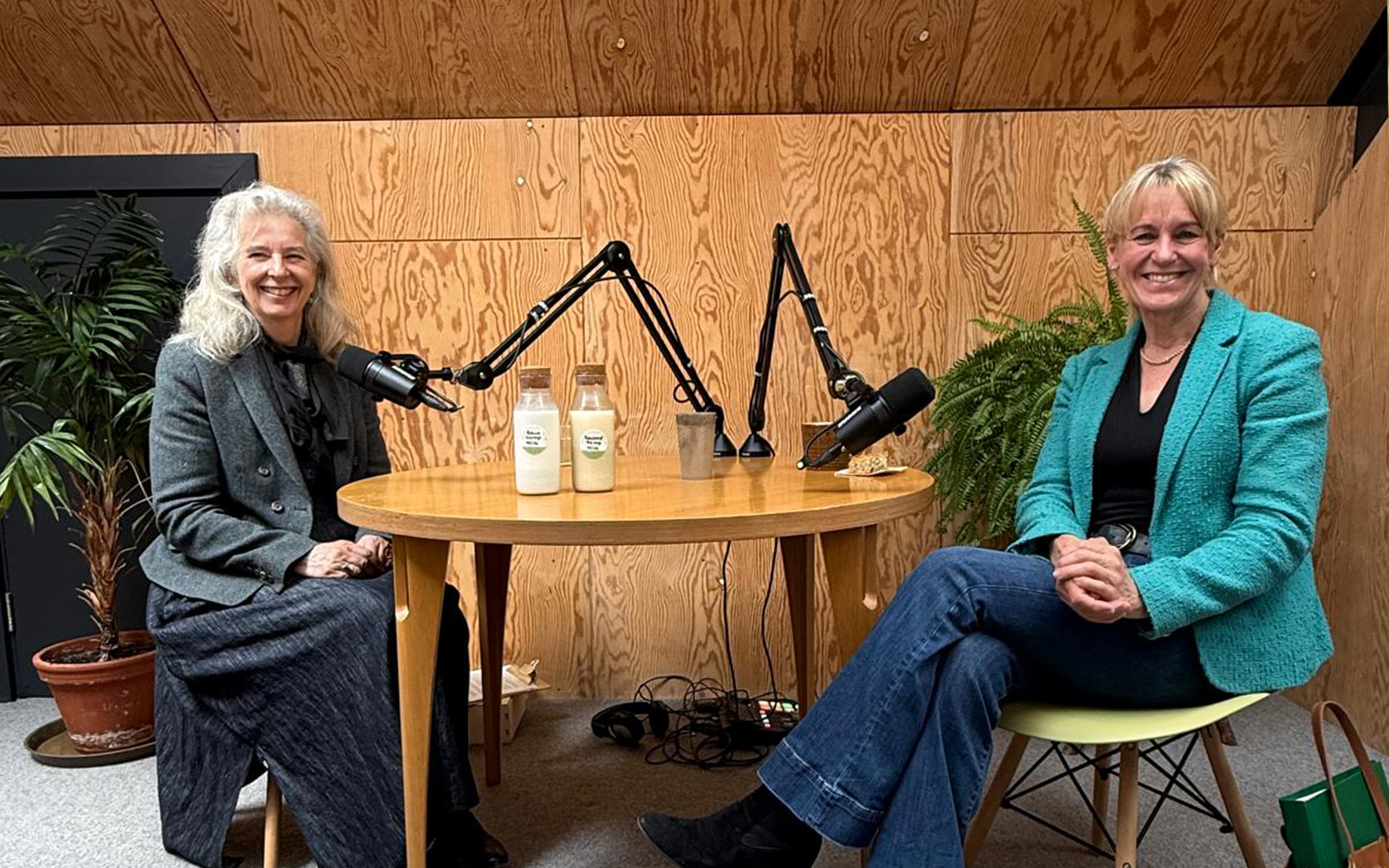
In this episode of The FarmED Podcast, guest host, Lydia Smith from NIAB, talks to Minette Batters, the first woman to be President of the National Farmers Union, in advance of the publication of her autobiography and farming manifesto, Harvest. The wide-ranging conversation covers everything from how to command respect as the first woman President of the NFU and juggling a high-pressure job with motherhood. Minette talks about the challenges of leading the NFU through Brexit and the pandemic, why she was so angered, on behalf of British farmers, by the trade deal with Australia, the difficult debate around glyphosate and difficult interviews with politicians! She also gets a chance to taste hemp milk and talk about the legal complexities of growing this high carbon capture crop in the UK.
Listen wherever you prefer to get you podcasts or watch on FarmED’s YouTube channel.
Lydia: Hello, welcome to the FarmED Podcast. We have Minette Batters here today, and it's difficult to introduce you in a small number of words, but Minette was NFU president from 2018 to 24. Of course, as part of the NFU group, she is a farmer in her own right, tenancy farmer, mixed farm, and recently cross bench peer and contributing to government policy through your recent report. So we'll come back to a few of those things in a minute, but you're so welcome. And my name is Lydia Smith. I'm from the formerly called NIAM, NIAB, based in Cambridge, and I spent a lot of time working with farmers and particularly in the novel crops and non food crop area. So, Minette, this is all about you though.
So, I was so pleased and delighted when you were nominated and actually got the gig at the NFU as president. And I remember saying to some friends and farmers, we were at some event, I'm so pleased that the first woman president has been nominated, but what's the chance that she's going to get it? And they said, you know, I think pretty good. And so we were so pleased when you got it. I mean, this is not about you being a woman because you were there because, you know, you'd set up the whole business of women in beef and had made your thoughts clear. But I don't want to say great, you were the first woman, although I do say that. But what was your experience after you got the gig? Do you think you've had a different experience to the legions of men that went before you.
Minette: Well, Lydia, first of all, it's a great pleasure to be here and do this podcast with you. It was very odd in the beginning being, I mean, don't forget I've been deputy president, but nothing quite prepared me or I think anyone else for the fact that when I was president, it was all about being the first woman. And as a woman, as you well know, what you want to be is the best person to do the job, the last thing you want to be seen as, well, you're different because you're a woman. There were a few difficult conversations. I remember people coming up to me, a couple of people came up in the early days, just before I was elected president, and said, you're never going to command the same respect in the media as a man. And there was quite a bit of that. You're not going to be commanding enough. You're not going to command the respect. And the irony, actually, when I left, and a lot of people said, well, of course, it was much easier for you with the media being a woman. So it's sort of strange, really. I mean, at the end of the day, there is a job to do, and the NFU is a solid policy led organization representing very diverse membership. And, you know, what I wanted to always get across was, I guess, looking at farming through the lens of food and the environment to ensure our voice was heard and campaigning more again so our voice was heard. But yeah, it was all about being a woman and it was all about how I would command the respect. But of course, that strengthens your resolve and makes you more determined.
Lydia: It does, doesn't it? And I think the fact that your voice is a different timbre. I remember when I went to my first farmer based meeting in the very distant past. I'm a little bit older than you. And there was just this roar of the male voices. And I looked around and there was not a single woman there. Oh, and then I finally spotted one in the sort of back of the room. But the fact that your voice is just a little bit up, actually, I think, you know, in the face of the idiots that said you won't get any traction with journalists, you probably did, just by almost some quite physical things like that. And the fact that, you know, you're brightly coloured, you're not wearing the tedious dark green, or actually, I'm wearing dark green, sorry about that, or black.
So, but to just develop that theme a little bit, I recall an interview that you did with one of the many politicians. And obviously, being the leader at NFU, a lot of your time was probably spent with politicians of one kind and another. But, in my view an awful interview that you did with Therese Coffey at the NFU conference. So I was up at the top where the east farmers were, and we were all looking forward to it in a way. She was so rude. She seemed to be so ill prepared. She tried to take the baton off you as being the interviewer. And we were so appalled at how rude she was and how very well prepared you were. I mean, how do you work your way through those sort of experiences with politicians?
Minette: You never know quite what is coming and what has happened. When she arrived, the previous session that Tom Bradshaw was chairing was running slightly over time. So we said to Therese and her team, this session is running slightly over time. We think it'll be five or ten minutes over. Do you want us to pull it early so you can go on in time, or can we finish it? And she and her team said, no, don't worry, it's fine, finish the session and then I'll go on. But she quickly became very angry that the session was late, and so she sort of started off after her speech with a Q&A with me saying, you know, we couldn't run a conference to time. And so, you're trying to have a conversation whereby the vast number of NFU members in the audience gets their chance to ask questions. And so it's my job to hold the minister to account, to get them to answer the questions. And of course, front page of every newspaper, we had the rationing of salads, the weather event in Morocco. We also had a billion less eggs due to the cost of production not being met by the major retailers. So this hadn't come up. And so I put it to her on the back of one question well, there are these situations going on. Surely this is a market failure situation. To which she was categoric, no, it's not a market failure. So then, of course, I had to say, what, billion less eggs, front page of every paper, rationing of salads, appears to be a market failure. And she still defended it. And so she got quite spiky then. And then we were getting very short on time. And actually, it was Tony Bambridge from Norfolk. He was asking a question, and I could see her getting more and more agitated in her seat. So I gesticulated to Tony to hurry up. And then I think the final nail in my coffin really was saying, Tony, you've got to hurry up, or the Secretary of State is going to have to run for the train. To which she harumphed and said, I'm not running for any train. And so it just wasn't the easiest interview. But it's a fine line between holding to account and trying to get people to really buy into the excitement of our sector and see all the opportunities that are available.
But that was a memorable NFU conference.
Lydia: It was. It felt like so long as well when she was doing that, peering into the audience. Oh, I think there was another question over there. And the farmers that were sitting around me, quite a few of them got up and went out. They said, I can't bear it. It's so awful. So it's extraordinary that a politician would do something that felt so counterproductive in terms of their sort of voting public.
Minette: And of course, it's been building frustration. You know, DEFRA has had a new Secretary of State every year. So I think farmers, you know, just feel, gosh, you know, yet another one and where's the plan for farming? And that is what's been the elusive part in all of this no plan for farming. So understandably, everybody is very frustrated, stroke, very angry.
Lydia: And the sort of thought that perhaps because she's a fellow woman that's got to a difficult place, might have had a little bit more sisterhood, there was absolutely no evidence of that, was there?
Minette: None. So, oddly enough, I've read your book. So, some of you will not be aware of this. But it'll be out in the very near future. Minette's written a book called Harvest, and it is due out soon, I think.
Minette: Next week, actually, Lydia, the 28th of May.
Lydia: Fantastic.
Minette: It’s on the shelves, effectively.
Lydia: So, I, because I was interviewing you today, I was given a forward copy of it, and I must say I enjoyed it enormously. So, as it says in the book, as a dyslexic and occasional, unexpected, and unmeant to be truant, how extraordinary to find yourself in a position to be a published author. And that's on top of the report that you've just submitted a little while ago to the government on profitability. Was it a labor of love?
Minette: Everybody’s bizarrely saying to me, and now you've left the NFU, your life must be so much easier and so much quieter. And I'm just like, No. At the NFU, I had a vast team of people all committed to one cause for farmers and growers. And now I have to do everything myself, write everything myself. And so I was doing the review and writing the book at the same time. And I was just working all day, every day, into the night. I would just spend weekends, get everything done on the farm, and then just spend12 hours on my laptop. I look back and I'm not sure how I did it because really a book, you want to have a mind that is free and you know, not restricted and certainly not pressurised. And I felt majorly pressurised all of the time. So it was, yeah, you didn't want to see my house while I was doing that because I just felt like I lived on a laptop and got it done. And of course, in many ways, the manifesto part of the book actually was very much almost what I was writing in the review. So the two did come together a bit then as a rallying cry to save the family farm and have a policy, a roadmap in place for the future of farming.
Lydia: It’s been a really difficult period when you've been at the helm. How could you possibly have imagined when you took it on that we were going to have Brexit, COVID, you know all sorts of changes. I don't even know what question to ask you here. I suppose, how have you managed to do … when I read the book and I looked at all the things that you were doing and the hours you were putting in and the distances that you were traveling, I mean, how on earth did you do it?
Minette: Yeah, Lydia, I asked that myself a bit and I sort of don't know. I mean, COVID almost came at a perfect moment. For me and the kids, really. You know, their GCSEs were cancelled, they were at home. That first week of, or first two weeks of lockdown, was a nightmare. I was wondering how were they ever going to do an exam again? What was the future of their education going to be? I was leading a membership organisation. Our broadband was so bad, I couldn't even speak to the team that had been in Stoneleigh that were now working from home. So there was a real feeling of this is disaster. And then it settled into a rhythm, really. We got the broadband going, we got the campaign on the food standards going, and everything started to work. And of course, I was at home with the kids really pretty much for two years on and off. I mean, I did the occasional visit to London. I can remember going to London in lockdown to meet Liz Truss when everything was deserted. I was sort of the only one on the train wearing a mask - such a surreal time, but it gave me that time with the children at a critical time. And then my mother was brilliant doing the school run. We just juggled things and fitted things in. But of course, you could never talk about it or own up to it. And I think this is a challenge for women. You know, we're juggling multiple balls. And I've tried to cover that in the book to empower other people because I think that feeling of guilt as a working mother never goes away. And I really wanted to talk about that openly to give others confidence I think. I don't think women are as confident, I think we question ourselves and I think we overthink situations. We don't ask for help because we're worried that'll be seen as a sign of weakness so we battle on and I wanted to really air that in an open way in the book to, as I say, give other people confidence.
Lydia: Yeah I think I think you did that beautifully. I have to say it was a real page turner. I'm not usually an autobiography fan. But I thought, well, I'm going to enjoy this one because it's all about farming and I've lived through all of the same sort of difficult times that you have and that you're writing about. But there's a lot of policy in there as well. I think I would recommend getting hold of a copy. I think looking at the politics and the politicians behind the policy that you were trying to get through is really, really interesting. For me. I found it anyhow.
Minette: I think some bits people will say are a dry read, but again, what I wanted to do, I think a lot of people have little understanding of how government works, how Whitehall operates, and the fact that it's such a long game to move the dial a tiny bit. And, you know, the relationships, you know, I know when I first got into the NFU, you felt like, you know, thumping the table a robust conversation and everything was resolved. And it's absolutely not. I mean, the real challenge is to sort of stay at the table and to have a solution that others start to think, Wow, yeah, okay, let's think more about that. But I wanted to really try and bring to life the nature of Whitehall, the challenges of operating in Parliament. You know, I find it in the Lords, you know, it moves very, very slowly, our democracy.
15:57
Minette: And so. My Editor kept saying, keep coming back to the farm, keep coming back to the personal story. So it is fully integrated. And I'm sure I wanted to write a book about trade policy. That was, for me, what the book was going to be about. And my agent said, look, Minette, you're passionate about trade policy. Most people are not. So he was the one that persuaded me to widen it out. And so it became a very different book to, I guess, my initial thought process.
Lydia: And I think that's why it was so readable because there's this all this stuff on financial policy, which I personally don't understand very well, and definitely not the import export side of things. I wish I could have had you there when I was trying to import some seed recently. You probably would have been very helpful. I fell into multiple man traps. But I think, sorry, flipping back to the personal side, your family, and you're right, you know, we don't like to ask for help, do we? Especially the slightly older generations. But my daughter said to me when I said to her one day, you know, would you have preferred I was at home a bit more? And she said, well, you were home, you know, a lot, but you were very interesting to talk to and you were doing interesting things. And I would never have wanted you to do anything different. And I think in the book, you say you had a similar conversation with your children.
17:35
Minette: Yeah, throughout. I mean We continued to discuss it, and they, children are incredibly resilient, and they were always, no, Mum, it's good. And the horror, and I write about it in the book of when I turned up to pick them up from school in my waterproof, sort of splattered with a bit of cow muck, and, you know, the sort of stay in the car, don't come out, you know. So I think they enjoyed the diversity of me on the farm. And, you know, I was always there at weekends. I would always try and take them to school if I could, pick them up from school when I could, get to matches. And the golden rule was I always said to them, if ever you need me, wherever I am in the country, I will get there. And, you know, there was one occasion when, you know, my son did need me and I cancelled the meeting that I was driving to and I turned around and I drove five hours back. And it was the only time it happened, but I could just tell I needed to get there. And I think that's what children want. They want to know that if they need you, and to a certain extent, it's still the same now, you know, you're like the walls of a swimming pool, the swimming pool might get bigger, but the walls are still there, and you're still there to support them. But I still think the guilt doesn't go away. At the time, I questioned myself whether it was right. And your obligation, you know, the NFU was going through a hugely turbulent time then. Farmers, our members going through, you know, they want a hundred percent of you. So 100 of you. So you're constantly weighing that up. But I think if you're the first at anything, you are, or I was determined that I was not going to be the worst. You know, I wanted just to be seen that I did a good job, that there wasn't a difference between men and women. You know, both did a good job. That was what I wanted.
Lydia: It looked great from the outside. You know, I have a lot of friends and colleagues within NFU, but I'm not personally, a farmer, although I work a lot with farmers, and yeah, it was very impressive. Your reach, so I think previous NFU presidents have been great, and everyone has their own flavor and strategy. But I think the fact that you looked out beyond farming as well and reached people that had never really known what the NFU was about ,National Farmers Union, what does that mean? Is it union? Is it do they lobby? I think that's why your time has been very, very important. And I think the perception, and now some of the things that you're doing, and we'll come on to that perhaps in a moment, to reach out and understand what people understand about farming or what they don't understand more to the point.
I listened to your Start the Week the other day. I can't remember when it was. Was it yesterday?
Minette: Monday.
Lydia: Oh, right. And I was thinking that the questions were very much for a non farm audience, you know, having to define what things were and I think that you're right, a lot of people don't understand farming and we can do a lot better. But I think we're already on the road. And I think some of the things that you've been doing and many others in this space, getting back to the connection between food and farming, is happening.
21:00
Lydia: What more do you think we can do? And interestingly, we're going to go into a Leaders in the Field event where we're talking about communication after we finish today. But what more can we do and what different?
Minette: So, I think despite all the challenges that are going on and all the frustration at you know political situations, changes, lack of certainty, lack of clarity on the road that farming is on, I do think this is an incredibly exciting time. You know, you look at the research now on health and food, soil, gut microbiome. I think we are going to see in the next decade a real step change in our approach to food and what we eat, the value of our soils. I talk about in the review that they should be national, soil is a national asset. It has to be treated as such. And nature the same. And getting back to whole foods, cooking from scratch, I think there is a real..I guess the public now consumes I think a lot of people looking at food, looking at farming in a very different way. And of course, access to the countryside and access to nature. So I talk about closing the gap between rural and urban areas. And I think we are going to do that. I mean, for government, for Whitehall, it is set up as a product of the EU. You know, Emma Reynolds was doing an interview this morning. Emma Reynolds is the Secretary of State for the Environment. You've got all the conversations going on today about capping of food prices. You know, we really have to make sure that food has a seat at the Cabinet table. And I've always said and absolutely believe environment and food are two sides of that same coin, and we must treat them as such.
22:58
Hence, my proposals on SoilShot to really lead that transformation and that funding model that I believe will keep the family farm structure. So we've got to play this carefully, I think, and I very much focus on looking at the opportunities and the excitement because that is what opens doors. And there's a great guy called Will Lockhart who's heading up the nature markets work in DEFRA, and he and I had a very exciting conversation the other day where I really felt, gosh, you get it. You know, you get it on the international stage, you get the opportunity here, and I'm really hopeful that DEFRA can be the catalyst for change. DEFRA is seen as a backwater in Whitehall. And to me, it's at the forefront of shaping the rural economy as an equivalent with the City of London. So let's be upbeat, let's be positive. And here we are today in the sort of epicentre, really, of where all of that can happen.
Lydia: Absolutely. Now, you talked about diversity on farm. And the soil and the interaction between cropping and what you do and how you maintain that health. I'm going to spring something on you now. It's not horrible, I assure you. So, I think I mentioned at the beginning that I've got very involved with alternative, underutilised, and novel crops. So, it might be a completely new one or it might be one that's used differently to the way that we do it now. So, I have here. I feel quite bad actually putting this in front of a livestock farmer because I'm going to give you some milk which is not animal based.
Minette: Okay.
Lydia: And I want to see what you think of it. So, there's two actually. I'm probably going to just get up, it's probably the way of doing it rather than crashing into all the microphones. Here's a simple one.
Minette: What’s it made from?
Lydia: It's made from plant. Okay. I was going to say, I wonder if you can guess what it could possibly be? I had a quick retaste this morning and I think you're going to really struggle. Sample 2 is the same crop plant but processed slightly differently.
Minette: It’s very, I know what that taste is but I can't put the name to it. It's a distinctive.
Lydia: Yes, the second I tell you, you're going to say, Of course it is. Try that one. Tastes like a salad crop, but...
Minette Sorry, I made a mess there. And that's a nutty.
Yes. So it's the same, but roasted.
Lydia: I’m going to let you... So here we go. This is hemp milk.
Mientte: My goodness.
Lydia: That’s roasted. Unroasted hemp hemp. And that one's pure. So it was made yesterday with our special new hemp milk making kit.
Minette: How fascinating.
Lydia: Now. The reason I bring this in is because I think there are so many interesting crops that we can introduce into the UK farmed environment, you know, to help with some of those issues that we've struggled with. And this one. I've been really holding the baton for it because I think it's got so many outcomes in the food area. This is from the seed. I'm sure you know what hemp seed looks like, but here's some hemp seed made from a cup made from hemp, interestingly.
Minette: Wow.
Lydia: So, in your experience as a food purveyor, because another one of the strings to your bow, of course. Is that you've produced food for events and even weddings, I believe.
Minette: Yes, I ran a big catering business for 25 years on the farm.
Lydia: How do we move that from the underutilised crop space? How do we take it to the marketplace? I mean, you have been very much a businesswoman, and it's very tricky, isn't it? Because there's so many ifs and buts along the way.
Minette: There is. But look, this is a classic example of the innovation now that we are facing into, the opportunities. The fact that hemp is so diverse in what you can achieve out of it. Um dietary needs of people, which is changing. I think it's so exciting, but getting things to market. And we're at a crucial stage probably now with the EU reset and precision breeding, if we're going to sign up to EU rules, which SPS, let's face it, is about biosecurity and health rules, food safety, what are the opportunities going to be? And I think, and I hope, the Irish have the presidency. I think Europe is on a journey. You know. We've got to be the pioneers of change, and we cannot be waiting, you know, 10 years for these things to get to market. You know, I look at the opportunities with the purple tomato at the John Innes Center. You know, these crops potentially are going to create enormous game changing. Potentially, enormous gamechanging potentially changes for health you know if we look at the link with fibre and dementia and Alzheimer's now so we're on the cusp of all of that and it's about how you fast track through you know you look at pharmaceuticals they seem to have been able you know big pharma has been able to fast track food has gone at snail's pace and so. That needs to change but look I I hope precision breeding paves the way for Europe to be in a different place. And for us to really hang on. You know, we've always been really good at innovating. We have, you know, NIAB being one example, but the best research stations of anywhere in the world, really. And that applied science, that near market research, that huge opportunity now. We have to grasp it.
Lydia: We do. There's just such a lot of steps on the way isn't there? I mean, hemp's quite an interesting.
Minette: Hemp’s had a lot of challenges.
Lydia: It’s got such a lot of challenges. There's that complicated, not quite perfect interaction between the Home Office and DEFRA, let's say, where farmers that are growing industrial hemp, which contains no pharmaceuticals, but needs a complicated, expensive license. And that's a very big put off for farmers.
Minette: Massive.
Lydia: This year I've spent hours. Farmers. This year I've spent hours and hours helping the farmers that I work with get through their license system, which was supposed to be a lot easier but has got some serious challenges still.
Minette: But Lydia. The catalyst for change here is that farming has to be a frontier industry. So this is a problem across 20 departments. This is a problem for land use and production. And that is all because agriculture is not perceived to be a frontier industry. So, you know, even if we look at planning, we find the process is in DEFRA and the arm's length bodies.
30:34
And yet planning sits in HMCLG, and the two don't work together. Hemp, the licensing responsibility sits in the Home Office, production sits in DEFRA. On and on you go. But if agriculture and horticulture can be set as a frontier industry, the seat at the cabinet table which I believe Emma Reynolds should be the Secretary of State for Food and the Environment. Then you start to pave the way for these things to happen because that is about our health, that is about economic growth and wealth creation. And at the moment, as I say DEFRA is a backwater. I've made it very clear that DEFRA needs to become an economic department and it needs to be the driver of food innovation because who else is going to do it? And I worry that too many of the conversations around food and health at the moment are in, you know, fats, sugars, reformulation. Tax. The excitement of food and the pleasure of food and the ability of a food culture to really transform health is almost getting lost in those sort of nanny state conversations and that is a travesty. So look, let's, let's, really work together, I think, to reposition DEFRA into what it needs to be. For the modern world?
Lydia: Yeah, I feel for the Defra people, you know.
32:01
I work with them day on day and I'm sure you do too, even more so, but the government way is to move people around and they just get to know all the people that are their stakeholders, get to know them and then they seem to shift sideways into another place. But I think you mentioned a bit in your book as well, don't you. That all of the sort of siloization of the different departments so they don't talk to each other properly. Because, you know, going back to hemp, it's quite a handy example. DEFRA thinks that it's all sorted now. We've made the license much easier and for longer and you can have it on your whole farm. And so when I've come back to contact DEFRA and say it's not working.
32:46
Because of this, they say, I don't understand. We thought it was all sorted. And again, so the Department of Trade and Industry has it changed its name?
Minette: No, that is right, DBT
Lydia: And DesNes, which was previously something else. That shift and sift of the talent, if you like, makes it even more difficult.
Minette: It does, but if you set the agenda, so we've set the agenda now on defence, some of the massive funding constraints, but it's pretty clear that the future is going to be investment in defence. Health, again, absolutely at the forefront of political thinking. Energy, real recognition that actually Europe should never have handed over so much power in the energy market to Russia. Food production has got to have the same approach. And that's where you start to join up the ambition across departments, because you can see the opportunity to keep money within a UK economy and it's in the nation's best interest. But I think for DEFRA at the moment, particularly challenging because EU reset, most of the legislation sits in DEFRA, you know, so there will be hundreds of people who will have been drafted in just to deal with EU reset.
34:09
I mean, I worked with five civil servants on my review, and it transformed my view of the civil service actually, because what I realised is, you know, when you're given a group of people and you clearly task them with the direction of travel, these are bright people, technically focused, they can do the job. But I think DEFRA has had to respond to a multitude of different leaders, a multitude of different challenges, and now hopefully is the chance for it to reset. You know, the farming roadmap, they respond to my review. I really hope this is paving the way for a different way forward that is far more partnership, with the likes of NIAB on the technical side, and really ambitious to be growing, creating, selling not just in the field Landscape, but also the opportunities.
34:57
You know, you look at this cup made from hemp, you know, we face plastics tax, you know, we should be pioneering the opportunities around replacing plastic with biodegradable products, which agriculture is the circular economy.
Lydia: For goodness sake, yes. I mean, I'm running a project called the Center for High Carbon Capture Cropping. So there's a huge Push in government and across departments actually to reduce our carbon footprint. But it's like, oh, that farming stuff's going on over there and they seem to forget it. Hemp again, it goes into building products. We absolutely have to decarbonise building, textiles, fashion, automobiles. And the answer to some of those questions are in farming, I think.
Minette: Without any shadow of doubt. And what we can grow which is becoming more and more capable rather than taking these finite resources out of the earth, the ability to grow them, invest in our soils, it's a win-win. The same as removing the waste nutrients, you know the water bill is going to be a massive bill in this Parliament.
36:17
You know we should be absolutely focusing on how we strip out waste nutrients like phosphate from nitrates. We know we can dry them. We know we can pelletise them. If you scale that up, you really start to transform things. And agriculture, you can't do it without farmers. So they are. I look forward to DEFRA being the lead government department. That's what I look forward to.
Lydia: Should it go back to being a ministry? I remember when I first started, it was the Ministry of Agriculture, Fisheries and Food.
Minette: It was, and of course, it was tarnished by the many things that happened at the latter end of those stages, I just think it's got to be about environment and food, and fibres and fuel. It is the circular economy. It doesn't matter whether you're looking at wool for sustainable rope, whether you're looking at hemp and the bioeconomy to be making much more of our packaging.
37:16
We can do so much of it. And the innovations around food, hemp milk, who would have thought?
Lydia: Yeah, I think it's quite tasty. It's the first step, we probably need to blend it a little bit more with one or two other things, perhaps sunflower.
Minette: It’s very fresh, and very refreshing.
Lydia: I think it'll work with coffee. Anyway, moving on from hemp, I feel like I should put them aside, a couple of thorny questions have sprung up in farming and I guess it's less happening on your farm but your reach is much much further than livestock, glyphosate.
37:55
So I remember back in the days when we were all gearing up for voting for or against staying in the EU. And it was very split across farmers, wasn't it? I don't think that you could say that farmers went in any particular way. There was definitely remains, leaves, and absolutely don't know. But one of the things I remember was farmers saying, EU's going to ban glyphosate, we want out. And the other side of that coin is those farmers that are interested in the soil health considerations that you have described so well in your report on profitability. How do you deal with coming out of a cover crop and out of a ley without that particular tool in the box? It's tricky, isn't it?
Minette: It’s really tricky. I mean, I think the debate is more and more centering around pre harvest glyphosate. It's very hard to see. How you imagine a world, impossible whereby, you know. I mean, I've just done exactly the same with our spring barley. We had cattle grazing a cover crop. We had to spray that crop off to clean up the ground. I can't imagine there would have been any other way of doing it other than really marginalising the herbal ley that went in actually to that one but in another field we put spring barley in so both the herbal ley and spring barley were coming out of a cover crop and I think it's a vital tool in that box and a lot of this.
39:40
And I write about it in the book is about how decisions are made whether they are made on a European basis of a hazard based approach or whether they are made in in a way that Australia, as an example, makes its decisions which is depoliticised is focused on a science and evidence based approach by assessing risk. And if you politicise it, it becomes very, very dangerous because these things get played out in the public domain and you are ultimately looking at a subjective approach rather than an objective approach. And I think glyphosate is one where we've got to remain solidly objective in what we're trying to achieve.
40:24
I think the pre harvest one is contentious amongst farmers. There is real difference of opinion. If you're in Scotland of course, you know, it's very, very difficult because you've got such a short summer and so you're looking at tiny windows. You know, will plant breeding, precision breeding make a difference? Most definitely yes, but we have to build bridges and I think it's about building the right bridges to get to where we want to get to. Otherwise, we just offshore our production and we import products that is causing far more environmental damage. That's the bigger danger.
41:05
Lydia: So that almost gives me a bit of a segue into another thing that you mentioned in your book. And I have to say, I completely don't understand the complexity of import-export but you were clearly incandescent about the structure of the agreement that we made with Australia. So I'm not even going to try and describe it because I'll probably get it wrong. But in your view, as I understand it, you felt that we didn't get a good deal for the UK and for the potential impact that will have on UK farmers. Would you like to sort of expand that a little bit?
Mineette: You’re right. Trade policy is pretty dry, complex stuff. But in simple and straight terms, you have what are known as safeguard measures, which translate into tariffs. And other measures that can be put in place that mean that you can manage trade flows.
42:02
Most countries in the world have them and operate them so they don't damage their own production. Australia doesn't. Australia and New Zealand are small populations in very, very large countries, and so they have a liberalised trade policy. We are a very densely populated island nation, nearly 70 million people. We obviously produce a lot of lamb. The second largest producer of sheep meat next to New Zealand. And so these trade deals were always going to happen, and trade is a good thing, but you have to put in safeguards. And what we have never done with trade policy is to set out our core standards so that we go to the negotiating table like other countries with this is our red line and we will not cross it. We've gone there with open book trade policy that has been focused on SPS effectively food safety. Well, every country in the world is focused on food safety.
43:04
So, with Australia, it became very political. I write about the fact that you know Australia felt betrayed when we joined the EU, and Alexander Downer saying to me several years previous, you know, we are coming back to get you. And so, when Scott Morrison, the Australian Prime Minister, Boris Johnson sat down. Boris Johnson, of course, put a date in the diary said, we're gonna shake hands at Cardiff's Bay. And so Scott Morrison was able to say, Well, we're not gonna shake hands unless you take away all the safeguards and we have a fully liberalised deal. And so that's what happened. We took back control, supposedly, in Brexit, but we gave it all away that one night in Downing Street at the dinner when the final, the final safeguard measure was to ensure that Australia was balancing its own carcass. I write about that in the book. And explain it. But basically what we wanted was them not just to be sending the strip-loins that they were sending the bone in, the frozen, balancing their own carcass, because otherwise if we brought just strip-loins in we were going to be unbalancing our carcass balance and ultimately Australia would displace Irish.
44:21
Irish would displace British and this also leads on into the out of home market whereby we don't have any regulation, we don't have any voluntary codes on country of origin labelling. So, your bars, your hotels, restaurants could be selling Australian or New Zealand and saying it's British because there is nothing to tell them. Yeah, nothing to tell them that they shouldn't be. So, this really matters on trade, and there are real dangers that it will undermine our farmers and that it will lower price. Now, livestock sector, small farms, we start lowering price, we're in a lot of trouble.
45:00
Lydia: Yeah, gosh, I hadn't. Gosh, I hadn't fully realized the repercussions. And also, you said that this is the first. It's quite likely that we'll carry on and look at deals of one kind or another with New Zealand and Canada. And then, having set a bit of a precedent, we may also have rather tied our hand behind our back in terms of what we can achieve with them.
Mineette: Most definitely. I mean, we've done a deal with India on dairy. India will get SPS compliant relatively quickly. SPS is not about food value values. Food values are about environmental protection and animal welfare. And don't forget, we've raised the bar considerably on those since 2020, whereby we've introduced a higher standard of primary legislation. So we've raised the bar for our farmers, but we continue to want to suck in imports that would be illegal to produce here. That's what's so wrong.
Lydia: So wrong. I’ve heard this a lot from pig farmers who have been bearing the brunt of it, haven't they with very very high standard which I'm absolutely for. I spent several years as a vegetarian and I thought no we're really good now but it seems so unfair that we can then just buy stuff in that they don't have to conform to those kind of standards.
46:19
Minette: Absolutely.
Lydia: We’re gonna run out of time I feel like I've only been talking to you for minutes. So I'm gonna I suppose return to the woman theme just a little bit. You've just been such a strong voice for farmers and now continuing to be, even now that you're not at the helm at the NFU. But you're in a strong position because you're cross-bench. And I think that you've sort of broken the ceiling a little bit. And I think that maybe some others, some other women in particular, that have very strong voices, they will take you as a bit of an example, and I think that's something to be proud of. I can think of some young women coming up in the NFU. Gosh, should I mention a name? Heather Oldfield. Very strong, coming through, Lincolnshire Farmer. I think she's potentially got some future there at the NFU.
47:25
But there's others coming, isn't there?
Minette: There are a lot, and honestly, the thing that mattered most of all to me when I led the NFU was leaving what I call the flight path really clear for women of the future, like Heather, to come forwards because I was so conscious. And I'd look, I made many mistakes, we all do. But if I damaged the role, I hated the thought of people at the end saying, God, don't you remember that time when we had a woman? We can't have another one of those. And so, for the likes of Heather and everybody else, many more women getting involved in the NFU, it was so important that, as I say, the runway was clear, because what you want is a mix. You know, the men have helped me equally as much as women, and a mix of people in a meeting is always, I think, a better meeting. So for the NFU, we want more women getting involved, and that's a really good thing, and I really hope in the not too distant future, we will have another woman leading the NFU. It's great that Robin Mundt is there as the vice president.
48:36
And as I say, let's have a mix, 'cause that's a really good thing.
Lydia: It almost makes me think of Black Lives Matter. You know, black lives don't only matter, they matter as well. You know, women have a voice as well.
Minette: Absolutely.
Lydia: And you're right, that mixed conversation is stronger and has more depth and breadth. So my last little question, You turned down the CBE twice? What were you thinking?
Minette: That was so hard at the time. I'll tell you why it was hard. It was really hard because my family so desperately deserved it. And for me, I felt very strongly on both occasions, weighing it up, I'd have been compromised.
49:22
But more importantly, the NFU would have been compromised. And I could read the headlines in the farming press, you know, bought off by the government. And I just took the decision. That that risk was too big a risk. And I felt I had to leave with integrity intact, knowing I'd done all I could. But the hard thing is that, you know, your family deserve it. My kids desperately deserved it. My mother deserved it. They sacrificed a lot for me to do what I did. But I didn't tell them until afterwards. And I mean, they're fine about it.
50:01
I still stand by it was the right thing to do. I wrote sort of long letters outlining and explaining and had a long telephone call the second time around explaining. And I actually told Steve Reid and explained why, because the last thing you wanted to appear is a snub. And it absolutely wasn't. But it was for the right reasons. And I think in my position you know you've got to do the right thing position, you've got to do the right thing for the people that you are there to lead and that was the decision.
Lydia: So what next? You've got your maiden speech behind you. Any further books?
Minette: I think that might be the last book. Who knows, I'm enjoying back being farming a lot more. I'm doing a book tour. I'm speaking at the Hay Festival and really looking forward to, I guess, talking positively about what farming can deliver. But also, I talk in the book at length about, you know, that, for me, that one moment, in that one day where I made a conscious decision that I was going to change my life. And for women and for men, for young people, there are many stories in there that I hope will empower people to think, actually, do you know what? I can change what I'm doing and I can be what I want to be. Because I speak to a lot of people who feel at a crossroads, I think right now it's quite gloomy and I hope it empowers people. That's what I hope.
Lydia: I absolutely believe that it will. Thank you so much for spending this time with me. I've enjoyed it enormously. And for those of you that have seen this podcast, please follow us and even better, write a review because we've only just started doing these podcasts in the last six to eight months and so it would be really great if a few people out there hear what we've had to say today and thank you again Minette.
Minette: Thanks much, Lydia.
Recent news items