

Wheat Harvest at FarmED and Why we Need to Farm Differently
Jul 22, 2026
By Ian Wilkson, FarmED Co-Founder and Director.
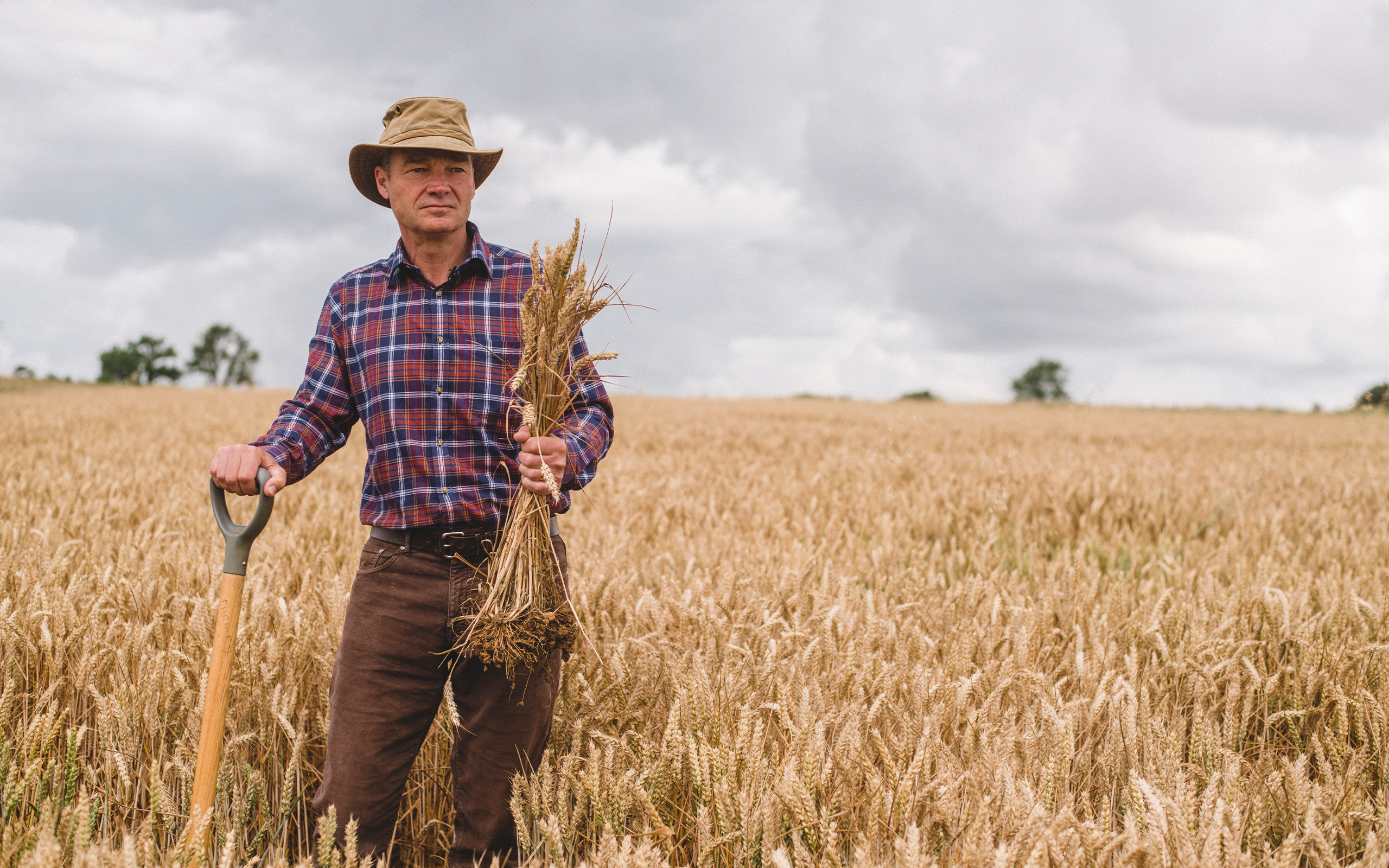
It’s the time of year to harvest wheat, a staple food in Britain which accounts for the largest acreage of crops. Most is sown in the autumn and harvested in July and August, but we’re combining three weeks earlier this year because of climate change and we’re entering a new era of wheat growing.
The Green Revolution of the 1950 - 1960s has increased yields from around a tonne an acre to three tonnes, driven by nitrogen fertiliser, which is made from oil and gas, and results in carbon emissions. With yield going up, plant breeders dwarfed the plant to a shorter, stronger stem. Had they not done that, the crop would grow leafy and stemmy with the fertiliser and fall over in the wind. On the one hand, what’s been done is amazing. But we’ve reached a point now where yields have plateaued and in four out of the last five years, average yields have actually dropped. The main reasons are declining soil health and climate change. We’ve had a series of wet winters and dry summers and we’ve also been extracting more and more from the soils resulting in a loss of organic matter. According to Cranfield University, many arable soils have lost 40-60% of their organic carbon (see reference here). By farming and tilling the land we've released the carbon from the soil as carbon dioxide and that's contributed to climate change.
That’s why looking critically at the wheat crop is really important for the future.
Here at FarmED we’re discussing the enormous success of high yields and cheap food, which has led to degradation of soils. We’re discussing how climate change is going to result in food inequality and population shifts and what we can do about it. Currently, fifty per cent of what’s grown is used to feed animals, ten percent of the crop makes biofuel and forty percent is used to make bread, cakes and biscuits for us to eat.
In the UK, two thirds of the country is grassland so that’s where our meat and dairy production sources feed for ruminant livestock. We don’t make inorganic nitrogen fertiliser in the UK, it comes through the Straits of Hormuz so it’s not sustainable and if we want to meet net zero we will need to sequester more carbon into the soil and slow the release of CO2, nitrous oxide and methane. Decarbonisation in transport and energy is happening at pace and at scale with wind turbines and electric cars and the like, so agriculture must not be left behind. We have to farm differently.
At FarmED we’re harvesting heritage wheat and conventional wheat on the control plot and we’re also harvesting rye, a crop we can grow very easily. It's a scavenging plant, so it doesn't need very much fertiliser and it can be used to make bread.
Growers in our district are expecting a loss of between £50 and £100 an acre this year - the farmers aren't making any money out of a loaf of white bread sold for 80p in a supermarket. But if the bread is made locally, you’re paying the miller (for us that’s Matthew’s Mill or Henry Astor at Bruen Farms), you’re paying the local bakers, the money stays local and the bread can be healthier - better for us and better for the planet.
Recent news items