

The FarmED Podcast: Katie Ward from Microbz
Jul 27, 2026
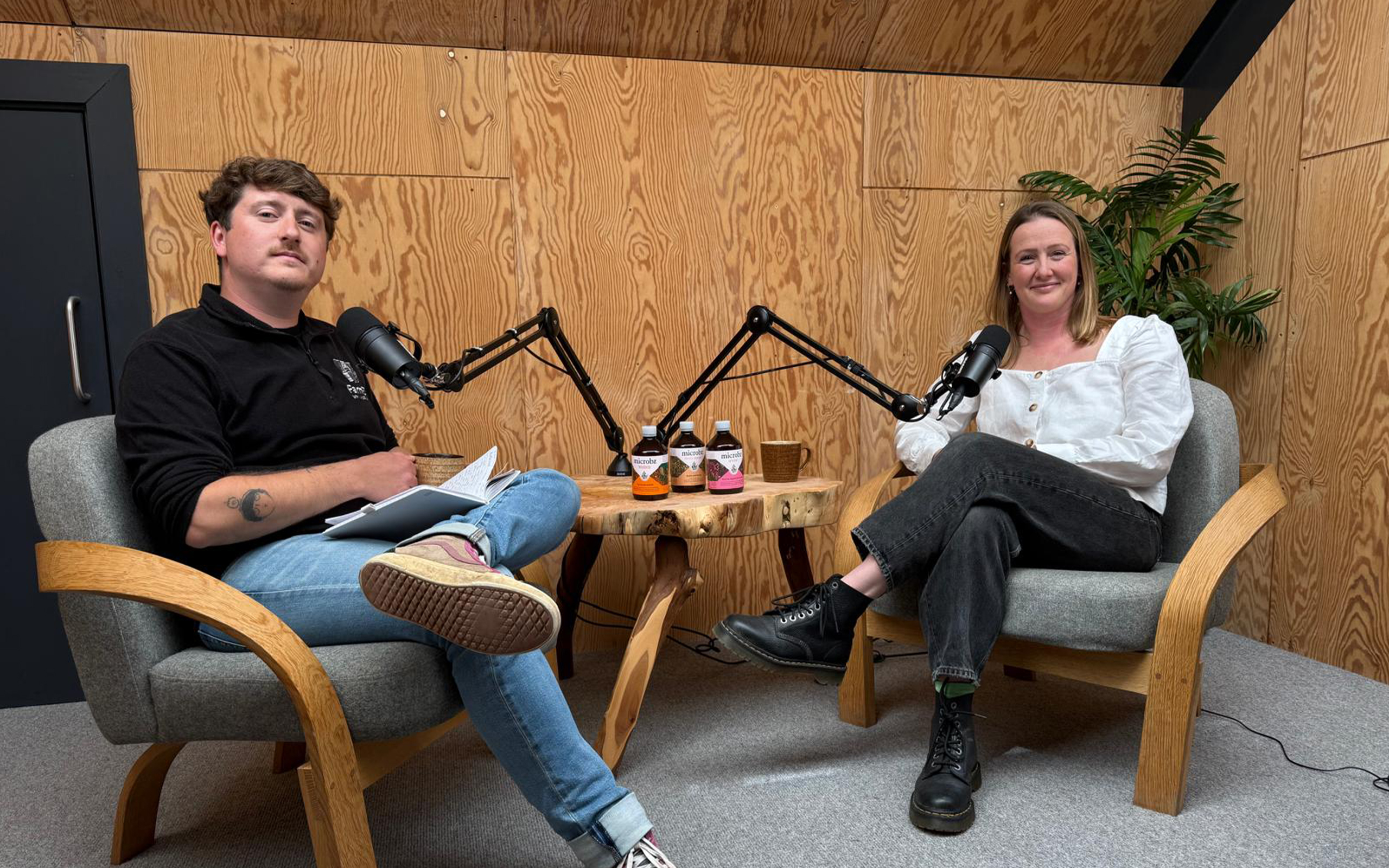
This month Alex is talking to Katie Ward, MD of Microbz, a unique family business that’s on a mission to encourage everyone to reconnect with the power of microbes by embracing a probiotic life, not just using them in our bodies but also for our pets, in our homes and gardens, and on our farms.
It all began when Katie’s dad, Jeff, returned from a trip to Europe and Australia where he’d seen a new technology that excited him: Microbial Balancing Technology. He saw a solution for the planet and started brewing jars in his kitchen.
Katie talks to Alex about why microbes are the ‘foundations of health’, the amazing results from using Microbz probiotics on fields of oats where the yield increased by 50% and why we all need to ‘move away from a 1980s’ culture of using products in our home to kill 99.9% of microbes. She also explains what ‘swing voter’ microbes are. ‘There are good microbes and there are bad microbes, but there's only about 10% of microbes that are good and 10% of microbes that are bad. The rest we call swing voters. So in an ecosystem that is more pathogenic, your swing voters go to that side. So if you have food poisoning, you get it very quickly because of the swing voters. If you create an environment that has more beneficial microbes, the swing voters kind of go to that side and create an ecosystem which is balanced.’
Do you feel inspired to improve your gut health? Use code FarmEd15 for 15% off you order!
You can also catch Katie at their event The Microbial Revolution in September.
Full Transcript
Alex: Robert Morse once said, Microbes are nature's janitors working to clean up a poorly kept culturing medium. Welcome to The FarmED Podcast. My name is Alex Dye and I will be your farm guide today. And today I am joined by someone to speak about the wonderful world of microbes. It is the MD of microbz. It's Katie Ward. Hello.
Katie: Hello. Thank you so much for having me.
Alex: You well today?
Katie: Very well today. Yeah, I've had my microbes. I'm feeling good.
Alex: Very good. Plug in early. That's nice. So let's start really, really broad then. Let's assume that someone has just switched on this podcast and we've said the word microbes a couple of times. What is, what are microbes?
Katie: At the most basic level, a microbe is a microscopic organism. So it's a, it's a very, very small organism that you can't see with the naked eye. But that really doesn't allow for the kind of broad diversity of different kinds of microbes. So I like to think that we live in a microbial world. And part of my job is about bringing to light this fascinating and incredible and life-giving world of microbes. So they existed way before us. You could say that microbes built this planet. So kind of the first forms of life on Earth. And, you know, there's that age-old thing where there's more microbes in a teaspoon of soil than there are people on the planet.
Alex: Teaspoon of soil?
Katie: Yes.
Alex: Wow. More microbes in a teaspoon of soil than there are people on the planet.
Katie: So even within this small amount of soil, there's this huge amount of diverse life. We know more about the galaxy than we know about microbes. So there's this kind of new frontier of knowledge where we've still got a lot left to learn about what they do for us. But essentially, we're moving away from this idea that we have to kill 99.9% of all bacteria or microbes towards this idea that microbes really are part of the foundation of health in many different environments.
Alex: So we talk a lot about food and farming and the environment on this podcast. Why would people who are interested in food farming and the environment be interested in microbes at all?
Katie: Well, microbes kind of created the natural world that we see, so coming from soil into all plants. So the way that I see it, every living system contains diverse microbes doing important jobs. And when we're talking about the basis of food and farming, which is soil, it needs a few things in order to be really healthy. It needs minerals, it needs organic matter, and it needs microbes. So those three things together really support plants to thrive, support life to thrive, to support, ecosystems to thrive.
Alex: Are you implying then that in some cases, some of our soils are deficient in some of these microbes?
Katie: Yes, I would say. I'm actually very surprised. So we've only just started the last 18 months to work in farming, working with about 20 farmers and kind of supporting people more and more, farmers more and more, to use microbes. And what I keep seeing and very surprised about is the level of compaction and the level of issues with the soils that we are seeing. And a lot of that can be helped with biology.
Alex: And how do these microbes improve? Say, you mentioned compaction, how do microbes influence that?
04:24
Katie: So, one of the first things you need to do is get them in the right place. So when you either aerate or subsoil, which I know is controversial depending on how much you want to disrupt the soil, we can adapt aerators and subsoilers to put nozzles on them that spray microbes at different levels of land. And what we've seen is three, six, twelve months after that spraying, the microbes create much more space within the soil so they create much more air pockets. They support the creation of a different structure, which does a few things. It helps that compaction ease, which improves the root structure. And the two farms that we've done most of work on with this, it really also helps the water retention. So the water can seep down to a much deeper level, which is really encouraging.
Alex: So, would you say then that you would need the skeleton I suppose, of a functioning soil system in order for microbes to really make a benefit or could microbes come into the most desolate soils and start to really turn things around say starting from 50 or starting from zero would that would do you need to have a certain starting point. Or are they able to deal with anything?
Katie: That's such a good question.
Alex: I didn't prepare you for that.
Katie: I would say from the experience that we've had, which is very new, we've been able on one field, to increase the yield on one half of the field by 50%. Now, my belief in that field is that there was already a lot of good things happening. So, there's already quite a lot of inputs. And what the biology did was it just allowed the plant to access those inputs. So, it created the kind of symbiotic relationship in which the plant could access the nutrients from the inputs that were already put there. So microbes do need organic matter minerals. They need something within the soil in order to deliver to the plant. But the way we ferment ours is we ferment them with mycorrhizal fungi and with seaweeds and with seawater concentrate. So there's a bit of that kind of, we call it the lunchbox, but the microbes need something to make bioavailable to the plant. And I'd be really interested to try it in different environments because to be honest, I just don't know the answer to that. And that's the kind of question that would be really interesting to do more research on and find out, you know, to what level do we need the organic matter and the minerals and other inputs in the soil already that the microbes make available and to what and how much can they do without that?
Alex: You’ve just shown a lovely bit of professionalism there because I kicked off and then I immediately went on a tangent about other things. But you've brought us back a little bit to who you are and your involvement with all of this. So you are involved whether you're the MD Of Microbz. What is Microbz?
07:42
Katie: Sure. So, we are a company based in Wiltshire. We are a family. So I've started with my mum and dad and basically about 20 years ago, my dad was working with an investor and he went around the world and he saw lots of different eco projects and he went to Australia and you saw this thing called microbial balancing technology and that's an area I'd love to come back to, this kind of idea of balancing.
But he fell in love with it and he came home and he went for a long walk with my mum. And my mum just said, wow, this feels like it could be a real solution. And they just started brewing little five litre jars on the kitchen table. And, you know, my dad's a bit of a maverick. So he was just kind of playing around with things.
Alex: Is it like making moonshine, but with microbes?
Katie: Kind of. It's like you get a mother culture and you brew it out, you ferment it. For about 30 days, you keep it warm. You feed it with molasses and they increase in their number and kind of grow and then we learned about how to harvest this from soil so the process of taking the microbes from soil and creating them into probiotics and our kind of vision is that we want to go back to nature so our vision is that nature built all of life and did it really wonderfully as far as we could tell before humans interrupted that process. And so we want to go back to where the microbes are most diverse in the soil and kind of use those to create health in different environments.
09:00
And so we just kept building and kept kind of taking the next step. And I remember my mum saying about 10 years ago, God, how are we going to explain this gut health thing to people, all these microbes and they're in the gut and they kind of help you digest your food and create, healthy bodies and reduce inflammation and luckily the whole world has done that job for us and now gut health is just a staple thing but I think people don't understand that microbes are everywhere, they're not just in your gut they're all over your body, in this room, in the air in the soil in every environment and they create health and I guess that comes back to this balancing point. So the way that we think about microbes is like it's all about balance, recreating. It's not good microbes, well, there are good microbes and there are bad microbes, but there's only about 10 % of microbes that are good and 10 % of microbes that are bad. The rest we call swing voters. So in an ecosystem that is more pathogenic, your swing voters go to that side. So if you have food poisoning, you get it very quickly because of the swing voters.If you create an environment that has more beneficial microbes, the swing voters kind of go to that side and create an ecosystem which is balanced.
10:13
Alex: I see. So they adapt to whatever is sort of happening in the soil. They will move in that direction, whether it be positive, negative. They're all sort of ready to move in that way. Is that right? I didn't know that. That's really interesting.
Katie: And also, you know, microbes can do different things in different environments. You put them in a compost heap and they can adapt to different temperatures. You put them in different areas, they're very adaptable in their communities. So we kind of fell in love with this living process and this idea of balance. And then we just started using microbes everywhere. I mean, in our house, when I was growing up, any issue, dad would be like, put some microbes on it. Cut on your leg, cough, and all over our land and all over when my mum was growing the tomatoes and the lettuces and everywhere we use microbes. And what I came to see was that life just came back to such a huge degree.
11:21
So a bird guide recently told us we have the biggest bird population in Wiltshire. Last Easter, we were there, we saw two grass snakes in our pond. We've got great crested newts all over the place. There's just so much life. And I take from that that diversity that we can see relies on microbial diversity. And that was really something that inspired me to get involved.
Alex: There was a quote that was, I'm going to attribute it to Merlin Sheldrake, but if I'm wrong, I apologize. He spoke to us once and said, looking out over a field is like looking out over the surface of the ocean, in that it might look quite nice on the surface, but it's what's happening underneath that's really interesting. We will never see most of what's happening underneath and that's where everything is sort of going on. So from the sounds of it then, and this is what is quite interesting about microbes as an organisation, as a company, is that there are some people who are doing lots of things in the realm of gut health and improving gut health in different ways, but I can't think of many, if any, who are using microbes in the way of improving your soil, improving your pet's health. I mean, you seem to be covering quite a lot of ranges there. Was that always the plan?
Katie: So it's really hard because I guess our kind of overall message is adding more beneficial microbes to any environment improves health. So cleaning with microbes, microbes for your gut, microbes for animal health, and we've really seen some incredible reviews on horse health and dog health, and then also for soils. It's like for so long the chemicals that we've used and the antibiotics have stripped back this microbial life, and our perspective is not about choosing which microbes do what in which environment, it's about adding back this wide range of diverse microbes from a healthy environment and letting the microbes have it with their own intelligence adapt to that environment and create the matrix of health. I guess we've always just been reinforced by our reviews, our research our people just saying I can see the difference and that was our experience. We could see the difference. And I guess part of me is kind of as surprised as anyone else that it works. But my experience is that it does work and there is a kind of a beauty in this microbial world or maybe an intelligence that we are yet to understand.
14:06
Alex: So we've had quite a few people, there's a few friends of the podcast, friends of the farm, who have said that since taking Microbes … we had an event here a couple of months ago you came to talk about what you do which is great by the way, thank you very much and a few people got some of the stuff then. And some of them have said it really has made a difference and I've heard lots of anecdotal things as a friend of the farm again who said, you know who you are, said that their dog it's got lovely lovely shiny healthy coat now they've seen marked improvements. And this is all obviously this is all great this is all sort of anecdotal evidence I suppose. I’m from a science background and I like to see these sorts of things backed up with data and with research. Is this something that you have the data to back up or is it something you're working on?
Katie: So, on the gut health side, you know, we really recognize that we're up against or we have a different voice within the gut health world to quite a lot of scientific stuff. So, the scientific world in the gut health industry is about specific strains for specific issues. There's a lot to be said for that. I mean, the research is incredible in terms of dementia, you know specific IBS stuff, you know, using individual microbes, single strains to treat problems. Our issue is kind of a few fold. One is that our product is very diverse, you know, it comes from soil, so it has many diverse microbes and we wouldn't, we harvest them in a way that means that they grow up in their own communities, they're not kind of taken out. So most gut health organisations will take out a strain and then cultivate it in the lab and then use it for a scientific experiment so um but you're looking at the population of all of them we're looking at the whole and honestly within that whole there's there's still gaps you know. That we still know less than one percent of soil microbes there's still a lot to learn um so we are looking with the university at how our probiotic can support mental health so that's one study that has come about in the last kind of twelve months. But we're very reluctant or we can't kind of diminish, we can't kind of slice it up and test individual microbes for different things. So we need research partners that are willing to help us look at the kind of the whole rather than the sum of the parts. We're very open to research. And I'd love to do much more in that area. But there's more kind of coming towards us in the farming area at the moment.
Alex: And what's going on in the farming area then?
Katie: Yeah, so it's only been about 18 months that we've been kind of doing much more work specifically on farms. So we've got things happening with silage and compost and compaction, winter wheat. So much more research in terms of before and afters so we can look more at soil structure and soil components before and afterwards. And the same with sap testing of the plants and stuff, so we can see how they're interacting with the soils. And then on the animal side, you know, we're kind of again open, very open to people supporting us with research there. And horses and dogs, we just get better coats, better temperaments, real changes that people can see and feel, and yet the science needs to come behind that at some point.
17:51
Alex: But you are working on it, so you mentioned you've got partners, people who are working on farm scale, I suppose, or growing scale tests of some products. Yeah. What, I mean, are you privy to share with us some of the things that you've found so far, or is it still too early in that process?
Katie: Yeah, so last year we did three tests. One was on compaction, and so we've got the results for that, and we can see a different soil structure over a certain amount of time. The second was on growing oats. So we saw this kind of Big 50 % increase in yield on the half of the field that was treated with microbes.
Alex: 50% increase in yield?
Katie: Yes.
Alex: What were the sort of practices in that field though? Was it quite a conventionally farmed area?
Katie: So it was a regen farm and they're growing oats and on one half they didn't spray with microbes and the other half they did. And this was the place where they already were using quite a lot of different inputs. And it's, you know, I think the idea of saying that we get a 50 increase in yield for every farm is semi-preposterous It's like such a big number. But we think this was because there was already a lot there in terms of inputs and it was the biology that unlocked that for the plant. There was also a 30 % increase in kind of nitrogen availability. So there's a lot of improvements which has only lit a kind of fire in us to learn more, really, and to try and do more. So this year we've got winter wheat, we've got working with a company to see if we can increase the dry matter in fields by adding microbes at an aerated level. So that's going to come out in September. That's really exciting. I think people in the farming world are looking for solutions. Especially with the increase in prices of herbicides and pesticides. And, you know, biologicals offer a really exciting area. And also, you know, again, a minefield of what's good, what's bad, what's been tested, you know, when farmers are in a position where they can't lose income, they need to have solutions that have been used by other people. And show an impact.
Alex: And when you spoke to us a few months ago and you came and you delivered your story, much like you are doing now, there was a quote that I wrote down that you said, and I'm going to paraphrase it, but it kind of follows on from what you were just saying about restoring that diversity of those microbes back into a soil, back into a landscape. You said, A perfect world as you see it is one in which microbes as a company doesn't need to exist. So is that sort of, you mean, in this case, if we can get soils to a point where they have this natural diversity, it's already part of the system, that is perfection as you see it.
Katie: Totally. And I think it starts off with the gut health supplement. So, as far as I see it, and parts of this is still yet to be confirmed by research, one of the reasons why people's guts are so depleted is because of the soil depletion. So there's a direct link there. We think we're separate from the soils that we live and farm on, but the food that you ate this morning, the place that that food was grown in will impact your health because, you know, because of this incredible relationship between microbes in the way that food is grown, the soil health impacts the food health, impacts the gut health. So, you know, we've, for the last 20 years, we've been making a gut health supplement and we've seen that it's really helped people. And the only thing that I can say from that is that people don't have enough soil microbes in their diet or in their lives. So I don't want to sell you my supplement or anybody else's that you have to take forever.
Alex: I was about to say that's an interesting sound, I don't want to sell you my supplement. Sorry, carry on.
Katie: But I feel like we've slept walked into a supplement culture and we're all kind of obsessed with the question which vitamin D is better, which creatine is better, which fibre is better without asking the question, kind of, why are we here? Why do we have to even have this conversation? Why is this not part of our food and farming system? And that's a bigger and harder question. It's a more systemic question. But I think that's the only way to start going back towards a kind of food first system rather than a supplement first system. And also the benefit of that is that we, the environmental benefit is like huge, just the power of carbon in soils, the biological and you know, biodiverse and climate change issue is, you know maybe a byproduct of that, but such an important part as well.
Alex: so it's like we're trying to deal with the symptom and not the cause
23:09
Katie: Yeah I think so. I think and the trouble with this is it's all microbial, right you can't see it but you can see the impacts of not having a healthy, diverse microbial system because you have poor soils, you have poor guts you can see the impact of that.
Alex: And you mentioned some of the other experiments that you've been trying or working with people on. Is nutrient density something you've been looking into with this as well? Because I know that's when it comes to gut health and I mean, that covers it across the board, isn't it? Your soil health goes into your nutrient density. Therefore, that's what we're eating and we're getting more out of that. I'm not sure why I'm explaining this to you, but is that something you've been looking into as well?
Katie: Oh, I'm so excited by this question and conversation and the fact that it's happening in many different circles. You know, I think we can definitely say that healthy soil has an impact on plants, but there's lots of people doing important research on this nutrient density question. And I think right now the science is still kind of up in the air, but there's a handful of really impressive people doing a lot of work on what makes food more nutrient dense. And that is pointing towards soil health and soil life, and that includes microbes, organic matter, and minerals. So, this then becomes kind of a public health, a public good. Making soils that have these important components in them becomes a real health question. But we're still yet to link this area of soil, which has microbes, minerals, and organic matter, to this nutrient density, to this gut health outcome. So, I just would you know, I just would love to see and be part of that kind of science going forward in the next kind of couple of years because that can really unlock a lot of policy, hopefully, and a lot of change. I mean, it opens up many more questions about whether things are affordable and, you know, how we go about delivering health, but it's exciting. And I suppose it is a system that would, it trickles down the whole way, doesn't it?
25:27
Because, much like you said before, we as people are only as healthy. What we're eating, and that follows down as well. Whatever we are eating is only as healthy as what that was eating, they're all the way down. And like you say, it comes back to the soil, so our gut health and our soil health are completely linked in that regard. I just find this I was really moved when I when it dawned on me that you know, the only way maybe that humans can regain our health is if the planet also regains its health, if the soil also regains its health. For me, there's a real beauty in that, there's a real kind of you know we're connected to the earth. And that's the way that we are part of nature for me I find that very beautiful.
Alex: And aside from going to the microbz website and perusing what you have on offer what could the average person do who was very very interested in say they've heard this conversation they thought oh that's interesting what what can I do to improve either my own health. Or say they've got a garden, a lot of them a farm. What could they do to introduce some better microbial diversity into that world?
Katie: So number one is connection to nature. I mean there's studies after studies that show us that forest bathing is really good for your inflammation, that gardening can impact your depression or anxiety. There was an interesting study where they had two groups of people and one group of people rubbed soil on their hands every day, and the other group didn't. And when they were given an immunisation, the group that rubbed soil on their hands every day had a better response to that immunisation. So, this contact to nature, you know, which is basically just get outside, open a window, have an animal, put your hands in the dirt, you know, that really is the best thing you can do for your mental health and your gut health.
Alex: This is something that's come up time and time again on the podcast and in various conversations I've had, which is it seems to be just our removing ourselves from the natural chain, if you want, and putting ourselves in big grey boxes in cities, removing ourselves from being in contact with soil and life, like you say. That is what is causing so many of our mental health issues around the world. And I'm sure someone was saying that, spoke to me, said that there's a type of bacteria, I'm sure that you'll be more than aware of this, a type of bacteria that if you are more in contact with soil, it gets into your gut system. And that in turn will boost your whole…I’m sorry, it's falling apart now, it boosts the whole mental health system. And it's purely from being in contact with these things. I have interrupted you just to explain your point further, I apologize.
28:30
Katie: Not at all. Yeah. Exactly that, you know, there is a microbe that you get through gardening that gets into your gut and that's not separate from the rest of your body, so it improves your mental health. And, you know, so that connection to nature, that touch, that feel, that, you know, being out in the forest is really good for you. So, bringing back that natural system. And then I would also say, you know, if you can eat food that is grown in healthy soils, if you can eat diverse foods, if you can, you know, the chemicals in our home is becoming a huge area. And so, I think if you can limit the chemicals that you have in your home in some way or not clean with bleach or antibacterial products as much as possible, that's really good. So, in one half of it is like trying to boost your good bacteria. The other half is try not to kill so many of them. But if you can do a bit of that on each side, then that's good. So being aware that maybe we don't need to kill 99.9 % of everything on our surfaces. No, we don't. We've been told we don't need to kill 99.9% of everything on our surfaces. And in fact, this is a real misunderstanding because it's like the war on drugs. You can't kill bacteria. The more you try to kill them, the more they mutate. And coming down the line is antimicrobial resistance. And we're already seeing that in terms of MRSA in our hospitals, which are the areas where we've used the most antibiotic products. And of course, surgical environments need to be sterile. But the wards around that, potentially, there's a place to kind of relax this war on bacteria because it creates more sickness and more vulnerability. So coming back to this idea of resilience, the way that we build our resilience in our bodies, in our food chains, is through diversity. Diversity of different kinds of microbes balance rather than killing 99.9% of bacteria. So we have to get our heads out of the 80s.
Alex: The same thing you always hear, isn't it, about letting your kids play in mud, letting your kids roll around in the dirt and stuff. I guess it is because they are becoming exposed then to those natural bacteria, natural microorganisms, whatever they might be, and becoming healthier as a result because they're building up their own tolerances rather than, I suppose, chemically adding them in later.
Katie: There’s a really cool study I read about last week. It was a playground somewhere in Norway. Or Sweden where they replaced the asphalt on the bottom of the playground with soil, and their children's immune systems were measurably better within six months. So, you know, we've concreted our children's environments, even where they play. That has an impact on their health, and even just understanding that, I think, opens up the possibility of changing that, doing it differently.
Alex: So, what's next? For microbz then? So you mentioned there's a few different places that you're sort of spinning. What is next?
Katie: So for me, it's opening up this link between soil health, plant health, and gut health, and understanding that microbes are key to that process. And also microbes from nature, they always were key to that process. We just kind of got in the way. And so we're trying to build back that microbial diversity and build back that resilience. But I'd say just getting more understanding about that chain and how important it is for public health.
Alex: And are there any areas of your products that you are hoping to move into in the future, or is that still tightly under wraps?
Katie: So, this is a classic. My dad is like a crazy inventor, he would make a million different products if he could. And he's just done, he was really excited about a year ago about mushrooms and microbes, you know, like back to the real beginnings of life, fungi and microbes. Very excited. So, we've had to make a lion's mane and a reishi probiotic. So, we're launching that this Friday actually.
Alex: Oh, wow, okay.
Katie: So, keep your eyes peeled. And but that's it for the gut health range. And then, you know, with the farming side, we can kind of tailor that to whatever is needed. So, we're trying to go out and respond to problems that farmers have using biology, so that can be you know more bespoke.
Alex: Excellent. And if anyone wants to know more about microbes and yourself and what you all do, where can they find you?
Katie: Yeah, on the website www.microbz.co.uk Follow me on LinkedIn, I'd love to chat, or yeah, we're on the kind of social channels.
Alex: Lovely. Well, thank you very much for spending some time with us this morning. Thank you. And thank you for spending some time with us here on The FarmED Podcast. If you're particularly pleased or displeased with anything that we're doing, please give us a review, give us some stars or likes or however it works on whatever streaming platform you use. And we hope to see you next time on The FarmED Podcast.
Recent news items