

The FarmED Podcast: Farming Storytelling with Anna Jones of Just Farmers
Aug 19, 2026
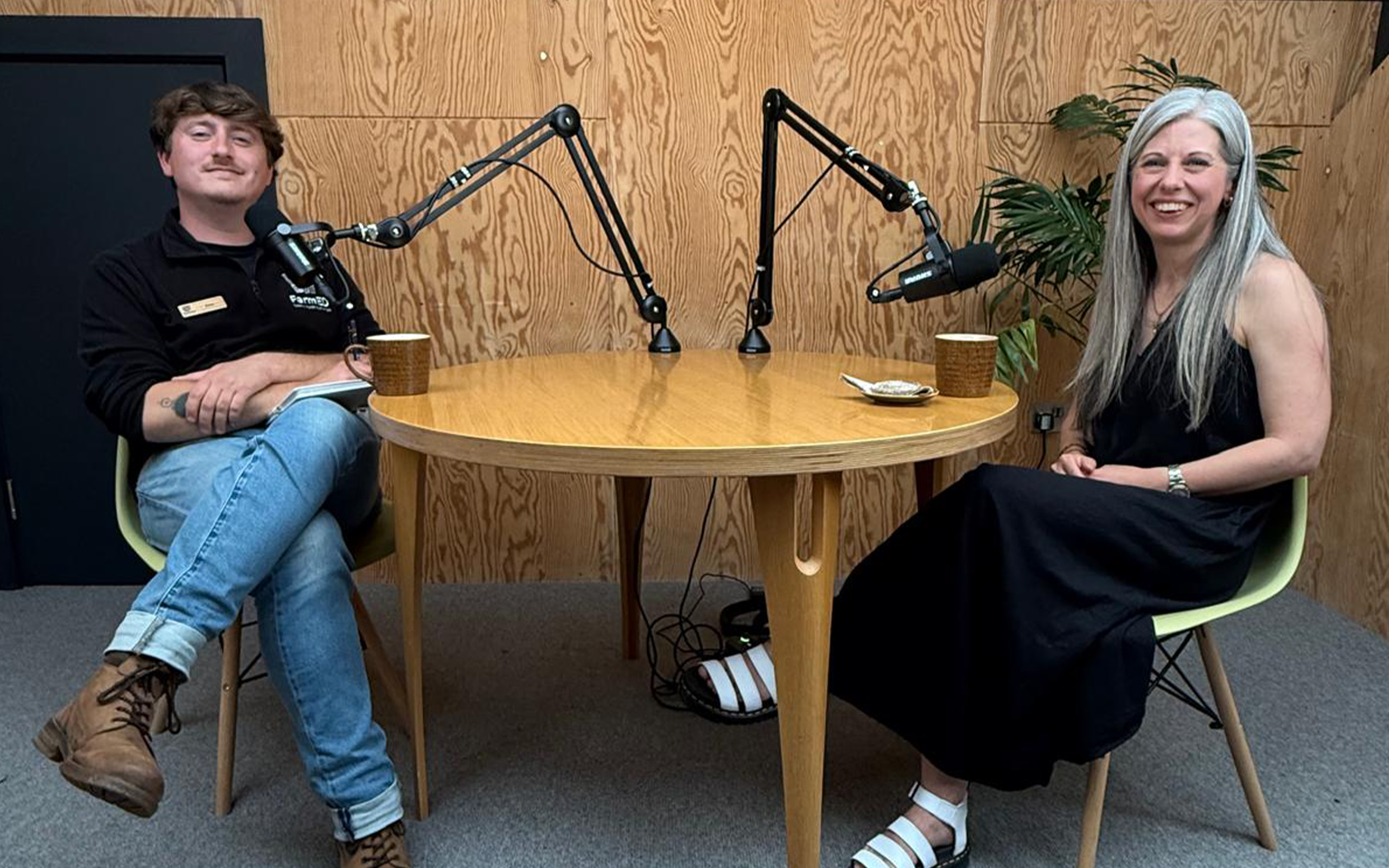
Presenter of The FarmED Podcast, Alex Dye, caught up with journalist, educator, author and founder of Just Farmers, Anna Jones, earlier this summer, just before Cereals and Groundswell. It’s a fascinating conversation during which Anna recalls her early career working as a newspaper journalist and making the move to the BBC where she worked as a reporter for the flagship ‘Countryfile’ and Radio 4’s ‘Farming Today’ as well as a brief stint as Farming and Countryside Advisor on The Archers.
Her Nuffield Scholarship looked at the barriers to communication for farmers negotiating mainstream media. This led her to establish Just Farmers as a way to create opportunities for farmers to engage with journalists.
‘They can see that we're just normal people, too, trying to do a job in stressful circumstances like farmers. You know, we're up against deadlines, and I always say journalists are as obsessed with time as farmers are with weather. So, if you can understand the pressures that weather puts on you as a farmer, you can understand the pressures the clock puts on journalists and why they can be so impatient. So, let's try and understand each other better.’
Find out more about Anna Jones by visiting the Just Farmers website, or follow @jonesthejourno and @justfarmers on Instagram.
Transcript
Alex: Hello, welcome to this episode of The FarmED Podcast with me, your farmhand and speaker, Alex Dye. I'm not sure I'm a speaker, podcast host, whatever you want to call me, I'm here. My guest today on this rainy, haily, sunny, windy day is the journalist, educator, author, storyteller, Anna Jones. Quite a broad resume of telling stories about all sorts of different things.
Anna: Well, when you put it like that, Alex, yeah, spinning a lot of plates there.
Alex: Speaking of, choking on my tea, let's go right back to the start then, in terms of all this sort of story. Your story does begin within the world of farming. You grew up on a farm, is that right?
Anna: Yeah, I did very much.
Alex: Tell us about that.
Anna: So I come from a long line of farmers. In fact, for the book, I did a bit of the family tree stuff and I went back…
Alex: Got the book plug it nice and early there.
Anna: Yeah, it’s called Divide. And I went back as far as the mid 1700s and my mum's side of the family and my dad's side of the family were farming within a 10 mile radius of each other along the English Welsh border. So I don't come from the deepest gene pool, that's what I discovered. And our family has just been rooted, hefted firmly to this strip of English Welsh border in Shropshire in Powys and that's where I am, were more sort of farm labourers, tenant farmers on very, very small acreages. My great, grandfather was a tenant of six acres and a farm labourer. And then on my dad's side, I suppose they did marginally better in the sense that they were tenant farmers and then they managed to buy a bit of land. So my grandfather had a 65 acre farm, which now, sounds really embarrassingly small when you say 65 acres now, but you know, I think he did quite well for his time.
02:11
Anna: But then, you know, going to the book, that was sold off due to family politics, farming family politics. And my dad pretty much had to start from scratch because he didn't inherit the family farm because it was sold when my great grandmother died. And so, my dad managed to buy of that 65 acres, he managed to get enough money together to buy 25 acres of it, and that's or is it 30? 25-30 acres, that's all we own. And then dad rents pockets of land here, there, and everywhere. And he worked really, really hard to raise his three girls on effectively 30 acres plus some rented ground here and there. And he did it, and that's where we're from. My dad is still farming at 74 years old with dodgy knees, but loving it. And my mum as well. And we go back whenever we can. I think he wants us to wrap wool this weekend, actually. So, yeah, that's where I'm from. But I kind of knew very early on that I didn't have the X factor that you need to farm full time. I wish I did, and sometimes I have kidded myself that I do. But if I look deeply inside I don't think I do. I think I'm lacking that farming gene, but I'm not lacking the love of farming and the passion for our community and the desire to want to contribute to the farming community. But I always knew that my personal passion was stories, people, asking questions, being nosy, and talking. And from a very young age, I used to go around our family with a hairbrush. As a microphone. And I invented a character called Anna Dooley Dally and I would go and interview my family about crucial key issues of the day.
Anna: What are you cooking tonight, Mum?" And I would just, this kid running around with a hairbrush like a microphone interviewing my family. What are your feelings about the weather today, Dad? And yeah, I was doing that from a very young age. So I think the writing was on the wall that I was going to be a journalist. I think I made that decision at 12 and then I went to university to study journalism. Worked in newspapers for a few years, did the kind of coalface stuff, the chasing ambulances and covering Crown Court and inquests, that kind of hard news stuff. And then started working at the BBC when I was 24.
Alex: And was that Farming Today, Countryfile?
Anna: Oh no, way back then. So my first ever job at the BBC was an Alan Titchmarsh series called The Nature of Britain, which was a wildlife series. And at the time I was a reporter on The Express and Star, which is a big evening newspaper in the Black Country based in Wolverhampton. Had a good job there on their features desk and just quit it for a six week contract at the BBC. So I was like, I'm going to back myself.
Anna: So I took this six week job, and on the final day of that six week contract, an internal job was advertised for a researcher on Countryfile and I had until midnight that night when my contract would be over and I would no longer be BBC staff. I had until then to get an application in so I remember on the last day of my contract being in the BBC offices in Birmingham in the Mailbox feverishly writing this application and then that was in the June or the July. And they weren't having the interviews until September so I left the BBC with no job. I went on the dole that summer actually, or Jobseeker's Allowance. I don't think we are allowed to call it the dole anymore. I did back then. I was on the dole. And then luckily, I got that job on Countryfile.
06:14
Anna: And that was the beginning of turning my journalistic career towards farming, towards ag and the environment and all the issues that I talk about now. And I was 25 years old and I spent 12 years at the BBC as staff on Countryfile, also on Farming Today on Radio 4. I did two series of a programme called Country Tracks.
Alex: Do you think if you hadn't come to that with your farming background, do you think that gave you a leg up in terms of getting your foot in the door to do a job anyway?
Anna: Oh, 100 percent. But what they wanted more was the journalism background. I remember that being more highly prized, the newsroom background, because, you know, Countryfile does have a strong journalistic seam running through it. The TV industry, the people that work in TV aren't always necessarily journalists. They are content producers, they are TV producers, but don't always come from a news background. So, I remember the thing that really got me the job I think was the fact that I was from a newspaper background and I had that kind of news pedigree. But the farming background, the strength of that came through later, and because no one else was from a farming background, most people were from urban backgrounds because most people in the UK are from urban backgrounds.
Anna:So, I sort of quickly became a sounding board for all agricultural questions. Anna what do you think about this? and what would your dad say about this? and you know getting asked questions about poultry production. I don't know, we're a beef and sheep farm! But I quickly discovered that I was fascinated with farming and food production and really geeked out on it and earned a bit of a reputation on Countryfile for being the farming geek and sometimes I would want to delve deeper because it's television and it's prime time television and it's for a very general audience and I would have to sort of get reined in a bit. Because I would want to get into the nitty-gritty and that's when I requested an attachment to Radio 4 so that I could work on Farming Today and On Your Farm and Radio 4's amazing raft of rural programs because that's where I could really geek out. I can really get into the nitty-gritty and suddenly I was surrounded by people that are just as geeky as I am about farming. Charlotte Smith and Anna Hill and Caz Graham and Heather Simons and this wonderful team of radio producers who are still amazing friends now. So yeah, I feel very lucky to have had that dual, you know, Radio 4 can go into things a bit deeper and it's a bit more newsy as well, so it scratched that news itch.
Anna: But then also having Countryfile to teach me the importance of a light touch with your script, the importance of not, keep bringing people in by not going into too much detail, by not using jargon, by being really inclusive in the way that you do a story and learning about storytelling techniques that hook big audiences. Because when you're on Radio 4. You're talking more to a niche audience. As much as they say Farming Today is for everyone, it's not pulling the viewers that Countryfile is. So I think that was a really great storytelling training about how to adjust your story depending on how much information that audience is ready for.
Alex: Did you find that work on these programmes, did that, were you surprised or did it change. You sort of touched upon this already, changed your mind or you were surprised at how farming was depicted in the media in some ways? Were there some times where you just thought well that's just not quite right? I mean you've already sort of said you wanted to go more in depth with some things but were you a bit concerned at any point about things being, not wanting to misrepresent things in a certain way? Yeah I mean that's quite a loaded question though. I'm not trying to point any fingers at anyone.
Anna: No, and I'm glad you asked it, Alex, because the BBC gets a lot of stick. Countryfile gets a lot of stick. People calling it Townyfile, and it rose tints the countryside, and it creates this dumbed down view, this romantic notion of farming. I would push back against that. No. In fact, the BBC values. You get hit around the head with them when you're BBC staff, and far from misrepresenting farming, I witnessed throughout my whole BBC career a real desire and determination to get it right, but sometimes the lack of specialism within the team, which is why I became such an important part of that team. You know.
Anna: I think they were incredibly aware of how complicated agricultural issues are and how complicated agricultural stories are. That I remember long hours late into the night, we'd be, you know, poring over these scripts. And I'd be saying, oh, you can't really say that. And they were like, Yeah, but Anna, if we put that in, it's too complicated. People aren't going to understand what that means. So we'd have to work really, really hard, and I'm talking hours spent on these scripts. How do we distill this really impenetrable, complicated information that only farmers and people working in the industry will understand? How do we wrestle with that and put it across to people in a way that is accessible and is engaging but crucially accurate. And we never once compromised on accuracy. Of course you make mistakes because we're human beings and the BBC is run by human beings and of course there were some times that we get something wrong but that was never ever intentional. And on the very very few occasions we did oh my gosh Alex I would cry my heart out I wouldn't get over it for weeks. You know, making a mistake at the BBC is the worst feeling because you do uphold those principles of truth and accuracy and fairness and impartiality. I mean. They get drummed into you to the point that you really feel this weight of responsibility as a public service broadcaster. You feel that sense of public service. And if you do get something wrong unwittingly it's the worst feeling, and everybody shares that. So, no. I've never seen sort of deliberate misrepresentation or anything like that.
Alex: Okay, so you were also involved with the Archers for a little while. Is that right?
Anna: Oh no! Yes, I was, but you're gonna out me now, because yes, I was. I was the agricultural advisor on The Archers.
Alex: Can I just say I have no idea what I've just stepped in here? I don't know what this is.
Anna: Well, I have to be truthful. I completely believe in being truthful. So in 2022, The Archers came to me because the agricultural advisor that had been doing the job brilliantly for ages was sick and was off long term. Somebody from the Farming Today team had stepped in to cover, but that person couldn't be released from the Farming Today schedule any longer. So they needed a freelancer to step in. So the editor called me and I said, okay, look. I'm gonna have to be completely honest with you. I don't listen to The Archers and I never have. I actually don't know anything about The Archers and I know there's gonna be intakes of breath around the country now. What? And I said, I really would feel like a fraud. And he said, look, we can teach you The Archers stuff we just need someone who knows the farming stuff. I said, oh, I can do the farming stuff. I don't necessarily know all the farming answers, but I've got a hell of a contact book and I know all the people that would. I think that's the key thing, you know. I'm not saying I'm some kind of guru of agriculture, but I do know where to go to find the answers. I do know the right people, and I feel very, very lucky to through Just Farmers and through my career on Countryfile and Farming Today. So, anyway, I started on The Archers and I just it was, I mean, all of these family lineages and dynasties and their stories and their backstories and Brian Aldridge did this in the 80s or that in the 90s and you're just like oh my gosh, there's so much background, I'm never going to catch up on this and the team on The Archers are just so dedicated and so passionate about those characters and the scriptwriters.
Anna: And it's just a wonderful team. I did it for six months, but it got to the point where I feel like I'm occupying shoes that need to be worn by an Archers fan because this is the dream job for an Archers fan. And I was job sharing with Sybil Ruscoe, who does the job now, who is an incredible journalist and an Archers fan and absolutely adores The Archers. So I sort of, after they'd got back on their feet. Sybil could step into the breach, I sort of politely doffed my cap and said, I'm going to bow out now. So that's my Archer's truth.
Alex: And you mentioned during that, you dropped the Just Farmers hint. Yes. Where does that come in your timeline? At what point was that born?
Anna: That was born in 2018.
Alex: Oh, and also, can you tell us what it is? Sorry, I jumped in there.
Anna: So it was the same year that I left the BBC and they're linked. So you have to go back to around 2015m bearing in mind, I worked on Countryfile for the first time in 2006. Very, very different times to where we are now. And simpler times, in a way. Countryfile was on a Sunday morning then, in this sleepy morning slot where sort of hungover students loved watching it, and John Craven leaning on a gate, and you'd get 1.8 million viewers. We were covering rigorous stories, but it wasn't in the public spotlight in the same way it was after 2009. It went to primetime, and it suddenly went from 1.8 million viewers to 9 million viewers at its peak. It was pulling in more viewers than X Factor, the most watched factual program across British television, all channels, an absolute juggernaut of a program. And with that kind of profile, inevitably comes a lot of scrutiny. And people that want to knock it down and suddenly you're seeing it covered in the press a lot more. And 2015, so by this point, because again of my news background, I tended to work on the investigations more than the more lighthearted pieces.
Anna: So Countryfile is a magazine program and it's a mixture of light and shadow shade and harder subjects, softer subjects. And I would inevitably be working with Tom Heap on the investigative pieces, and I really loved that, but obviously they tend to be more controversial subjects and rely on getting access to farms when it's a farming story. And this was when we were starting to see the rise of environmental activism, a sort of renaissance of animal rights activism, the whole vegan agenda. I remember that time, the media got obsessed with vegans, and there was a lot of coverage at that time.
Anna: It’s kind of gone off the boil now, but farmers were really experiencing challenge and scrutiny at a level they'd never experienced before, and they weren't match fit for it. It sort of came out of the blue, and farmers, well, hang on a minute, we're just getting on with feeding the country, and now we're public enemy number one. Where's this come from? Like, what have we done to deserve this? It was, it really blindsided them, and my job was to cover these issues because that's the job of the BBC or any media outlet is to cover the issues that are in the public interest. And at that time, there was a lot of scrutiny on agriculture, and it was just getting really hard. Farmers saying, Oh, no, we're not doing it, we don't want to stick our head above the parapet, we don't want to invite unwanted attention from activists, and we're scared. And farmers didn't want to talk to us. They were scared of sticking their head above the parapet and inviting unwanted attention from activists. They were worried for their families, for their homes. We were seeing a lot of trespassing and people creeping around farmyards and balaclavas, and it was very tense. And also, there's a level of articulate debate on the other side of these subjects. You know, people like George Monbiot, who is a masterful debater, you know, that is his job. He is a professional communicator, writer, activist, campaigner, and in a debate he makes mincemeat of his opponents. I think farmers suddenly felt really scared of joining in these debates, and certainly on national television, on a program with the profile that Countryfile had. So it was getting harder to get onto farms, it was getting harder to reassure farmers, and they were losing trust in us. They thought that we had this pro vegan, pro green, anti farming agenda, and we were getting called farmer bashing, and just got really gnarly and really difficult. And obviously, all the way through this, I'm a farmer's daughter, and this is my job, but this is also my community and where I'm from. And I suddenly felt this deep personal responsibility to try and do something because I understand how the media works. We're just trying to do our job, we're just trying to tell stories, we're not bringing bias, we're just trying to tell a story.
Anna: And we need both sides of that story in order to do that. And if one side is pulling away from us, that's a serious issue for journalistic balance and ultimately democracy. You need everyone to feel that they can have their say. So, I applied for a Nuffield Farming Scholarship.
Alex: Just to clarify for anyone who is unfamiliar with what that might be, I'm sure in the farming world everyone knows what that is, but what is a Nuffield Farming Scholarship?
Anna: I'm just going to take a sip of tea. It's a global study programme. So you can go to the Nuffield Farming Scholarships Trust and you pitch to them an idea for a study that will benefit British agriculture. It could be anything. I mean, the scope is vast. And I went to them and said, I would like to look at the coverage of agriculture in the mainstream media and understand what is creating these barriers to communication that I keep running into. And what can we do about it? So I went down to London had my interview with the very scary Nuffield board of interviewers. And bearing in mind, I'm a farmer's daughter, but my world is media. My world is, you know, trainers, jeans, and hoodies in a production office in some BBC building in a big city. I've not at that point moved in agricultural circles, certainly not the leadership circles that Nuffield is. So it was really scary. I was quite intimidated. I had massive imposter syndrome. I bought a tweed coat just to fit in.
Alex: Just to look the part.
Anna: Yeah, I was like, oh, everyone wears tweed. I better buy some tweed. In fact, one time I went double tweed, had a tweed skirt and a tweed coat. So not me, but I was so desperate to try and fit into this world that I perceived I didn't have a place in, even though I'm from that world. I felt like this media type that didn't really know what was going on. Anyway, I got the Nuffield and they give you a bursary to travel and go and look at your subjects. So I spent two years, so from 2016 and 2017, travelled to the US, all over Europe, Kenya, South Africa. It was incredible. I went all over the place to newsrooms, to farms, to the offices of political lobbying organisations, just talking about communication. Discovered a lot of problems on both sides. The media had responsibility, people were losing trust in the media, but also farmers were overly defensive. There was a real lack of transparency, it was a kind of like wanting to hide things from the public because they weren't quite sure how to be open about farming practices and things.
Alex: Was that more about how they, rather than it being whatever they were doing was bad, it was more, they were worried about how it would be perceived?
Anna: 100 per cent, okay yeah so and just this feeling that everyone was against them. Yeah, so it was a difficult relationship. So I came back and thought, I wrote up my report, I presented my findings at the Nuffield Farming Conference in Bristol in 2017. And, um. Here are all the problems, here are why the media and farmers are locking horns and why we're not telling the stories of agriculture as well as we could.
Anna: I thought, that's very depressing, you know, here's a load of problems, bye, mic drop, and I thought, no, I need to think about solutions, I need to think about what I can do to try and improve this relationship. So the idea for Just Farmers came to me on a walk around where my mum and dad live and I suddenly thought, why can't there be like a sort of somewhere that kind of brings farmers together, helps them understand how the media works, tries to strip away some of that fear and some of that suspicion, introduces them to media people that do this job? They can see that we don't have horns and that we're not these evil characters digging through bins and selling our granny for a story, they can see that we're just normal people, too, trying to do a job in stressful circumstances like farmers. You know, we're up against deadlines, and I always say journalists are as obsessed with time as farmers are with weather. So, if you can understand the pressures that weather put on you as a farmer, you can understand the pressures the clock put on journalists and why they can be so impatient. So, let's try and understand each other better.
Anna: But then, equally, once we've given farmers some training in storytelling and media education so that they can understand how this whole machine works. Then there can be like a central place that members of the media can come to when they need an independent case study. You know, not a politician, not a lobbyist, not an office holder at the NFU or the CLA or the Soil Association or any of these big trade associations, just a farmer or grower, just somebody who can speak from the heart, from, you know, every day working on the land, who can just give their personal testimony.
Anna: And just say, this is how the big issues affect me. And wouldn't that be great? Because we were always looking for a case study. Anyway, just Farmers was born, it does exactly that. We give farmers media education, these free workshops, fully funded, grant funded for farmers and growers. And then once they've received that training, they get a profile on our website. And then members of the media who we have verified, who we know who they are, who they say they are. They register on the Just Farmers website, and if they're doing a story about bovine TB or agricultural policy, whatever it might be, they can put bovine TB into our search function and it will bring up all the farmers that are happy to talk about bovine TB and a whole other raft of issues.
Anna: And we've got 156 farmers in the network now and 500 members of the media using the website, international media, national media, local, farm press, general press. It's amazing, it works. And it's a force for good.
Alex: Have there been any really notable success moments where you've thought you've seen something come together and you thought, we did that, we've squashed this problem, whatever it might be, this misconception, because we managed to put these two people in a room together? Anything that you thought, we made that happen, that's a brilliant moment?
Anna: No, we're more hands off than that. Because it's never about Just Farmers, we try and stay in the background as much as possible. We're not a press office. We're not a marketing agency. We don't claim the success for ourselves. All we do is unlock the potential and talent that is within these farmers already. And they go off and do it. And they go off and have the success of achieving those things. You know, we are just creating opportunities for farmers to engage with the media. And we're making it easier for the media to find farmers. What they go off to talk about or film or be interviewed about, that's not my business. You know, we say to the farmers, we're not a dragon at the gate. This is your decision. If you want to pick up the phone to Good Morning Britain or GB News or Countryfile or The One Show or whoever, if you want to pick up the phone and if you want to do it, do it. And we're never going to tell you what to say. We're not going to be there whispering in your ear. It's your opportunity. You make the most of it. And we just kind of, I think we just give give them that confidence to go and do it themselves.
Anna: I’m so proud of them. I mean, gosh, there's been three or four of them on Clarkson's Farm. Richard Heady is in the Hawkestone Choir. You know, this is not our success, this is just what they go on to do. Charles Goadby in Group One, who is a well known ambassador for agriculture and very, very passionate about British farming, he came to me when I was recruiting the first ever group of farmers. He'd never done anything. He said, oh, I'm just that farmer that shouts at the radio and gets really angry about how people are talking about us as farmers. But I never do anything. I never say anything. I never stick up for us. And he said, maybe I should put my money where my mouth is. I said, maybe you should. So he came along, and look at him now. He's doing all sorts of stuff. He's all over the place. I mean, I can't even list the things that Charles is doing. He's doing there's so many, and there's loads of them. I mean, you have to go into the Just Farmers website, find a farmer, and you'll see them. Sophie Gregory's on there. Johanne Humphries. Oh gosh, the Welsh farmer is Johanne Humphries who was, after he did his Just Farmers workshop, instrumental in getting the supermarkets to increase the price of eggs. And, you know. So I would never claim these successes for myself or for Just Farmers. They are the farmers' successes. But I like to think that we've given them that little boost. And that they might not have put themselves out there if they hadn't spent four days with media people saying, You've got a great story. Tell it. Share it. Because you've really got something special to say. And I think once we give them that permission, they just fly.
Alex: Beautifully put. Beautifully put. Were there any... When it came to these training sessions, when you got everyone together in a room to talk about their stories and how they wanted to... To sort of display themselves, present themselves. Where there any issues or topics that the farmers were struggling with that you sort of come up time and time again? Certain topics they didn't know how to broach or were too afraid to broach, or was it a bit more general than that?
Anna: Yeah, the classic one is what we call the spiral of doom over, we farm animals and then we kill them, we love our animals and then we kill them, you know, and this is something that farmers really wrestle with because if you're not a farmer and you are somebody that finds the idea of eating animals abhorrent, that is not something that is going to change. You know, that is your view. And I think what we do at Just Farmers is say, you know, that is okay. That is not something that you need to carry or feel angry about, but you do need to respect that people that want to be vegetarian or vegan, that that is an absolutely okay choice. It's not something that we need to fight over. You know, we all have agency and control over what we decide to put in our mouths and what we believe. But I was like, they're always like, oh God, I'm scared of somebody asking me the question about how can you justify killing an animal that wants to live? I can't give you a script for answering that question. You just have to speak from here and what is true to you. I come from a long line of farmers who have raised animals to the best of their ability, loved those animals, and ultimately slaughtered those animals because that's what livestock production is. And the way that I describe it in my book, the way that I me personally, square it and feel comfortable with it and constantly check in with it throughout my life because this is something that evolves is, we look after animals in life and they look after us in death. And that's the partnership, that's the ancient contract between human and domesticated animal that has evolved over thousands of years through the evolution of farming. And probably because of where I'm from, my genes, what’s in me, how I've been raised, I'm personally okay with that. But not everyone is, and that is totally fine.
Anna: So I think it's about sometimes trying to strip out combative tribalism, anger, division from things. We do a lot of work around that. We do a lot of work on bridging divides, overcoming... Well the world that we're in is all about division and I think Just Farmers is a proudly impartial... We're an impartial project because we want to be totally inclusive. So you'll never hear me say you should farm in this way or you should follow this system or that you should have this philosophy or this ideology about farming. Not my place to say. My job is to convene diverse groups of farmers and growers from all sectors, all systems, farms of all shapes and sizes, and to say, you've got a place here because you've all got a story, and we can all be in the room together, even though we farm differently, think differently. Believe different things. We can all be in a room together and use storytelling as the uniting force that levels us all, and because we've all got our own story, we're all walking our own path through this way.
Alex: But if I were, to put you on the spot and give you that spotlight and say, is there or are there any misconceptions that you see come up in the media or about farming generally that you would like to take this chance right now to quash, to say, this is true or this is false?
Anna: Right, okay. The two big stereotypes, neither of which is correct. So, in the blue corner. We have. The rosy Pa Larkin shepherd with his one sheep and one cow and his cute chickens scratching around the yard and the roses around the door, and this romantic notion of the sort of old McDonald kind of 1950s style farming thing. And that there is a lot of people out there that think that farming is this lovely life and it's so idyllic and you know. That's one and that can hold our industry back because when people see what modern food production is, they go, oh God, that's not what I thought it was like. I don't like that. So the rosy storybook image is a dangerous thing because if people are carrying that in their heads and then they see the reality, they're gonna go through some stuff.
Anna: So that’s one, in the red corner, The factory farming, subsidy swilling, badger killing, rich, entitled, horrible, fat landowner who just wants to shoot stuff and rape the countryside and throw his chemicals around and you know, also completely caricature. And you know, and we hear it all the time how rich farmers are, and yet, and it annoys me if farmers act like they are on the poverty line because let's face it, some are, some are, but most are not. But equally, this idea of privilege and elitism and wealth, and that really gets my goat, really does, because I did grow up in a working class farming community which was manual labor. Like all the kids I was in school with, you know, their dads, at that time it was the dads, you know, they are now kind of hunched and broken and arthritic old men who can't stand up straight, who are just, because they have had a life of just hard work on the land for very little money.
Anna: So when you get this, you're all living in big posh houses and driving Range Rovers, and then I look at my dad and I just see the work etched into every part of his body. That winds me up. So yeah, those that blue corner and red corner, those are the two wrong stereotypes that I rail against.
Alex: In terms of miscommunications, your book, Divide, is available now in all good bookshops, I'm sure.
Anna: I think in the bad ones too.
Alex: In the bad ones as well. Just the bookshops, in the bookshops. All bookshops.
Anna: Charity shops.
Alex: Bargain bin. You talk a lot about the relationship between town and country. What did that look like as you were looking back and writing this book, and what do you hope it will look like 10 years from now?
Anna: Do you know what's really interesting? When I wrote Divide, I was living in Eastern in Bristol, BS5 Bristol, which is an inner city, very urban, multicultural, quite economically deprived part of Bristol, though rapidly gentrifying. That was a fantastic place to write the book because I was looking from an urban perspective out. Halfway through writing the book, I moved back to Shropshire because Covid came along. Changed the way that we work, and with flexible working, I was able to sort of go back to my roots and I now live in Shrewsbury in Shropshire. Suddenly, I'm looking from the rural perspective out, and it's really interesting how things have evolved in my mind. I think being a journalist, I'm a trained contrarian and I will always be seeking the alternative experience, the alternative view. When I was in the city, I saw myself as a champion of rural life. And a corrector of mistakes and somebody that could catch false statements in the moment and go that's not true and I used to hear that a lot in the city and you know my local pub stopped serving beef and lamb for the climate and I was just like we just need to have a more detailed conversation about this so you know.
Anna: When I was in the city I really felt like I was trying to be a sort of bastion, speaking the rural voice, sort of speaking the rural voice and the farming experience in a place where it wasn't heard. And now I find myself doing that for the urban. And it's really annoying because I don't fit in anywhere. I'm always on the fence. And I'm always sort of. So I've gone back to my rural community and now I do hear a lot of things about all those clueless city people. And I've now found myself being the defender of the urban voice, the urban experience. When I hear things in rural communities that I know to be false, in the same way I heard them in urban communities and knew them to be false, I find myself saying, no, that's not true. You know what I mean? So, the answer to your question is I'm looking at the urban rural divide from a different side of the fence now, whereas when I wrote the book, I was in the city. If I was to write it again It probably might be a little bit different.
Anna: So they are different worlds, Alex. They are culturally, socially, politically, geographically, economically, so different, and we just need to have more conversations because ultimately they are the same because we're all human beings, and actually, there is common ground with every human being. You just have to put the time into finding it. But I truly believe that. You know you can find common ground with all of the nine billion people on this planet if you're willing to step out of your bubble and put yourself into theirs. With urban and rural issues, sometimes there's not a willingness to do that, and that's my constant plea, step out, think differently, and experience things from the other side of the fence. That's why I'm always saying to farmers, don't just go to the Royal Welsh Show for your holiday, go to London. And equally, you know, to anyone that's never really spent time in the working countryside, go to an agricultural show.
Anna: Don’t just go and sit in some bougie Airbnb in the countryside and think that's living the country life. Get yourself to the Royal Welsh Show.
Alex: Yeah, see the real deal.
Anna: That’s just what I'm always saying.
Alex: Yeah. So let's start to wind down because, full disclosure to our listeners, we've both had quite a long day, haven't we? I think I'm fading. I don't know about you.
Anna: We’re a bit late in the day, aren't we?
Alex: We're hanging in there. We’ve had some funny old weather today.
Anna: Anyway, we've got busy days tomorrow as well because we're off to Cereals.
Alex: That’s dated this episode nicely.
Anna: Oh, sorry.
Alex: What’s next, though? What can we expect to see from you in the future? Do you have any other plans? What can we expect to see from you coming soon?
Anna: I have got one exciting plan on the back burner that I can't talk about, unfortunately. So that's just a road to nowhere. Let me take that again. I have got. Ambitions and things that I would like to do but at the moment they're just plans. I think what's definitely one to watch is Just Farmers over the coming months. We've got some really exciting plans and which is an amazing thing for a tiny project that is quite vulnerable in the funding space. We have enough funding to get us through to the middle of 2027. After that is, who knows. But considering we're not particularly flush, boy, are we ambitious. Emily Davis and I, we're a small team of two part timers, freelancers that run Just Farmers, and then we draw upon this amazing team of external freelancers that run workshops with us and stuff. Plus our network of farmers, our funders, our sponsors, and we've now got a board of directors, which sounds very posh, but we've got this brilliant board of directors, Rob Mercer, Sheena Horner. Andrew Court, big shout out to those guys. I think you're going to see us doing some really cool stuff because, well, starting with Groundswell can I do a shout out for Groundswell? We are going to be bringing one of the favourite exercises from our TV workshop which the farmers always love, we're taking it to Groundswell - Hashtag Can You Clarkson, Can You Craven, we’re bringing our TV presenter challenge which is where you get to memorise a piece of script and see if you can deliver it to camera like a TV presenter and if you've got the X Factor that Clarkson has or John Craven.
Anna: Yeah, so we're going to be roaming around Groundswell with our camera, with our boom mic, with our Can You Clarkson sign, and you can come up to us, doesn't matter if you've had a few pints, you can come up and have a go at being a TV presenter. Because that's a little snapshot of what we do at Just Farmers in our media education workshops. We help people have a go at all these different storytelling techniques. So I'm excited about Groundswell.
Alex: And where will people, if post event, if it was listening to this post event, if someone's listened to this post Groundswell, where can they find the output?
Anna: Oh, so we're doing it in conjunction with Groundswell. So the Groundswell team are just brilliant. Like, they're totally taking a punt on this. I have this mad idea. Like, can we just go around with a camera and just see if people can be TV presenters? We're going to take all the footage and we're going to cut it into some fun reels because there'll be some outtakes. There'll be some people who won't be able to do it. But we're doing it. It's lighthearted. It's fun. It's, you know, I think communication sometimes can all get a bit heavy. Like, what's our message? And it doesn't need to be that. Let's have a bit of fun, let's play, let's play with the kit, with the cameras, with the microphones, and have some fun with it because that's where confidence comes from. Just Farmers' workshops are not heavy, they're very lighthearted. There's a lot of laughing, there's a lot of learning through play and fun. And we're going to bring a bit of that to Groundswell. And you should see it in the socials afterwards when we cut it all together and people trying to say some tongue twisters.
Anna: We’re gonna put a bit of farmer jargon in. So to see if people, 'cause you know, there's a lot of terms in agriculture that people outside our community won't have the foggiest what it means. So we're gonna play around with a piece to camera, takes a bit of farmer jargon. But then we're gonna turn it on its head and translate it into normal people language so that everyone can understand it. That's a little bit of a hint of what it will be like.
Alex: Nice, I look forward to seeing that. Wonderful. Well. Thank you so much for taking the time to come and visit us today to have a chat about all these weird and wonderful things that are going on in the world of farming. Thank you, Anna Jones.
Anna: Thank you.
Alex: Lovely having you here. And thank you for sticking with us today. I hope you enjoyed this episode. Do give us a review, a rating, a like. A dislike. If you didn't like it, let us know. We're interested in that as well. But thank you very much for checking out this episode of The FarmED Podcast, and we will hopefully see you next time.
Recent news items