

Can Farming Change The World?
Oct 22, 2026
Protein:
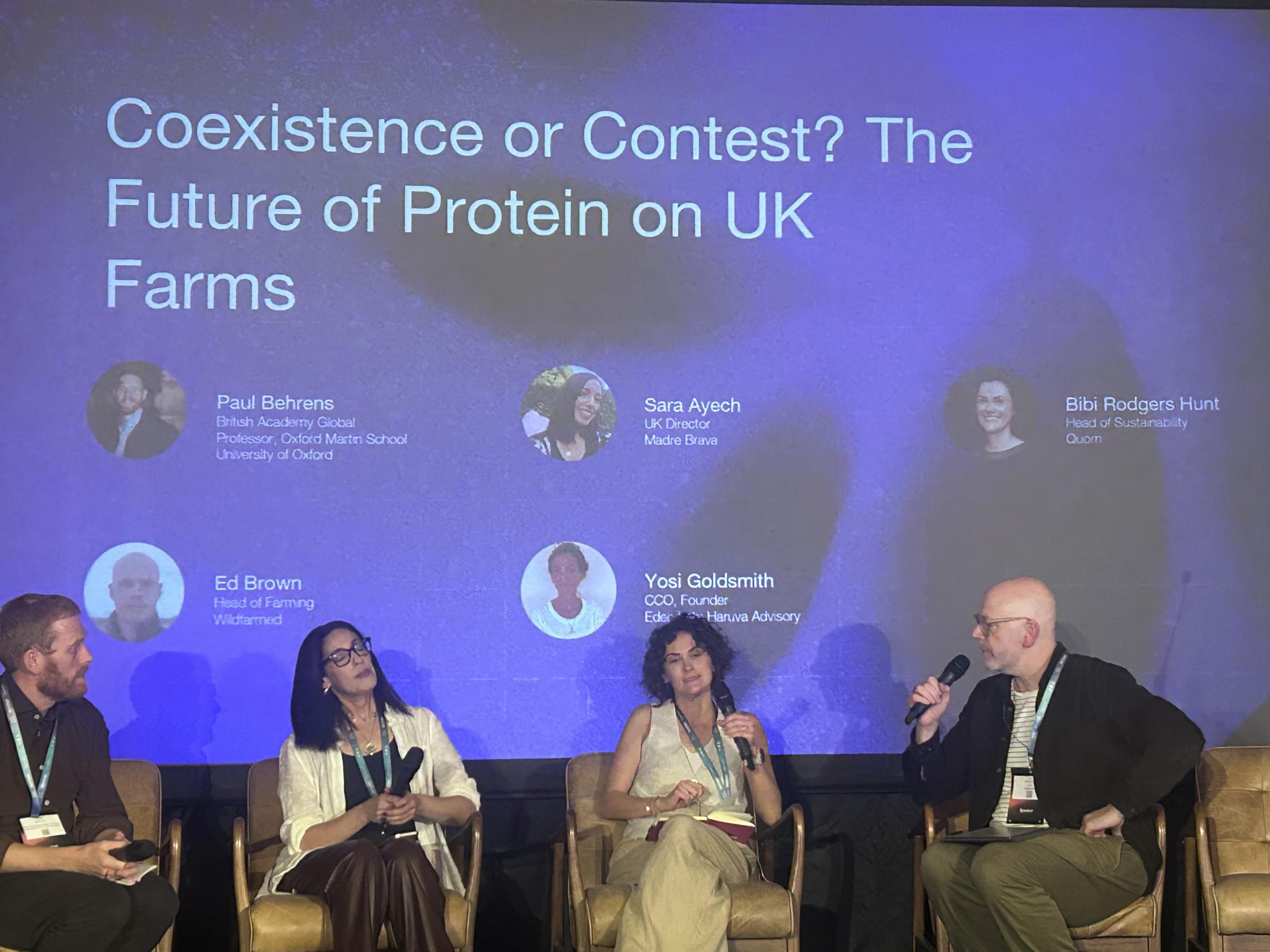
Talk: Coexistence or contest? The future of protein on UK Farms (L-R)
Paul Behrans, British Academy Global Professor, Oxford Martin School, University of Oxford. Sara Ayech, UK Director, Madre Brava. Bibi Rodgers-Hunt, Head of Sustainability, Quorn
(Chair): Leo Rayman, CEO, EdenLab
At the Blue Earth Summit last week, farming, agricultural practices, and food production were extensively represented on the agenda. Some of the best and brightest minds in climate change, environmental sustainability, and agriculture came together to look at the future of farming: from an exploration of the “future of protein on farms” to the climate opportunity in our soil, delegates were treated to the latest research on the future of farming.
What became clear across the board is that we know how to produce food well, and we increasingly know how to produce it while working with nature, but what we haven’t cracked yet is how to build the economic system we need to make climate-aligned farming the obvious, viable choice. Without this, farming and food production will continue to be one of the global industries with the biggest negative impact, and one that is increasingly vulnerable to natural and political threat.
Despite the obvious influence of agriculture, responsibility was not exclusively assigned to farmers but instead to every contributor in the supply chain. From the retailers who influence what we eat, to the manufacturers that drive ingredient demand, and the investors that push scale and commercialisation. Adjacent industries also shared the spotlight from the water companies to the infrastructure and transport businesses like Network Rail, that ultimately shape the land we live on. The key message: drawing every one of these stakeholders together will be essential for progress, and for shaping the conditions in which we all farm. A tenet central to FarmED’s own Leaders in the Field programme, which brings together stakeholders from farmers to land management companies, utilities businesses to government officials, to discuss the emerging topics of our time, and to find credible solutions that we can all adopt. There are too many organisations with a stake in the land to exclude any from a conversation that will drive meaningful change.
Ultimately, whether speakers were talking about alternative proteins, regenerative agriculture, rewilding, food security, or doughnut economics, they collectively kept returning to a similar problem: the gap between what we know needs to happen and what our existing systems encourage us to do. Yet the outlook was hopeful and the focus returned time and time again to the opportunity we have, and the innovations and people making change happen.
Key themes from Blue Earth:
Change needs to happen, but we don’t all agree how
As experts in their respective fields, every speaker had a natural direction to their thinking, and not all were aligned with each other. Some are working within existing commercial systems to drive change and encourage action, some are working at the forefront of new, emergent technologies, while some are questioning the foundations of those very systems and looking at alternatives to drive the necessary transformation. What is clear, however, is that progress can and is being made already, within the systems we’re all a part of.
Food Industry:
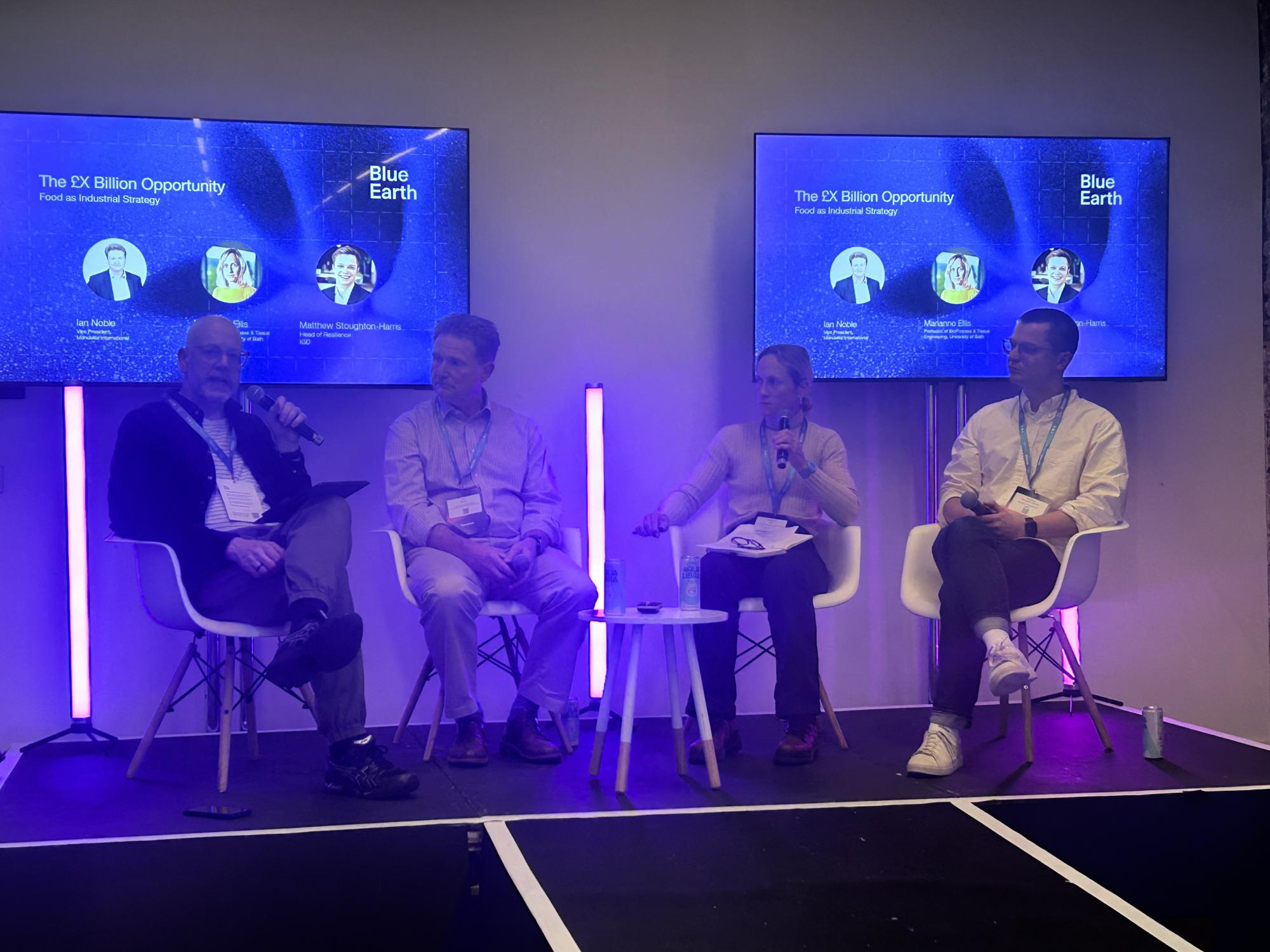
Talk: The £XBillion opportunity: food as industrial strategy (L-R) (Chair): Leo Rayman, CEO, EdenLab. Ian Noble, Vice President R&D, Research, Analytical Sciences & Cocoa, Mondelēz International. Marianne Ellis, Professor of BioProcess & Tissue Engineering, University of Bath (Cellular Agriculture). Matthew Stoughton-Harris, Head of Resilience, IGD
It’s about resilience, not sustainability
Contextualised within the UK reality, where we don’t have a food security plan, or a minister responsible for it, resilience became the overarching narrative across the board. Ian Noble, Vice President R&D Research from Mondelēz International, Marianne Ellis, Professor of BioProcess & Tissue Engineering at University of Bath, and Matthew Stoughton-Harris, Head of Resilience at IGD, took to the stage to look at food as a multi-billion-pound industrial strategy, and highlighted that the UK is already in a food crisis, but that our food distributors have become extraordinarily good at absorbing disruption and maintaining supermarket availability. While much of their attention was on technological advances and the future of food production, including cellular agriculture, their praise of the distribution sector nonetheless potentially concealed growing vulnerabilities and shortages in food supply that innovation and British production would ultimately need to compensate for in the future.
Meanwhile, during his panel on soil health and the power of regenerative agriculture, Andy Cato, Co-Founder of Wildfarmed approached the same issue from an alternative perspective. He highlighted modern farming strategies as a legacy of post-war priorities to maximise production, highlighting intensity at the expense of soil condition and longevity. Instead, he argued our attention must now turn to maximising production over the long-term instead of the short-term. It was a much-needed pivot for the audience, capturing the very real issue that agricultural output cannot continue to be measured in short-term outputs like yield per hectare, when those very outputs compromise the ecological conditions needed for future production. Indeed, on his own farm in Oxfordshire, Andy highlighted this year’s yields where his regenerative agriculture approach secured 80% of expected yields, compared with yields as low as 33% of expected yield in some regional, conventional farms. This echoes our own heritage wheat experience this year. Viewed against a backdrop of drought and extreme temperatures, this highlights the need for innovation and new approaches as climate change offers increasingly turbulent conditions.
These were not the only perspectives prioritising resilience. Discussions from Benedict Donald and Gil Martin of RESTORE, and Isabel Milligan of Great Yellow, highlighted ambitious nature-first rewilding processes that are protecting farmers and regional infrastructure by creatively reshaping the landscapes. Isabel is part of a project in Oxfordshire, rewiggling the Evenlode River to manage flood risk. The project is being championed by a local farming collective, while funding is being drawn from third-party investors that will benefit from reduced flood risk, including for example Network Rail, whose infrastructure crosses the river 27 times. Isobel highlighted “Nature is critical to infrastructure, but we just haven’t realised it yet” and her project case study highlighted the opportunity to shape the farming community and benefit nature, while drawing funding from those that will reap commercial rewards.
Wildfarmed:
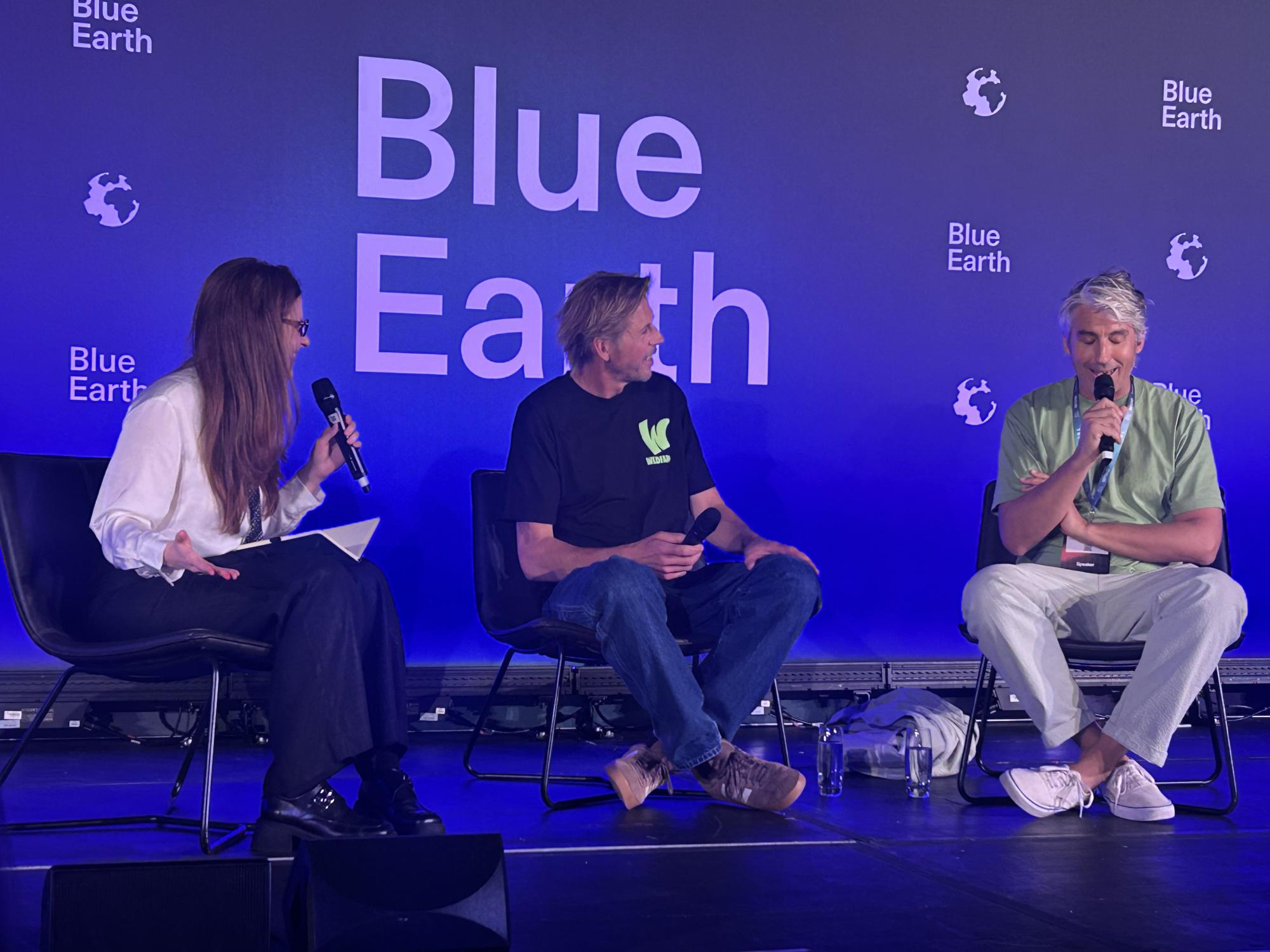
Talk: Ground up: the climate opportunity hiding in plain sight (L-R) (Chair): Amy Bourbeau, Chief Impact Officer, Seismic. Andy Cato, Co-Founder, Musician & Regenerative Farmer, Wildfarmed. George Lamb, Co-Founder, Broadcaster & Presenter, Wildfarmed
Nature and the economy cannot be separated
As Andy Cato and George Lamb, both of Wildfarmed, argued that the current food system prices nature at zero, Blue Earth provided scope for wider discussion of rewilding, regeneration, and nature-aligned farming practices that prioritise economic and natural balance. The Evenlode Landscape Recovery Project is just one example of this, but there were countless others throughout Blue Earth, highlighting the ecological, nutritional, value, and food security benefits that can come from transforming the way we currently farm. Discussion is certainly at a grassroots stage, but this shift in the narrative is one that could fundamentally alter the systems we currently farm in. In fact, early indications and these newly succeeding projects create an opportunity: instead of asking businesses and governments to fund nature because it is the right thing to do, focus shifts to funding because it creates financial value of nature. Something that could prove transformational in the future.
It won’t all be plain sailing, however. In her Doughnut Economics Circus, Kate Raworth highlighted the current conflict in the way we consume, with nature being relational, regenerative and long-term, while current financial models are reductive, accumulative, and short-term. Historically, finance has always won, and while connecting finance and nature for mutual benefit sounds like the perfect solution, Kate highlighted the need for careful balance. From this, we can consider that if we only protect nature that brings financial return, what happens to the locations, ecosystems or species that don’t have an obvious monetary value. While emergent projects offer opportunity for learning, it is clear that longer-term, broader scope policy will be necessary.
Commercial relationships around agriculture need to shift
Much of the innovation, the change, and the catalysts for change exist outside the farm gate, leaving farmers potentially wielding crystal balls to survive. Across the summit, there was consistent recognition that farmers operate within a system of incentives, risks, and constraints beyond their control, that ultimately influence most decisions. Despite being heralded as a success, the recent Sustainable Farming Incentive application window saw £233million distributed in under 6 hours, while leaving tens of thousands of farmers without the necessary subsidies to prioritise nature and wildlife.
Instead, changing practices and commitment to nature are at the mercy of market conditions. In the discussion on the future of protein on farms, Sara Ayech of Madre Brave observed that we cannot encourage farmers to switch to, or incorporate alternative protein sources like pulses into their crop rotations, without reliable demand. It is simply too big of a commercial risk. George Lamb of Wildfarmed made a similar point about their heritage grain and regenerative practices, highlighting the long, laborious reality of shifting food production supply chains, in order to provide the demand that they need commercially. Farmers need a financial model, supportive relationships and routes to market that reward different production practices. Without it, true change will fail.
In their discussion of industrial food strategy, Ian Noble, Marianne Ellis, and Matthew Stoughton-Harris broadened this point, discussing investment, manufacturing capacity, national strategy and supply-chain coordination as key considerations for the future of food security. They had a strangely detached view of the role of farmers in food production, considering innovative technologies over shaping relationships with the food at source. This is despite highlighting the recent impacts of the Ukraine war on food supplies for example.
Ultimately, we come back to the multi-stakeholder reality, and the need to shape the full commercial strategy for food. We must also embrace the topic of food security, in order to drive lasting, systemic change in farming. Until then, nature-aligned practices, be that regenerative, rewilded, or organic for example, will be adopted by individual farmers who think progressively about long-term yield.
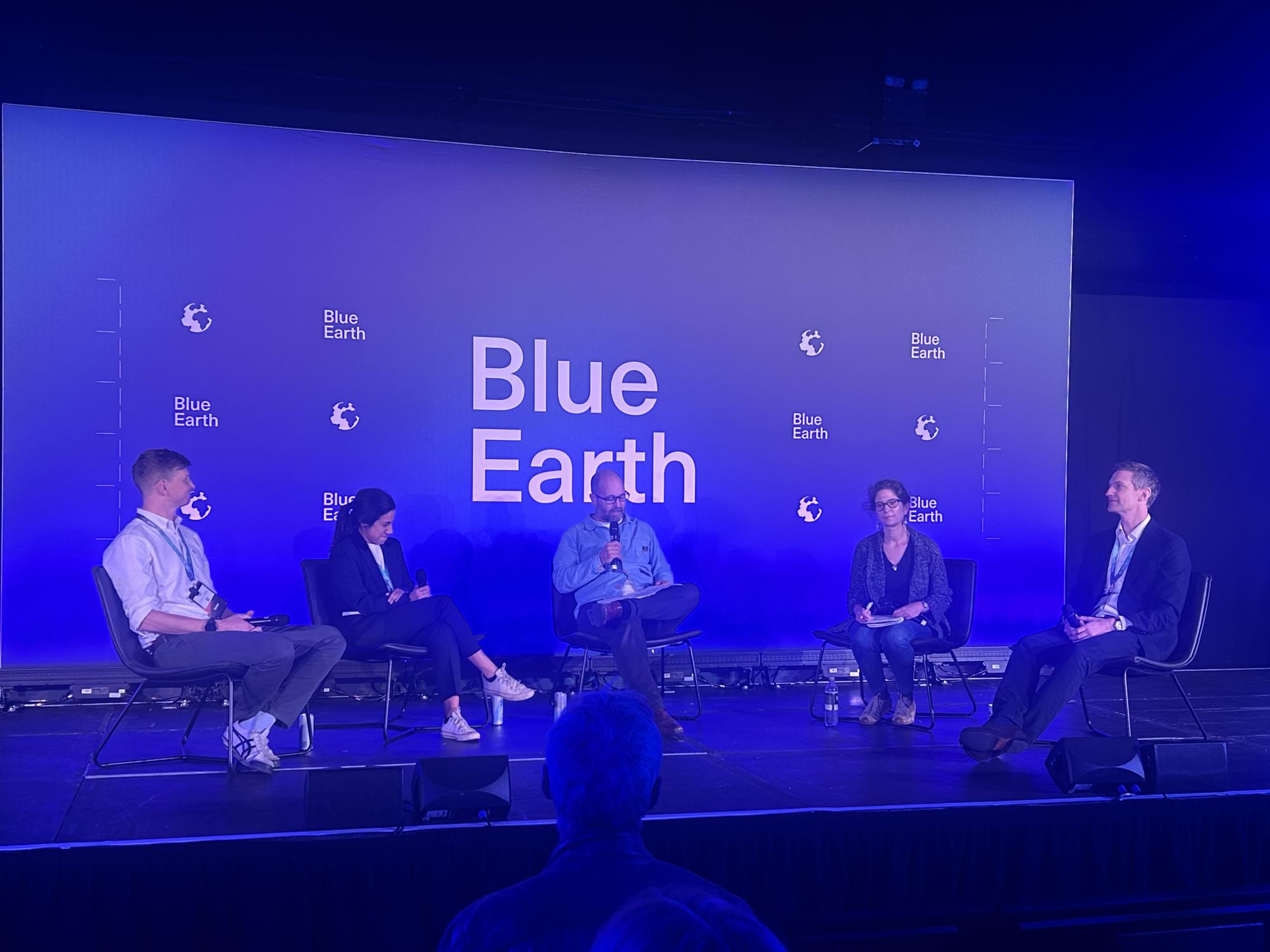
Nature Funding
Talk: The 3% problem: if nature works, why are we not funding it? (L-R) Freddie Ingleby, CEO, Caledonian Climate Partners. Gaia de Battista, Advisor, Virunga Foundation
(Chair). Ed Gillespie, Speaker, Writer, Poet & Futurist. Julia Steinberger, Professor of Societal Challenges of Climate Change, University of Lausanne. Will Foulkes, Co-Founder & CEO, Stabiliti
A different future?
Ultimately, a key value of the discussions at Blue Earth was the move beyond theoretical to projects that are happening right now, and which will ultimately shape future strategy. We are in exciting times, and we have the potential to see a very different, very resilient, nature-first landscape in the near future.
In the words of Kate Raworth, are we ready to think new thoughts?
Recent news items